Question
Define fixed exchange rate. How is the exchange rate determined in a flexible exchange rate system?
Answer

Fixed exchange rate (also known as pegged exchange rate) is determined by the government and government has complete control over it. Under a fixed exchange rate, the exchange rate remains fixed as determined by the government.
Equilibrium Exchange Rate:
Under a flexible exchange rate regime, the exchange rate is determined by the forces of demand and supply. Demand for foreign exchange arises from the need to make payments in foreign exchange. Demand for foreign exchange varies inversely with the foreign exchange rate. As the foreign exchange rate rises, the demand for foreign exchange falls and vice versa. Supply of foreign exchange arises from the receipts of foreign exchange.
The supply of foreign exchange rate varies directly with the foreign exchange rate. As foreign exchange rate rises, the supply of foreign exchange rises and vice versa.
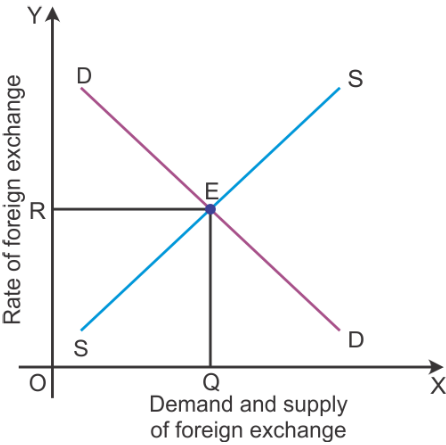
Equilibrium exchange rate is determined at the point where the demand for foreign exchange is equal to the supply of foreign exchange. Graphically, it is determined at the point where the demand curve for foreign exchange intersects the supply curve of foreign exchange.
According to the graph, the equilibrium is determined at Point E, where the demand curve DD intersects the supply curve SS. Here, the equilibrium exchange rate is OR and the equilibrium quantity of foreign exchange is OQ.

Need a full question paper?

Generate a complete, print-ready paper with questions like this in minutes — across 16+ boards, with answer keys.

Start Generating Free

Similar questions

What is government budget? Explain the role of government budget in influencing allocation of resources in the economy.
What are the alternative definitions of money supply in India?
Why must aggregate demand be equal to aggregate supply at the equilibrium level of income and output? Explain with the help of a diagram.
OR
Explain how is equilibrium level of income and employment established through AD and AS?
While estimating national income, how will you treat the following? Give reasons for your answer.
  1. Imputed rent of self-occupied houses.
  2. Interest received on debentures.
  3. Financial help received by flood victims.
Find national income and private income:
    Rs. Crores
  1.  
Wages and salaries 1000
  1.  
Net current transfers to abroad 20
  1.  
Net factor income paid to abroad 10
  1.  
Profit 400
  1.  
National debt interest 120
  1.  
Social security contributions by employers 100
  1.  
Current transfers from government 60
  1.  
National income accruing to government 150
  1.  
Rent 200
  1.  
Interest 300
  1.  
Royalty 50
Calculate National Income from the following data:
  (Rs. in crores)
  1. Private final consumption expenditure
900
  1. Profit
100
  1. Government final consumption expenditure
400
  1. Net indirect taxes
100
  1. Gross domestic capital formation
250
  1. Change in stock
50
  1. Net factor income from abroad
(-)40
  1. Consumption of fixed capital
20
  1. Net imports
30
Consider an economy described by the following functions: C = 20 + 0.80Y, I = 30, G = 50, TR = 100.
  1. Find the equilibrium level of income and the autonomous expenditure multiplier in the model.
  2. If government expenditure increases by 30, what is the impact on equilibrium income?
  3. If a lump-sum tax of 30 is added to pay for the increase in government purchases, how will equilibrium income change?
Why does the demand for foreign currency fall and supply rises when its price rises? Explain.
Indian investors lend abroad. Answer the following questions:
  1. In which sub-account and on which side of Balance of Payments Account such lending is recorded? Give reasons.
  2. Explain the impact of this lending on market exchange rate.
Find net national product at market price and personal disposable income:
    (Rs. crores)
(i) Personal taxes $200$
(ii) Wage and salaries $1200$
(iii) Undistributed profit $50$
(iv) Rent $300$
(v) Corporation tax $200$
(vi) Private income $2000$
(vii) Interest $400$
(viii) Net indirect tax $300$
(ix) Net factor income to abroad $20$
(x) Profit $500$
(xi) Social security contributions by employers $250$