Question

Define gauge pressure.
When is gauge pressure (i) positive (ii) negative?
Give two examples where gauge pressure is more relevant.

Answer


Definition: Gauge pressure is the pressure exerted by a fluid relative to the local atmospheric pressure.
Gauge pressure, $p_g=p-p_0$
where $\mathrm{p}$ is the absolute pressure and $\mathrm{p}_0$ is the local atmospheric pressure.
When the pressure inside a closed container or tank is greater than atmospheric pressure, the pressure reading on a pressure gauge is positive. The pressure inside a 'vacuum chamber'-a rigid chamber from which some of the air is pumped out-is less than the atmospheric pressure, so a pressure gauge on the chamber designed to measure negative pressure reads a negative value.
At a depth within a liquid of density $p_{\text {r }}$ the gauge pressure is $p_g=p-p_0=h p g$
Examples: Tyre pressure gauge, blood pressure gauge, pressure gauge on an oxygen or scuba tank.

Need a full question paper?

Generate a complete, print-ready paper with questions like this in minutes — across 16+ boards, with answer keys.
Start Generating Free

Similar questions

Two capacitors, each of capacity $5 \mu F$, and a battery of emf $180 V$ are given to you. Which combination gives the maximum energy? What is its value? Also find the charge on each capacitor of that combination.
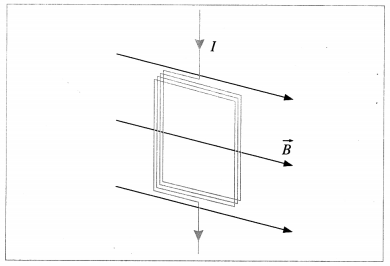
A rectangular coil of $10$ turns, each of area $0.05 m ^2,$ is suspended freely in a uniform magnetic field of induction $0.01 T$. A current of $30 \ ( A$ is passed through$)$ it.
Image
$(i)$ What is the magnetic moment of the coil?
$(ii)$ What is the maximum torque experienced by the coil?
$(iii)$ What is the minimum torque experienced by the coil?
A conductor of length $25 cm$ is placed (i) parallel (ii) perpendicular (iii) inclined at an angle $30^{\circ}$, to a uniform magnetic field of induction $2 T$. If $1 C$ of charge passes through it in $5 s$, calculate the force experienced by the conductor in each case.
Explain why the free surface of some liquids in contact with a solid is not horizontal.
OR
Explain the formation of concave and covex surface of a liquid on the basis of molecular theory.
A sonometer wire of length $L_1$ is in unison with a tuning fork of frequency $n$. When the vibrating length of the wire is reduced to $L_2$, it produces $x$ beats per second with the fork. Show that $n = x _2 \cdot \frac{L_2}{L_1-L_2}$.
Explain the term decibel
An electron in an atom is revolving round the nucleus in a circular orbit of radius $5.3 \times 10^{-11} m$, with a speed of $2 \times$ $10^6 ms^{-1}$ Find the resultant orbital magnetic moment and angular momentum of electron. (charge on electron $e =$ $1.6 \times 10^{-19} C$, mass of electron $m _{ e }=9.1 \times 10^{-31} kg$.)
State an expression for the moment of inertia of a solid sphere about its diameter. Write the expression for the corresponding radius of gyration.
What do you mean by a logic gate, a truth table and a Boolean expression?
What does a heat engine consist of ?
OR
What are the elements (parts) of a typical heat engine?