Question
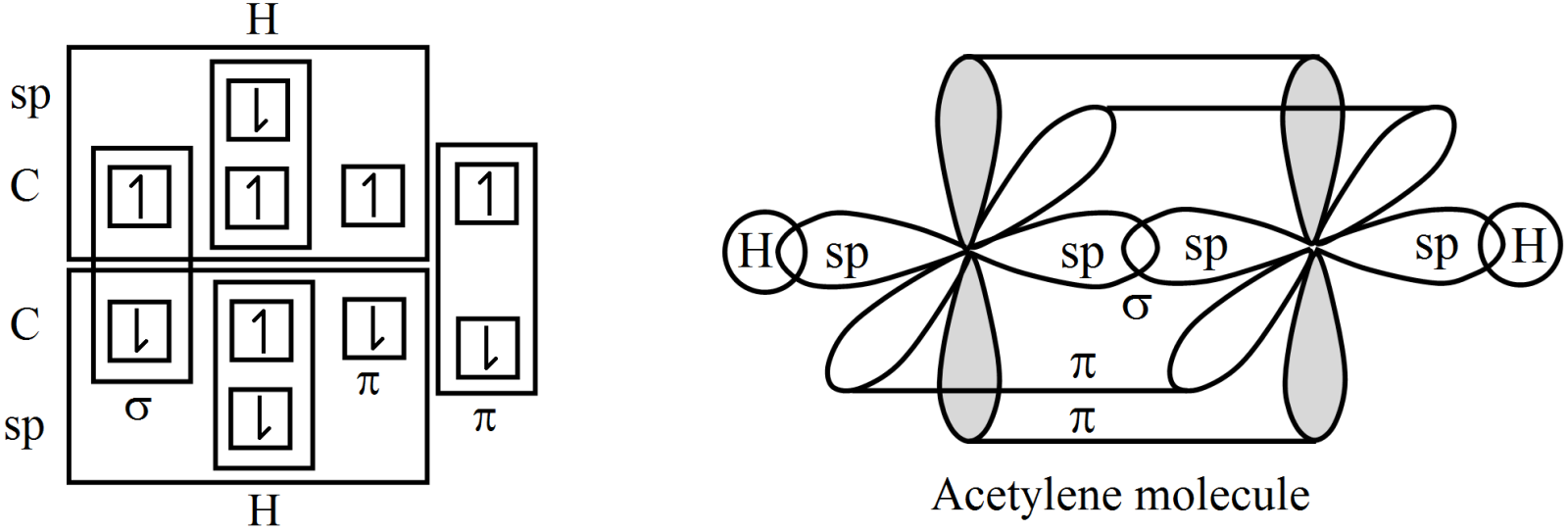
Define hybridisation. Explain the structure of $\mathrm{C}_2 \mathrm{H}_2$ with orbital diagram.

Answer


Hybridisation is process of intermixing of atomic orbitals of slightly different energies which give rise to hybridised orbitals having exactly equal energy, identical shape and more stability.
In $\text{H}-\text{C}\equiv\text{C}-\text{H}$ each 'C' is 'sp' hybridised, therefore, it has linear shape.

Need a full question paper?

Generate a complete, print-ready paper with questions like this in minutes — across 16+ boards, with answer keys.
Start Generating Free

Similar questions

Knowing the properties of $\mathrm{H}_2 \mathrm{O}$ and $\mathrm{D}_2 \mathrm{O}$, do you think that $\mathrm{D}_2 \mathrm{O}$ can be used for drinking purposes?
What happens when $\text{I}_2$ is titrated with sodium thio sulphate (hypo) solution? Write chemical equation.
What do you meant by bond enthalpy? In polyatomic molecules in which way it can be calculated?
Calculate the pH of the resultant mixtures:
10 mL of $0.1 \mathrm{M} \mathrm{~H}_2 \mathrm{SO}_4+10 \mathrm{~mL}$ of 0.1 M KOH
Classify the following species into Lewis acids and Lewis bases and show how these act as Lewis acid/base:
a. $OH ^{-}$
b. $F ^{-}$
c. $H ^{+}$
d. $BCl _3$
0.35g of an organic compound was Kjeldahlised. The ammonia evolved on distilling the Kjeldahlised extract with 100ml of $\frac{\text{M}}{10\text{ H}_2\text{SO}_4}$ The residual acid required 154ml of $\frac{\text{M}}{10\text{ NaOH}}$ for complete neutralization. Calculate the percentage of nitrogen in organic compound.
What do you meant by ionisation enthalpy? On basis of this explain the acidic nature of oxides and stability of carbonates.
Assign oxidation number to the underlined elements in the following species:$\text{H}_4\text{P}_2\text{O}_7$
Complete the following reactions.
  1. $\text{Iso-propyl bromide}\xrightarrow[\text{Heat}]{\text{Alc. KOH}}\text{A}\xrightarrow[\text{Peroxide}]{\text{HBr}}\text{B}$
  2. $\text{n-propyl alcohol}\xrightarrow[443\text{K}]{\text{Conc. H}_2\text{SO}_4}\text{A}\xrightarrow[\text{Heat}]{\text{O}_2,\ \text{Ag}}\text{B}$
Calculate the heat of reaction of the following reaction:$\text{CO}_2\text{(g)}+\text{H}_2(\text{g})\overrightarrow{\ \ \ \ \ \ }\ \text{CO(g)}+\text{H}_2\text{O(g)}$
Given that the $\Delta_\text{f}\text{H}^\circ\text{CO(g)}=-110.5\text{kJ mol}^{-1},$ $\Delta_\text{f}\text{H}^\circ\text{CO}_2\text{(g)}=-393.8\text{kJ mol}^{-1}$ and $\Delta_\text{f}\text{H}^\circ\text{H}_2\text{O(g)}=-241.8\text{kJ mol}^{-1}$ respectively.