Question
Define hydrogen bond. Is it weaker or stronger than the van der Waals forces?
Answer

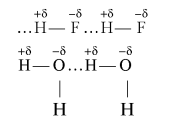
In polar molecules the partial positive hydrogen atom of molecule is attracted by partial negative element of other molecule. This attraction force is called H -bond. Example : HF and $H _2 O$.
Image
Hence, hydrogen is the force of attraction that binds the H atom one-one molecule to the electronegative atom ( $F , O$ or N ) of other molecule. The H-bond is stronger than Van der Waals force because it is a strong dipole-dipole attraction whereas Van der Waals force is weak dispersion force or London force.

Need a full question paper?

Generate a complete, print-ready paper with questions like this in minutes — across 16+ boards, with answer keys.

Start Generating Free

Similar questions

Consider the elements:

Cs, Ne, I and F

Identify the element that exhibits both positive and negative oxidation states.

When 4.2g of NaHCO3 is added to a solution of CH3COOH weighing 10.0g, 1120cm2 at of CO2 at is released into atmosphere leaving behind 12.0g of residue. Prove that this observation is in accordance with law of conservation of mass.
What will be the molarity of a solution. Which contains 5.58g of NaCl(s) per 500mL?
Carbon reacts with oxygen to for two types of oxides in which % of carbon is $27.27 \%$ and $42.8 \%$ respectively. Prove that these data confirm law of multiple proportions.
Write the electronic configuration of the following ions:
  1. H-
  2. Na+
  3. O2-
  4. F-
  1. Which of the following are isostructural species. Give their structures.

$\text{NO}^+_2,\text{BCl}_3,\text{CO}_2,\text{BeCl}_2$

  1. Which has most electronegativity of carbon? Why?

$\text{CH}_3-\text{CH}_3,\text{CH}=\text{CH}_2,\text{HC}\equiv\text{CH}$

On estimating sulphur by Carius method, 0.5825 gm of $BaSO _4$ is formed from 0.2175 gm of a substance. Find percentage of sulphur in substance.
At 700 K , equilibrium constant for the reaction :
$H _2(g)+ I _2(g) \rightleftharpoons 2 HI ( g )$
is 54.8 . If $0.5 mol L ^{-1}$ of $HI ( g )$ is present at equilibrium at 700 K , what are the concentration of $H _2(g)$ and $I _2(g)$ assuming that we initially started with $HI ( g )$and allowed it to reach equilibrium at 700 K ?
Calculate the oxidation states of Carbon, Bromine and Manganese in $C _3 O _2$ (Carbon suboxide), $Br _3 O _8$ (Tribromo octaoxide) and $Mn _3 O _4$ respectively.
Define:
  1. Metallic radius.
  2. Van der Waals' radius.