Maharashtra BoardEnglish MediumSTD 12 SciencePhysicsQuestion Bank [ 2022 ]4 Marks
Question
Define ideal simple pendulum and obtain an expression for its periodic time.
✓
Answer
An ideal simple pendulum is a heavy particle suspended by a massless, inextensible, flexible string from a rigid support.
Expression for a time period of the simple pendulum:
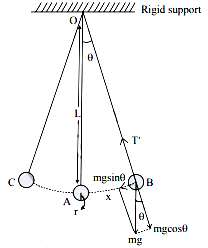
i. Let ' $m$ ' be the mass of the bob and $T$ ' be the tension in the string. The pendulum remains in equilibrium in the position $O A$, with the center of gravity of the bob, vertically below the point of suspension $O$.
ii. If now the pendulum is displaced through a small angle $\theta$, called angular amplitude, and released, it begins to oscillate on either side of the mean (equilibrium) position in a single vertical plane.
Simple pendulum
iii. In the displaced position (extreme position), two forces are acting on the bob.
a. Force $T^{\prime}$ due to tension in the string, directed along the string, towards the support.
b. Weight $mg$, in the vertically downward direction.
iv. At the extreme positions, there should not be any net force along the string.
v. The component of $mg$ can only balance the force due to tension. Thus, weight $mg$ is resolved into two components;
a. The component $mg \cos \theta$ along the string, which is balanced by the tension $T ^{\prime}$.
b. The component $mg \sin \theta$ perpendicular to the string is the restoring force acting on mass $m$ tending to return it to the equilibrium position.
$\therefore$ Restoring force, $F =- mg \sin \theta$
vi. As $\theta$ is very small $\left(\theta<10^{\circ}\right)$,
$ \sin \theta \approx \theta^c$
$\therefore F \approx- mg \theta $
From the figure,
For small angle, $\theta=\frac{ x }{ L }$
$\therefore F =- mg \frac{ x }{ L }$
As $m , g$ and $L$ are constant, $F \propto- x$
vii. Thus, for small displacement, the restoring force is directly proportional to the displacement and is oppositely directed. Hence the bob of a simple pendulum performs linear S.H.M. for small amplitudes.
viii. The period T of oscillation of a pendulum is given by,
$T =\frac{2 \pi}{\omega}=\frac{2 \pi}{\sqrt{\text { acceleration per unit displacement }}}$
Using equation (1),
$ F =- mg \frac{ x }{ L }$
$\therefore ma =- mg \frac{ x }{ L } \ldots \ldots \ldots \ldots . .(\because F = ma )$
$\therefore a =- g \frac{ x }{ L }$
$\therefore \frac{ a }{ x }=-\frac{ g }{ L }=\frac{ g }{ L } \text { (in } $
magnitude)
Substituting in the expression for T,
$T =2 \pi \sqrt{\frac{ L }{ g }}$
This gives the expression for the time period of a simple pendulum.
Need a full question paper?
Generate a complete, print-ready paper with questions like this in minutes — across 16+ boards, with answer keys.