Question
Define ionization enthalpy. Name the factors on which ionisation enthalpy depends? How does it vary down the group and across a period?
Answer

i. The energy required to remove an electron from the isolated gaseous atom in its ground state is called ionization enthalpy $(\triangle _iH).$
Ionization enthalpy is the quantitative measure of tendency of an element to lose electron and expressed in $kJ\ mol^{-1}.$
ii. Ionization energy depends on the following factors
  • Size (radius) of an atom
  • Nuclear charge
  • The shielding or screening effect of inner electrons
  • Nature of electronic configuration
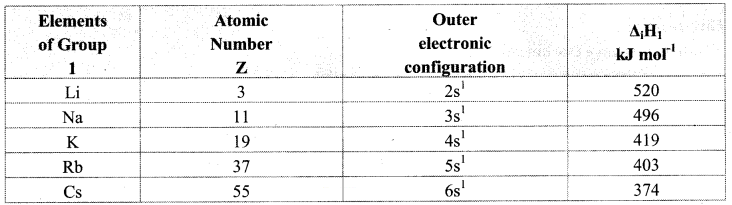
iii. Variation of ionization energy down the group: On moving down the group, the ionization enthalpy decreases. This is because electron is to be removed from the larger valence shell. Screening due to core electrons goes on increasing and the effective nuclear charge decreases down the group. As a result, the removal of the outer electron becomes easier down the group.
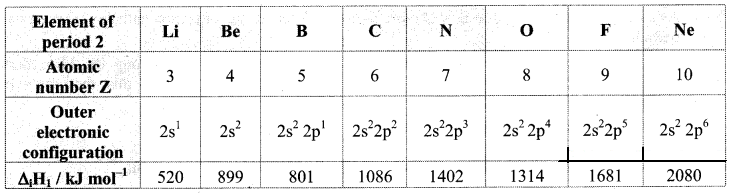
iv. Variation of ionization energy across a period: The screening effect is the same while the effective nuclear charge increases across a period. As a result, the outer electron is held more tightly and hence, the ionization enthalpy increases across a period. Therefore, the alkali metal shows the lowest first ionization enthalpy while the inert gas shows the highest first ionization enthalpy across a period.
Note: First ionization enthalpy values of elements of group $1$.
Image
Note: First ionization enthalpy values of elements of period $2.$
Image

Need a full question paper?

Generate a complete, print-ready paper with questions like this in minutes — across 16+ boards, with answer keys.
Start Generating Free

Similar questions

Identify type of the intermolecular forces in the following compounds.
a. $CH_3 – OH$
b. $CH_2 = CH_2$
c. $CHCl_3$
d. $CH_2Cl_2$
A balloon is inflated with helium gas at room temperature of 25 °C and at 1 bar pressure when its initial volume is 2.27L and allowed to rise in air. As it rises in the air external pressure decreases and the volume of the gas increases till finally it bursts when external pressure is 0.3bar. What is the limit at which volume of the balloon can stay inflated ?
Round off each of the following quantities to two significant figures :
a. $25.55 mL$
b. $0.00254 m$
c. $1.491 \times 10^5 mg$
d. $199 g$
How many electrons are present in ${ }_1^2 \mathrm{H},{ }_2 \mathrm{He}$ and $\mathrm{He}^{+}$? Which of these are hydrogen-like species?
Phytane is naturally occuring alkane produced by the alga spirogyra and is a constituent of petroleum. The IUPAC name for phytane is 2, 6, 10, 14-tetramethyl hexadecane. Write zig-zag formula for phytane. How many primary, secondary, tertiary and quaternary carbons are present in this molecule.
Elements belonging to which groups constitute the p-block and why?
Write the structure of monomer from which each of the following polymers are obtained.Image
Write a short note on similarity between the solar system and structure of atom.
Write condensed orbital notation of electonic configuration of the following elements:
a. Lithium (Z = 3)
b. Carbon (Z=6)
c. Oxygen (Z = 8)
d. Silicon (Z = 14)
e. Chlorine (Z = 17)
f. Calcium (Z = 20)
Write bond line formulae and condensed formulae for the following compounds
a. 3-methyloctane
b. hept-2-ene
c. 2, 2, 4, 4- tetramethylpentane
d. octa-1,4-diene
e. methoxyethane