Question
Define lens and write its formula.

Answer

Any transparent medium surrounded by two surfaces, one of which or both surfaces are spherical is called lens. There are two types of lenses-(1) Convex lens (2) Concave lens.
The relationship between the distances of the object, the distance of the image and the focal length of the lens is called lens formula. i.e., $-\frac{1}{u}+\frac{1}{v}=\frac{1}{f}$.

Need a full question paper?

Generate a complete, print-ready paper with questions like this in minutes — across 16+ boards, with answer keys.
Start Generating Free

Similar questions

Answer the following question:
Why should gases be insulators at ordinary pressures and start conducting at very low pressures?
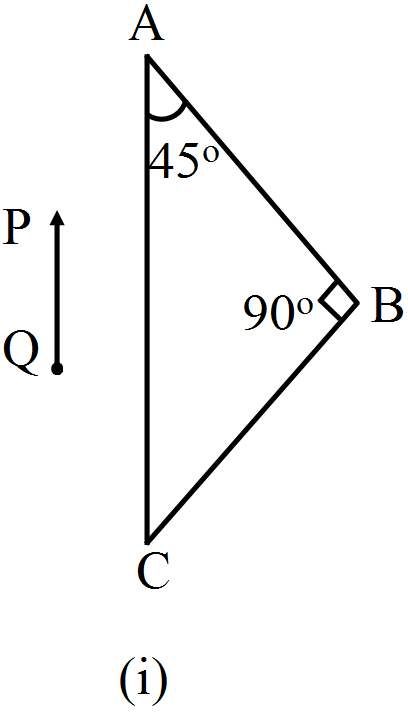
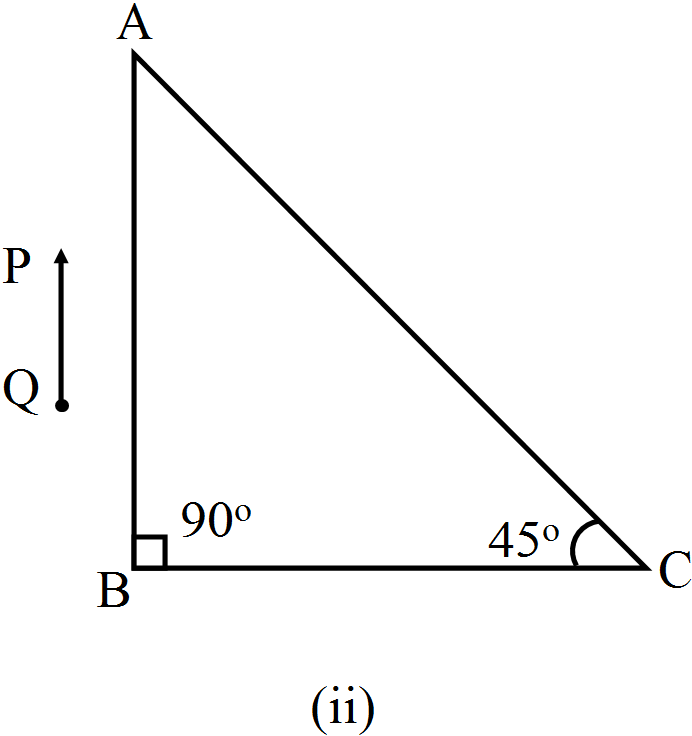
A right-angled crown glass prism with critical angle 41° is placed before an object, PQ in two positions as shown in the figures (i) and (ii). Trace the paths of the rays from P and Q passing through the prisms in the two cases.
Find the binding energy of a hydrogen atom in the state n = 2.
Consider a small cube of volume $1mm^3$ at the centre of a circular loop of radius 10cm carrying a current of 4A. Find the magnetic energy stored inside the cube.
A compound microscope forms an inverted image of an object. In which of the following cases it is kely to create difficulties?
  1. Looking at small germs.
  2. Looking at circular spots.
  3. Looking at a vertical tube containing some water.
A force F facts on a point charge placed on the axis of an electric dipole. If the distance of a point charge from the dipole is doubled, what will be the force on it? Explain the reason also.
The radii of two conductors $A$ and $B$ with equal charge density are $R_1$ and $R_2$, respectively ( $R_1$ $>R_2$ ). If the conductors are connected to a conducting wire of negligible capacitance then find out :(a) From which conductor will the charge flowto whom?(b) What will be the ratio of charges on the conductors after charge redistribution?
Can you have $\overrightarrow{\text{A}}\times\overrightarrow{\text{B}}=\overrightarrow{\text{A}}\cdot\overrightarrow{\text{B}}$ with $\text{A}\neq0$ and $\text{B}\neq0?$ What if one of the two vectors is zero?
Calculate the momentum of a photon of light of wavelength 500nm.
The lower end of a capillary tube is immersed in mercury. The level of mercury in the tube is found to be 2cm below the outer level. If the same tube is immersed in water, upto what height will the water rise in the capillary?