Question
Define lens and write its formula.

Answer

Any transparent medium surrounded by two surfaces, one of which or both surfaces are spherical is called lens. There are two types of lenses-(1) Convex lens (2) Concave lens.
The relationship between the distances of the object, the distance of the image and the focal length of the lens is called lens formula. i.e., $-\frac{1}{u}+\frac{1}{v}=\frac{1}{f}$.

Need a full question paper?

Generate a complete, print-ready paper with questions like this in minutes — across 16+ boards, with answer keys.
Start Generating Free

Similar questions

Draw the phasor diagram and graph of voltage and current versus $\omega t$  for a purely capacitive circuit and explain it.
The radius of a spherical conductor shell is $R$ and the charge on it is $Q$. Compare the potential at a distance 2 R from the centre of the sphere with the potential at a distance $R / 2$.
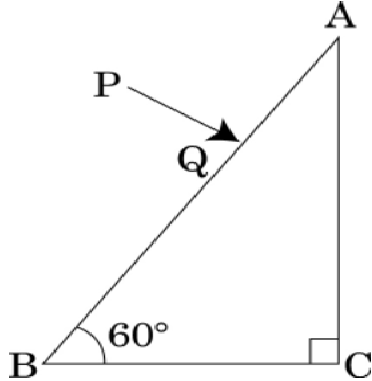
A ray PQ incident normally on the refracting face BA is refracting in the prism BAC made of material of refractive index 1.5. Complete the path of ray through the prism. From which face will the ray emerge? Justify your answer.

A copper wire of cross-sectional area 0.01cm2 is under a tension of 20N. Find the decrease in the cross-sectional area. Young's modulus of copper = 1.1 × 10 11N/m2 and Poisson's ratio = 0.32.

$\Big[$Hint: $\frac{\triangle\text{A}}{\text{A}}=2\frac{\triangle\text{r}}{\text{r}}\Big]$

When a glass rod is rubbed with a silk cloth, charges appear on both. A similar phenomenon is observed with many other pairs of bodies. Explain how this observation is consistent with the law of conservation of charge.
A hydrogen atom initially in the ground level absorbs a photon which excites it to the $n=4$ level. Determine the wavelength and frequency of photon.
\[\left(h=6.625 \times 10^{-34} Js, c=3 \times 10^8 m / s\right)\]
Answer the following question:
Does the apparent depth of a tank of water change if viewed obliquely? If so, does the apparent depth increase or decrease?
Give the characteristics of an electric field.
A bullet going with speed 350m/s enters a concrete wall and penetrates a distance of 5.0cm before coming to rest. Find the deceleration.
The masses of 11C and 11B are respectively 11.0114u and 11.0093u. Find the maximum energy a positron can have in the $\beta^+$-decay of 11C to 11B.