Question
Define light. Name three important properties of light.

Answer

Light is a form of energy, which produces the sensation of vision.It has following characteristics:
  1. It travels in straight lines and does not bend.
  2. It does not require any medium to travel i.e. it travels even in vacuum.
  3. Its speed in vacuum is maximum whose value is $3 \times 10^8 \mathrm{~m} / \mathrm{s}$.
  4. It exhibits phenomena of reflection, refraction and scattering.
  5. A white light consists of seven colors $(VIBGYOR).$

Need a full question paper?

Generate a complete, print-ready paper with questions like this in minutes — across 16+ boards, with answer keys.
Start Generating Free

Similar questions

Answer the following:
  1. When does a person need artificial respiration?
  2. From where can the person get supply of oxygen for artificial respiration?
  3. Does the person need to be kept on artificial respiration temporarily or permanently?
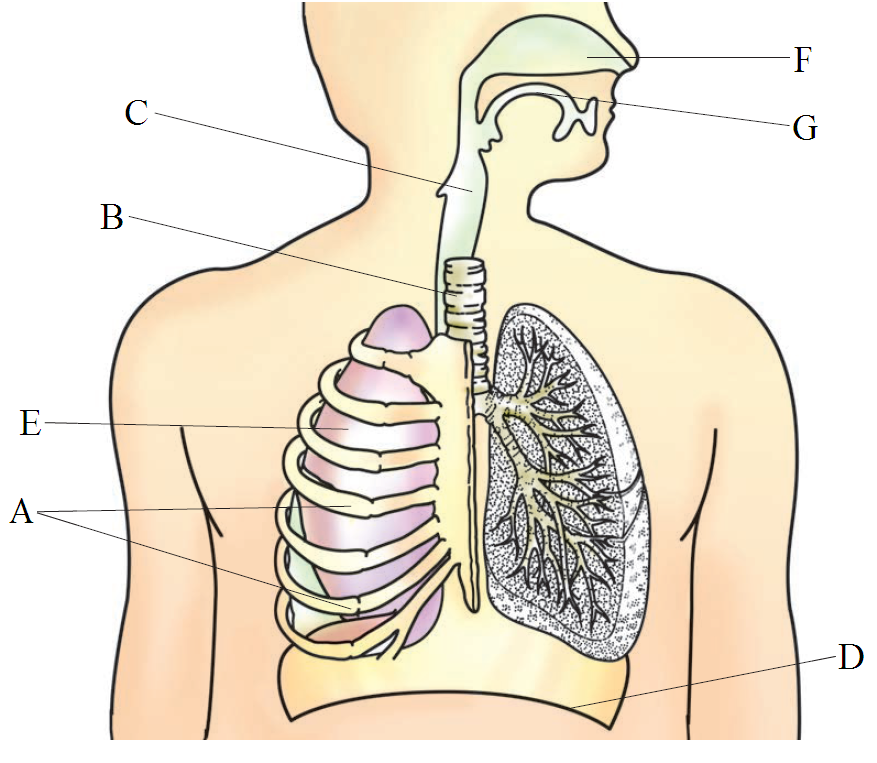
Observe the given diagram of human respiratory system. List the organs from $(A)$ to $(G).$

What happens to the food in mouth and oesophagus of the digestive tract?
In places of hot climate it is advised that the outer walls of houses be painted white. Explain.
  1. Soil has various important component. Write them.
  2. Arrange the following rock particles which occur in soil in the increasing order. Silt, clay, gravel, sand.
  3. Observe the following figure. What does this figure show?
Why should oils and fats be not released in the drain? Explain.
Read the passage and answer the questions :
A student is conducting an experiment to observe the reaction of magnesium ribbon when it is burned in air. The student first cleans a small piece of magnesium ribbon using sandpaper and then ignites it using a flame. The ribbon burns with a dazzling white flame, and a white powdery substance is formed after the reaction. The student records these observations and continues to investigate the nature of the product formed by adding a small amount of water to the white powder.
Q.1. What is the white powder formed after burning magnesium ribbon?
(a) Magnesium sulphate
(b) Magnesium oxide
(c) Magnesium hydroxide
(d) Magnesium carbonate
Q.2. Which of the following will most likely happen after magnesium ribbon burns?
(a) The product will turn blue litmus paper red
(b) The product will turn red litmus paper blue
(c) The product will have no effect on litmus paper
(d) The product will blue litmus paper red as well as red litmus paper blue
Q.3. What is the result of adding water to magnesium oxide?
(a) It forms an acidic solution
(b) It forms a basic solution
(c) It forms a neutral solution
(d) It does not react with water
Open your mouth, look into a mirror and try to count the different types of teeth in your mouth. Compare them with Figure on page 13 of your $NCERT$ textbook. Record your observations in the table below:
Type of teeth Number of teeth
In my mouth In the figure
Incisors    
Canines    
Premolar    
Molar    
  1. Did you observe any difference in the number of teeth? If yes, could you identify which type of teeth showed the difference?
  2. Compare the number and type of teeth in an adult (say your parents or cousins who have reached the age of $25–30$ or more). Note your observation.
Read the passage and answer the questions :
Arjun observes two cyclists covering the same distance at different speeds.
Q.1. Who has higher average speed?
(a) One who takes less time
(b) One who pedals slower
(c) One with more gears
(d) One who rests more
Q.2. If both reach at same time but use different paths, what can be different?
(a) Speed$\quad$$\quad$(b) Distance
(c) Both (a) and (b)$\quad$(d) None of these
Q.3. What does a speedometer show during this observation?
(a) Constant speed
(b) Variable speed
(c) Distance only
(d) Acceleration only
State two experiences that made you think that air exerts pressure (other than those given in the text).