Question
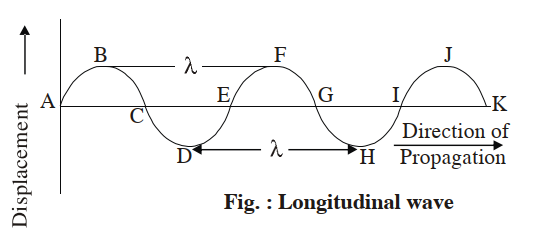
Define longitudinal and transverse waves and also draw diagram of both.

Need a full question paper?

Generate a complete, print-ready paper with questions like this in minutes — across 16+ boards, with answer keys.
Start Generating Free

Similar questions

Two charged particles, having equal charges of 2.0 × 10-5C each, are brought from infinity to within a separation of 10cm. Find the increase in the electric potential energy during the process.
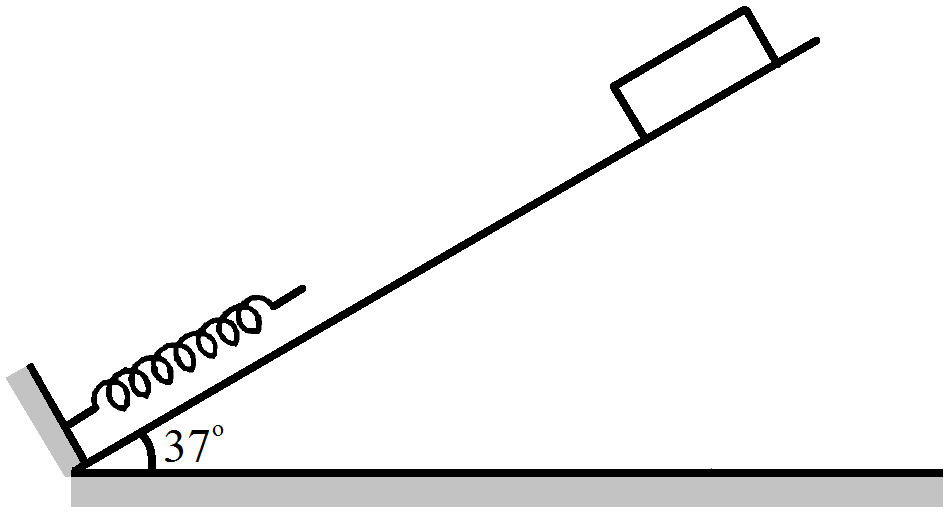
Figure shows a spring fixed at the bottom end of an incline of inclination 37°. A small block of mass 2kg starts slipping down the incline from a point 4.8m away from the spring. The block compresses the spring by 20cm, stops momentarily and then rebounds through a distance of 1m up the incline. Find.
  1. The friction coefficient between the plane and the block.
  2. The spring constant of the spring. Take g = 10m/s2.

State work energy theorem for rotational motion.
A famous relation in physics relates ‘moving mass’ m to the ‘rest mass’ mo of a particle in terms of its speed v and the speed of light, c. (This relation first arose as a consequence of special relativity due to Albert Einstein). A boy recalls the relation almost correctly but forgets where to put the constant c. He writes:
$\text{m}=\frac{\text{m}_0}{(1-\text{v}^2)^{1/2}}.$
Guess where to put the missing c.
A solid sphere rolling on a rough horizontal surface with a linear speed v collides elastically with a fixed, smooth, vertical wall. Find the speed of the sphere after it has started pure rolling in the backward direction.
A copper rod of length 1.0m is clamped at its middle point. Find the frequencies between 20Hz - 20,000Hz at which standing longitudinal waves can be set up in the rod. The speed of sound in copper is 3.8km/s.
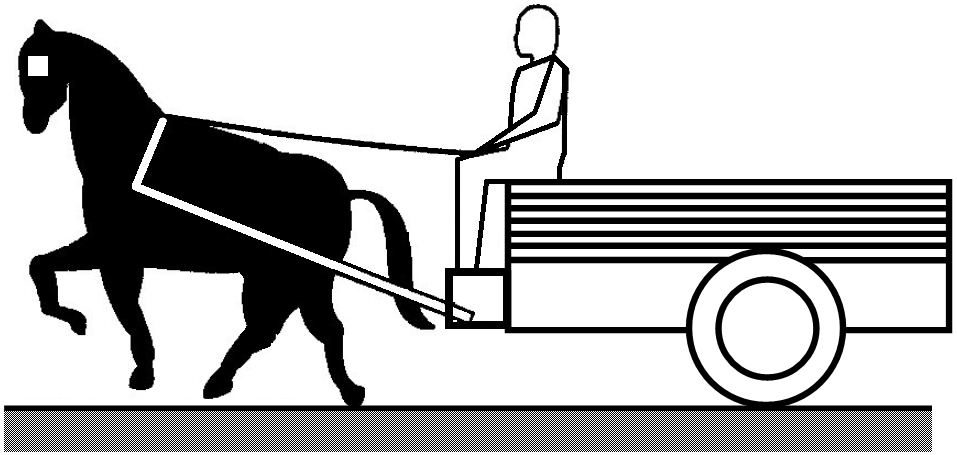
Figure shows a cart. Complete the table shown.
A man can swim at the rate of 5km/ h in still water. A river 1km wide flows at the rate of 3km/ h. A swimmer wishes to cross the river straight.
  1. Along what direction must he strike?
  2. What should be his resultant velocity?
  3. How much time he would take to cross?
A 2.00m long rope, having a mass of 80g, is fixed at one end and is tied to a light string at the other end. The tension in the string is 256N.
  1. Find the frequencies of the fundamental and the first two overtones.
  2. Find the wavelength in the fundamental and the first two overtones.
The planet Mars has two moons, phobos and delmos. (i) phobos has a period 7 hours, 39 minutes and an orbital radius of $9.4 \times 10^3 km$. Calculate the mass of mars. (ii) Assume that earth and mars move in circular orbits around the sun, with the martian orbit being 1.52 times the orbital radius of the earth. What is the length of the martian year in days?