Question
Define magnetic permeability and magnetic susceptibility. Prove that $\mu_{r} = (1+\chi)$.
Answer

Magnetic Permeability : It is the ability of a material to permit the passage of magnetic field lines through it. Hence it is the degree to which the magnetic field can penetrate the material.
For example, when a piece of iron is placed in a magnetising field, lines of force become much more concentrated in iron (where they become lines of induction) than in air. Thus iron is said to have greater permeability than air. The permeability of a medium may be defined as ratio of the lines of induction per unit normal area to the number of lines of force of the magnetising field per unit normal area. The former measures the magnetic induction B in the medium and the latter measures the strength of the magnetising field H. Hence permeability µ is defined as the ratio of the magnetising induction (B) in the specimen to the magnetising field (H). Thus $\mu=\frac{B}{H}$.
The ratio of magnetic permeability of the material $\mu$ and magnetic permeability of free space $\left(\mu_0\right)$ is called relative permeability of the substance denoted by $\mu_r$ i.e. $\mu_r=\mu / \mu_0$.
where $\mu_0 \times 4 \pi \times 10^{-7} Wb / Am$
Magnetic Susceptibility : For a large number of magnetic materials the intensity of magnetisation I is proportional to magnetising field strength, H. i.e.
$I \propto H$ or $I=\chi . H$
Where $\chi$ is a proportionality constant and is known as magnetic susceptibility of magnetic material.
Now $I =\chi H \Rightarrow \chi= I / H$
Hence the magnetisation per unit field strength is called the magnetic susceptibility.
Since I and H have the same dimensions the quantity $\chi$ is dimensionless i.e. it has no unit.
The magnetic susceptibility of a specimen of a magnetic material measures the ease with which the specimen can be magnetised. Since I is equal to the magnetic moment per unit volume, hence the susceptibility as defined above is also called volume susceptibility of the material.
Derivation of $\mu _r=(1+\chi)$ : When a magnetic material is placed in a magnetising field of magnetic intensity $\overrightarrow{ H }$, the material gets magnetised. In this state the total magnetic induction $\overrightarrow{ B }$ is the sum of the magnetic induction $\overrightarrow{ B }_0$ in vaccum produced by the magnetic intensity $\overrightarrow{ H }$ and magnetic induction $\overrightarrow{ B }_m$ due to magnetisation of the material i.e. intensity of magnetisation.
Hence $\overrightarrow{ B }=\overrightarrow{ B }_0+\overrightarrow{ B }_m$
but $\overrightarrow{ B }=\mu \overrightarrow{ H }, B _0=\mu_0 \overrightarrow{ H }$ and $\overrightarrow{ B }_m=\mu_0 \overrightarrow{ I }$
$\mu H =\mu_0( H + I )$
$\Rightarrow \quad \mu H =\mu_0 H \left(1+\frac{ I }{ H }\right)$
$\Rightarrow \quad \frac{\mu}{\mu_0}=\left(1+\frac{ I }{ H }\right)$. But $\mu / \mu_0=\mu_r$ and $I / H =\chi$
$\therefore \quad \mu_r=(1+\chi)$

Need a full question paper?

Generate a complete, print-ready paper with questions like this in minutes — across 16+ boards, with answer keys.

Start Generating Free

Similar questions

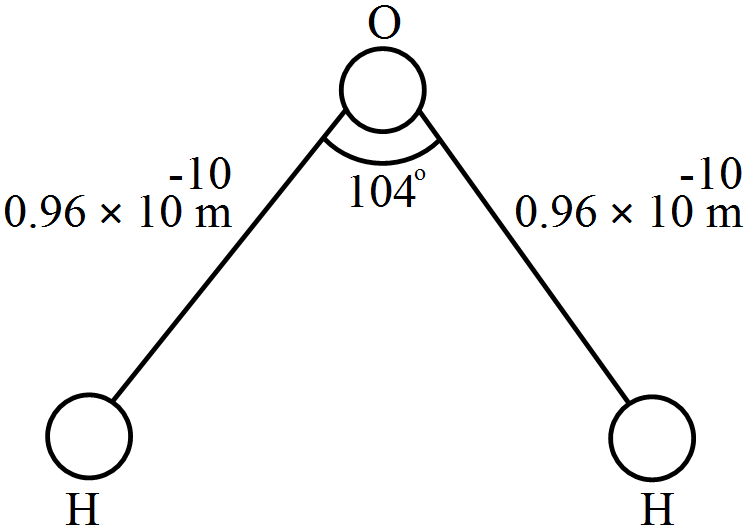
The structure of a water molecule is shown in figure. Find the distance of the centre of mass of the molecule from the centre of the oxygen atom.

We have stimulated emission and spontaneous emission. Do we also have stimulated absorption and spontaneous absorption?
A glass window is to be fit in an aluminium frame. The temperature on the working day is 40°C and the glass window measures exactly 20cm × 30cm. What should be the size of the aluminium frame so that there is no stress on the glass in winter even if the temperature drops to 0°C ? Coefficients of linear expansion for glass and aluminium are 9.0 × 10⁻⁶ °C-1 and 24 × 10-6 °C-1 respectively.
The amplitude of the magnetic field part of a harmonic electromagnetic wave in vacuum is B0 = 510 nT. What is the amplitude of the electric field part of the wave?
In a certain region of space, electric field is along the z-direction throughout. The magnitude of electric field is, however, not constant but increases uniformly along the positive z-direction, at the rate of 105 NC-1 per metre. What are the force and torque experienced by a system having a total dipole moment equal to 10-7 Cm in the negative z-direction?
A Cassegrain telescope uses two mirrors. Such a telescope is built with the mirrors 20 mm apart. If the radius of curvature of the large mirror is 220 mm and the small mirror is 140 mm, where will the final image of an object at infinity be?
Consider a circular ring of radius r, uniformly charged with linear charge density $\lambda.$ Find the electric potential at a point on the axis at a distance x from the centre of the ring. Using this expression for the potential, find the electric field at this point.
On the basis of band theory, differentiate between conductors, insulators and conductors.
Suppose India had a target of producing by 2020 AD, 200,000 MW of electric power, ten percent of which was to be obtained from nuclear power plants. Suppose we are given that, on an average, the efficiency of utilization (i.e. conversion to electric energy) of thermal energy produced in a reactor was 25%. How much amount of fissionable uranium would our country need per year by 2020? Take the heat energy per fission of $^{235}\text{U}$ to be about 200MeV.
Calculate potential on the axis of a ring due to charge Q uniformly distributed along the ring of radius R.