Question
Define magnifying power of a telescope. Write its expression.
A small telescope has an objective lens of focal length 150 cm and an eye piece of focal length 5 cm. If this telescope is used to view a 100m high tower 3 km away, find the height of the final image when it is formed 25 cm away from the eye piece.
Answer

  1. Magnifying power is the ratio of the angle subtended at the eye by the image to the angle subtended at the unaided eye by the object.
Expression
$\text{m} = \beta\big/\alpha = \text{f}_{o}\big/\text{f}_{e}$
or $\text{m} = \text{f}_{o} /_{ \text{f}_{e}}\bigg(1 + \frac{\text{f}_{e}}{\text{D}}\bigg)$
  1. Using, the lens equation for objective lens,:
$\frac{1}{\text{f}_{o}} =\frac{1}{\text{v}_{o}}-\frac{1}{\text{u}_{o}}$
$ => \frac{1}{150} = \frac{1}{\text{v}_{o}} - \frac{1}{-3\times10^{5}}$
$ => \frac{1}{\text{v}_{o}} =\frac{1}{150} -\frac{1}{-3\times10^{5}} = \frac{2000-1}{3\times10^{5}}$
$ =>\text{v}_{o} = \frac{3\times10^{5}}{1999}\text{cm}$
$\approx 150 \text{cm}$
Hence, magnification due to the objective lens
$\text{m}_{o} =\frac{\text{v}_{o}}{\text{u}_{o}} = \frac{150\times10^{-2}\text{m}}{3000\text{m}}$
$\approx\frac{10^{-2}}{20} = .05\times10^{-2}$
Using lens formula for eyepiece
$\frac{1}{\text{f}_{e}} =\frac{1}{\text{v}_{e}} - \frac{1}{\text{u}_{e}}$
$ = > \frac{1}{5} = \frac{1}{-25} -\frac{1}{\text{u}_{e}}$
$ = > \frac{1}{\text{u}_{e}} =\frac{1}{-25} - \frac{1}{5} = \frac{-1-5}{25}$
$ = >\text{u}_{e} =\frac{-25}{6}\text{cm}$
$\therefore\text{ Magnification due to eyepiece} \text{ m}_{e} =\frac{-25}{-\frac{25}{6}}= 6 $
Hence, total magnification $ = > \text{m} = \text{m}_{e}\times\text{m}_{o}$
$\text{m} = 6 \times5\times10^{-4} = 30 \times10^{-4}$
Hence, size of final image
$ = 30 \times10^{-4}\times100 \text{m}$
$ = 30 \text{ cm}.$

Need a full question paper?

Generate a complete, print-ready paper with questions like this in minutes — across 16+ boards, with answer keys.

Start Generating Free

Similar questions

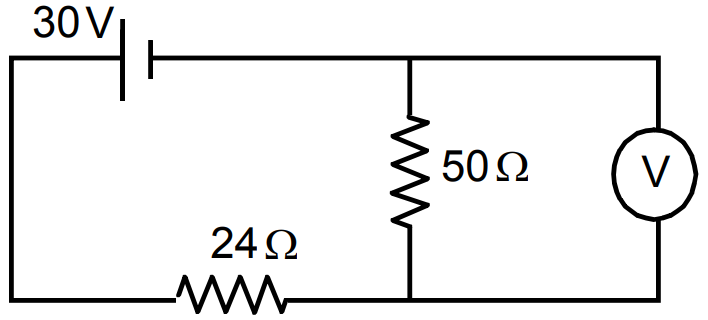
The voltmeter shown in the figure. reads 18V across the $50\Omega$ resistor. Find the resistance of the voltmeter.
An electric current flows in a wire from north to south. What will be the direction of the magnetic field due to this wire at a point east of the wire? West of the wire? Vertically above the wire? Vertically below the wire?
An astronomical telescope is to be designed to have a magnifying power of $50$ in normal adjustment. If the length of the tube is $102\ cm,$ find the powers of the objective and the eyepiece.
In Young’s double $-$ slit experiment using monochromatic light of wavelength $\lambda ,$ the intensity of light at a point on the screen where path difference is $\lambda ,$ is $K$ units. What is the intensity of light at a point where path difference is $\lambda /3$?
Calculate and compare the energy released by $a ($ fusion of $1.0 \ kg$ of hydrogen deep within Sun and $b)$ the fission of $1.0 \ kg$ of $^{235}\text{U}$ in a fission reactor.
A paperweight in the form of a hemisphere of radius 3.0cm is used to hold down a printed page. An observer looks at the page vertically through the paperweight. At what height above the page will the printed letters near the centre appear to the observer?
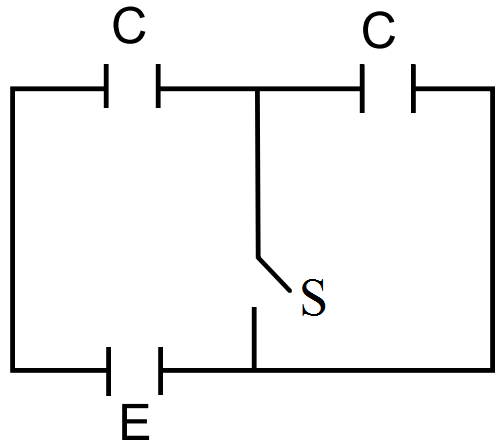
Consider the situation shown in figure. The switch S is open for a long time and then closed:
  1. Find the charge flown through the battery when the switch S is closed.
  2. Find the work done by the battery.
  3. Find the change in energy stored in the capacitors.
  4. Find the heat developed in the system.
$^{238}U$ decays to $^{206}Pb$ with a half$-$life of $4.47 \times 10^9y$. This happens in a number of steps. Can you justify a single half for this chain of processes? A sample of rock is found to contain $2.00\ mg$ of $^{238}U$ and $0.600\ mg$ of $^{206}Pb$. Assuming that all the lead has come from uranium, find the life of the rock.
A turn of radius 20m is banked for the vehicles going at a speed of 36 km/h. If the coefficient of static friction between the road and the tyre is 0.4, what are the possible speeds of a vehicle so that it neither slips down nor skids up?
A plane electromagnetic wave is passing through a region. Consider (a) electric field (b) magnetic field (c) electrical energy in a small volume and (d) magnetic energy in a small volume. Construct the pairs of the quantities that oscillate with equal frequencies.