Question
  1. Define mutual inductance and write its S.I. unit.
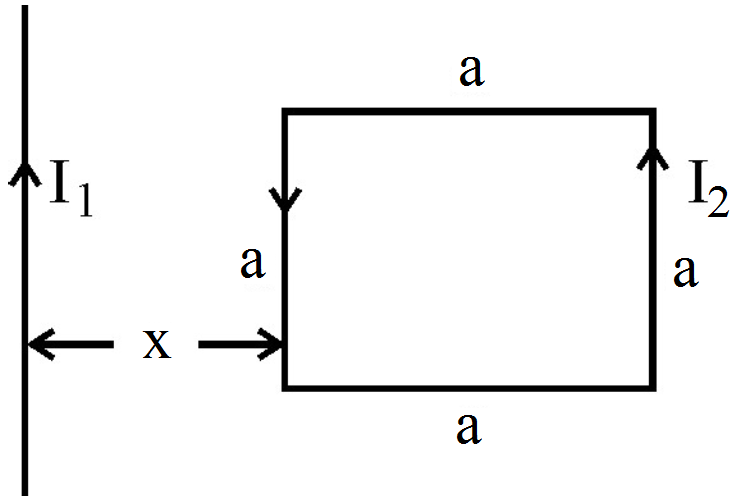
  2. A square loop of side ‘a’ carrying a current $I_2$ is kept at distance x from an infinitely long straight wire carrying a current $I_1$ as shown in the figure. Obtain the expression for the resultant force acting on the loop.
Answer

  1. Mutual inductance is where the magnetic field generated by a coil of wire induces voltage in an adjacent coil of wire. A transformer is a device constructed of two or more coils in close proximity to each other, with the express purpose of creating a condition of mutual inductance between the coils. It's SI unit is: $\frac{\text{Wb}}{\text{A}}$
  2.  

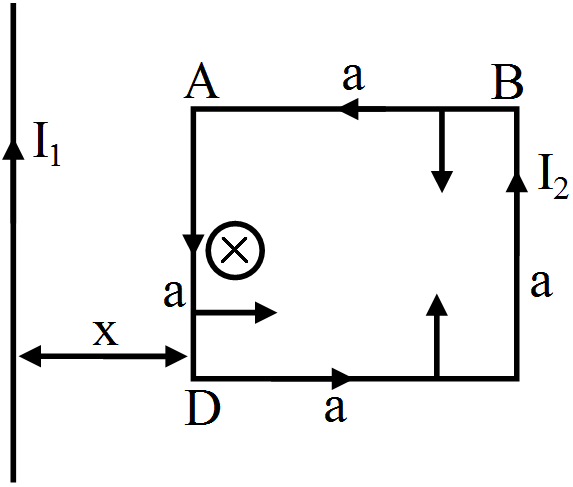
According to the right-hand screw rule, the magnetic field will be into the plane across the loop.
Force on length AD:
F = Bil
$\text{F}_1=\frac{\mu_0\text{I}_1\text{I}_2\text{a}}{2\pi\text{x}}$ (Towards Right)
Force on length AD:
F = Bil
$\text{F}_2=\frac{\mu_0\text{I}_1\text{I}_2\text{a}}{2\pi(\text{x}+\text{a})}$ (Towards Left)
Force on AB and CD will be equal and opposite.
Hence, they'll cancel out.
Force on the loop:
$\text{F}_\text{Net}=\text{F}_1-\text{F}_2$
$=\frac{\mu_0\text{I}_1\text{I}_2\text{a}}{2\pi}\Big[\frac{1}{\text{x}}-\frac{1}{(\text{x}+\text{a})}\Big]$
$\text{F}_\text{Net}=\frac{\mu_0\text{I}_1\text{I}_2\text{a}}{2\pi}\Big[\frac{\text{x}+\text{a}-\text{x}}{(\text{x}+\text{a})\text{x}}\Big]=\frac{\mu_0\text{I}_1\text{I}_2\text{a}^2}{2\pi(\text{x}+\text{a})\text{x}}$
$\text{F}_\text{Net}=\frac{\mu_0\text{I}_1\text{I}_2\text{a}^2}{2\pi\text{x}(\text{x}+\text{a})}$ (Towards left)

Need a full question paper?

Generate a complete, print-ready paper with questions like this in minutes — across 16+ boards, with answer keys.

Start Generating Free

Similar questions

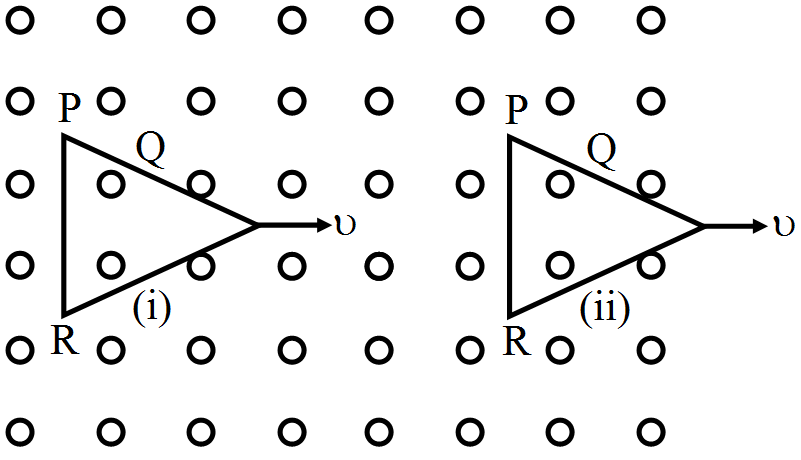
Fig. shows two positions of a loop PQR in a perpendicular uniform magnetic field. In which position of the coil is there an induced emf?
A small conducting sphere (radius r ) is placed concentrically inside a larger conducting hollow sphere of radius $R$. The big and small spheres are charged with $Q$ and $q(Q>q)$ respectively and kept separate from each other. Calculate the potential difference between the spheres.
Define the terms threshold frequency and stopping potential in relation to the phenomenon of photoelectric effect. How is the photoelectric current affected on increasing the (1) frequency (2) intensity of the incident radiations and why?
A ball of mass 0.50kg moving at a speed of 5.0m/s collides with another ball of mass 1.0kg. After the collision the balls stick together and remain motionless. What was the velocity of the 1.0kg block before the collision?
Double - convex lenses are to be manufactured from a glass of refractive index 1.55, with both faces of the same radius of curvature. What is the radius of curvature required if the focal length is to be 20cm?
A current loop of arbitrary shape lies in a uniform magnetic field B. Show that the net magnetic force acting on the loop is zero.
Estimate the change in the density of water in ocean at a depth of 400m below the surface. The density of water at the surface $= 1030kg/m^3$ and the bulk modulus of water $= 2 \times 10^9N/m^2.$
What is the basic difference between the atom and molecule of a diamagnetic and a paramagnetic material? Why are elements with even atomic number more likely to be diamagnetic?
A man is sitting on the shore of a river. He is in the line of a 1.0m long boat and is 5.5m away from the centre of the boat. He wishes to throw an apple into the boat. If he can throw the apple only with a speed of 10m/s, find the minimum and maximum angles of projection for successful shot. Assume that the point of projection and the edge of the boat are in the same horizontal level.
How does the resolving power of a compound microscope get affected on:
  1. Decreasing the diameter of its objective?
  2. Increasing the focal length of its objective?