Question
  1. Define mutual inductance and write its S.I. unit.
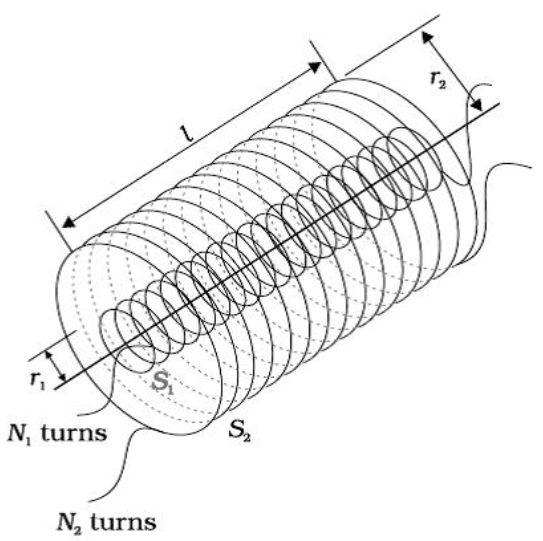
  2. Derive an expression for the mutual inductance of two long co-axial solenoids of same length wound one over the other.
  3. In an experiment, two coils $c_1 $ and $c_2$ are placed close to each other. Find out the expression for the emf induced in the coil $c_1$ due to a change in the current through the coil $c_2.$
Answer

  1. $\phi = \text{MI}$
Mutual inductance of two coils is equal to the magnetic flux linked with one coil when a unit current is passed in the other coil.
Alternate Answer
$\text{e} = - \text{M}\frac{\text{dl}}{\text{dt}}$
Mutual inductance is equal to the induced emf set up in one coil when the rate of change of current flowing through the other coil is unity.
SI unit: henry/(weber ampere$^{–1})/($volt second ampere$^{–1})$

Let a current $I_2$ flow through $S_2$.This sets up a magnetic flux $\phi_{1}$ through each turn of the coil $S_1.$
Total flux linked with $S_1$
$\text{N}_{1}\phi_{1} = \text{M}_{12}\text{I}_{2}$......(i)
where $M_{12}$ is the mutual inductance between the two solenoids Magnetic field due to the current $I_2$ in $S_2$ is $\text{S}_{2}\text{ is } \mu_{\circ}\text{n}_{2}\text{I}_{2}$
Therefore, resulting flux linked with $S_{1.}$
$\text{N}_{1}\phi_{1} = [ (\text{n}_{1}\ell)\pi\text{r}^{2}](\mu_0\text{n}_{2}\text{I}_{2})$........(ii)
Comparing (i) & (ii),we get
$M_{12}I_2 =(\text{n}_{1}\ell)\pi\text{r}_{1}^{2}(\mu_{0}\text{n}_{2}\text{I}_{2})$
$\therefore\text{M}_{12} = \mu_{0}\text{n}_{1}\text{n}_{2}\pi\text{r}_{1}^{2}\ell$
  1. Let a magnetic flux be $(\phi_{1})$linked with coil $C_1$ due to current (I_2) in coil $C_{2};​​​​​​​$​​​​​​​
We have:
$\Phi_{1}\propto\text{I}_{2}$
$ = > \Phi_{1} = \text{MI}_{2}$
$\therefore\frac{\text{d}\Phi_{1}}{\text{dt}}= \text{M}\frac{\text{dI}_{2}}{\text{dt}}$
$= > \text{e} = - \text{M}\frac{\text{dI}_{2}}{\text{dt}}$.

Need a full question paper?

Generate a complete, print-ready paper with questions like this in minutes — across 16+ boards, with answer keys.

Start Generating Free

Similar questions

An icebox almost completely filled with ice at 0°C is dipped into a large volume of water at 20°C. The box has walls of surface area $2400cm^2,$ thickness 2.0mm and thermal conductivity $0.06\text{Wm}^{-1}{^{\circ}}\text{C}^{-1}.$ Calculate the rate at which the ice melts in the box. Latent heat of fusion of ice $= 3.4\times10^5\text{Jkg}^{-1}.$
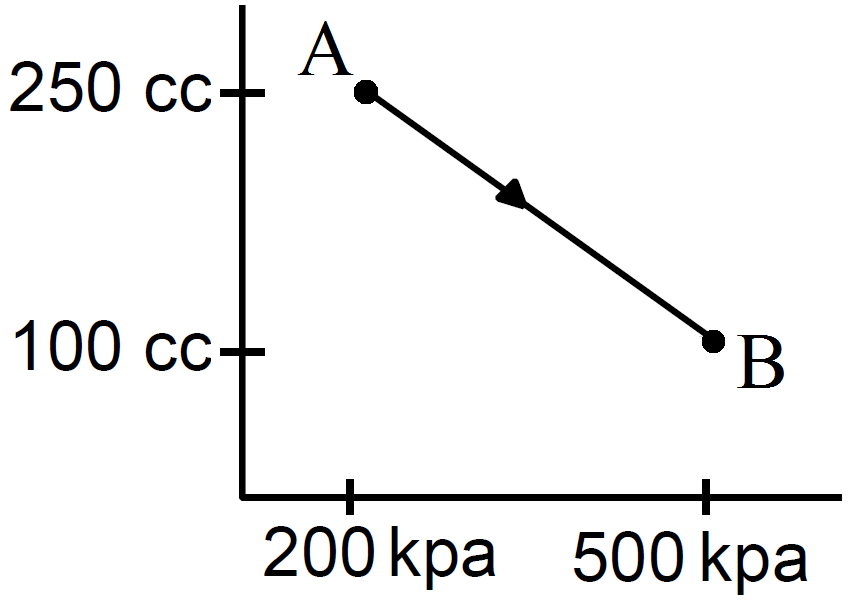
A gas is taken along the path AB as shown in figure. If 70cal of heat is extracted from the gas in the process, calculate the change in the internal energy of the system.
Two point charges of $+5 \times 10^{-19}C$ and $+20 \times 10^{-19}C$ are separated by a distance of 2m. Find the point on the line joining them at which electric field intensity is zero.
An aluminium can of cylindrical shape contains $500 \mathrm{~cm}^3$ of water. The area of the inner cross section of the can is $125 \mathrm{~cm}^2$. All measurements refer to $10^{\circ} \mathrm{C}$. Find the rise in the water level if the temperature increases to $80^{\circ} \mathrm{C}$. The coefficient of linear expansion of aluminium $=23 \times 10^{-6}{ }^{\circ} \mathrm{C}^{-1}$ and the average coefficient of volume expansion of water $=3.2 \times 10^{-4}{ }^{\circ} \mathrm{C}^{-1}$ respectively.
Consider an electron in front of metallic surface at a distance d (treated as an infinite plane surface). Assume the force of attraction by the plate is given as $\frac{1}{2}\frac{\text{q}^2}{4\pi\in_0\text{d}^2}$
Calculate work in taking the charge to an infinite distance from the plate. Taking d = 0.1nm, find the work done in electron volts. [Such a force law is not valid for d < 0.1nm].
Three particles of masses 1.0kg, 2.0kg and 3.0kg are placed at the corners A, B and C respectively of an equilateral triangle ABC of edge 1m. Locate the centre of mass of the system.
Two charges $2.0 \times 10^{-6}C$ and $1.0 \times 10^{-6}C$ are placed at a separation of 10cm. Where should a third charge be placed such that it experiences no net force due to these charges?
All the surfaces shown in are frictionless. The mass of the car is M, that of the block is m and the spring has spring constant k. Initially, the car and the block are at rest and the spring is stretched through a length x, when the system is released.
  1. Find the amplitudes of the simple harmonic motion of the block and of the car as seen from the road.
  2. Find the time period(s) of the two simple harmonic motions.
A bullet of mass m moving at a speed v hits a ball of mass M kept at rest. A small part having mass m' breaks from the ball and sticks to the bullet. The remaining ball is found to move at a speed $v_1$ in the direction of the bullet. Find the velocity of the bullet after the collision.
A thermally insulated, closed copper vessel contains water at $15^{\circ} \mathrm{C}$. When the vessel is shaken vigorously for 15 minutes, the temperature rises to $17^{\circ} \mathrm{C}$. The .mass of the vessel is 100 g and that of the water is 200 g . The specific heat capacities of copper and water are $420 \mathrm{Jgg}^{-1} \mathrm{~K}^{-1}$ and $4200 \mathrm{Jkg}^{-1} \mathrm{~K}^{-1}$ respectively. Neglect any thermal expansion.
  1. How much heat is transferred to the liquid-vessel system?
  2. How much work has been done on this system?
  3. How much is the increase in internal energy of the system?