Question
Define polarization.

Answer

The process of separating charges by pulling atoms in a dielectric in an induced electric field is called polarization. The pull of the atoms continues until the force exerted by the electric field on the charges becomes equal to the restoring force. Due to this stretching, the positive centre of gravity of the nucleus and the negative centre of gravity, which is formed due to the electrons, get separated from each other. And thus the atoms acquire dipole moment. That is, the dipole moment per unit volume of a substance is called its polarization and it is denoted by $\vec{p}$.
For linear isotropic dielectrics $ \vec{p}=\chi_0 E $
Here, $\chi_0$ is a constant characteristic of the dielectric which is called the electrical tendency of the dielectric medium.

Need a full question paper?

Generate a complete, print-ready paper with questions like this in minutes — across 16+ boards, with answer keys.
Start Generating Free

Similar questions

A circular loop of radius R carries a current I. Another circular loop of radius r ( << R) carries a current i and is placed at the centre of the larger loop. The planes of the two circles are at right angle to each other. Find the torque acting on the smaller loop.
Explain how $p-n$ junction is formed.
The number of electrons in an insulator is of the same order as the number of electrons in a conductor. What is then the basic difference between a conductor and an insulator?
  1. Obtain the expression for the cyclotron frequency.
  2. A deuteron and a proton are accelerated by the cyclotron. Can both be accelerated with the same oscillator frequency? Give reason to justify your answer.
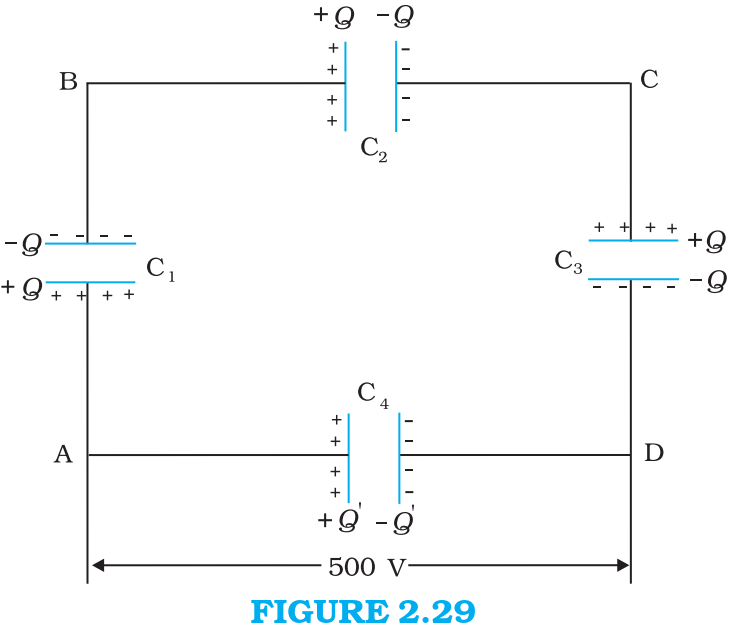
A network of four $10 \mu F$ capacitors is connected to a $500 V$ supply, as shown in Fig. $2.29$. Determine $(a)$ the equivalent capacitance of the network and $(b)$ the charge on each capacitor. $($Note, the charge on a capacitor is the charge on the plate with higher potential, equal and opposite to the charge on the plate with lower potential.$)$
Image
Suppose we have $12$ protons and $12$ neutrons. We can assemble them to form either $a :uMg$ nucleus or two $12C$ nuclei. In which of the two cases more energy will be liberated$?$
$a$. A toroidal solenoid with an air core has an average radius of $0.15\ m,$ area of cross section $12 \times 10^{-4} m^2$ and $1200$ turns. Obtain the self inductance of the toroid. Ignore field variation across the cross section of the toroid.
$b$. A second coil of $300$ turns is wound closely on the toroid above. If the current in the primary coil is increased from zero to $2.0 A$ in $0.05\ s,$ obtain the induced emf in the secondary coil.
Light of frequency $7.21 \times 10^{14} Hz$ is incident on a metal surface. Electrons with a maximum speed of $6.0 \times 10^5\ m/s$ are ejected from the surface. What is the threshold frequency for photoemission of electrons?
The numerical value of ionization energy in $eV$ equals the ionization potential in volts. Does the equality hold if these quantities are measured in some other units?
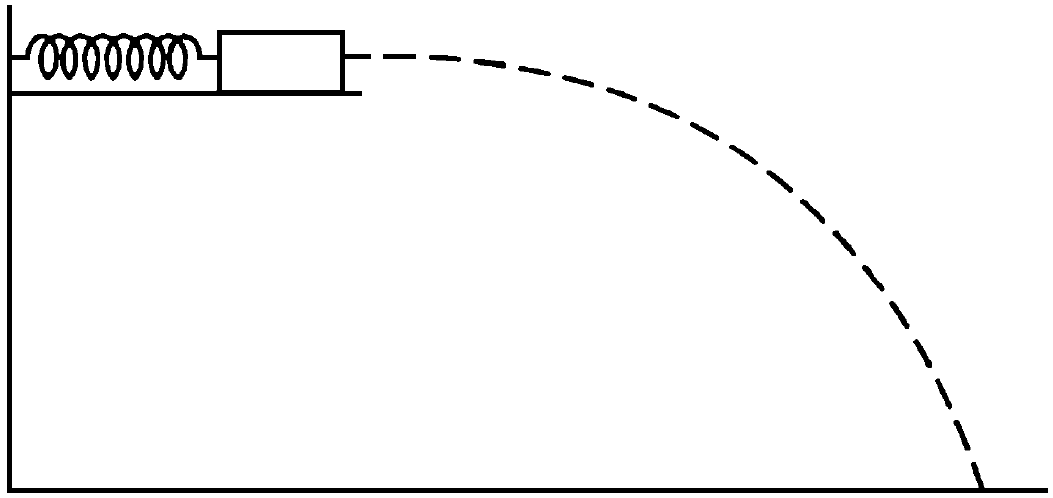
A small block of mass 100g is pressed against a horizontal spring fixed at one end to compress the spring through 5.0cm (figure). The spring constant is 100N/m. When released, the block moves horizontally till it leaves the spring. Where will it hit the ground 2m below the spring?