Question
Define pressure. What is the relation between pressure, force and area? State the units in which pressure is measured.

Answer

Pressure is defined as a measure of the force applied over a unit area. Pressure often is expressed in units of Pascals (Pa), newtons per square meter $(N/m^2$ or $kg/m.s^2)$, or pounds per square inch. Other units include the atmosphere (atm), torr, bar, and meters sea water (msw). In equations, pressure is denoted by the capital letter P or the lowercase letter p. Pressure is a derived unit, generally expressed according to the units of the equation:$\text{P}= \frac{\text{F}}{\text{A}}$
Where P is pressure, F is force, and A is area. P is pressure. F is the component of force perpendicular to the surface. A is the area of the surface. When a force is constant over an area, the pressure acting on that area is simply. Pressure is a scalar quantity, thus it acts in all directions at any given point. In order for pressure to create a force, the pressure must be integrated over some area.

Need a full question paper?

Generate a complete, print-ready paper with questions like this in minutes — across 16+ boards, with answer keys.

Start Generating Free

Similar questions

State the difference between eukaryotes and prokaryotes.
What are the advantages of using this tool?
Look at the pictures of the Moon in the figure, and answer the following questions.
Image
Q.1. Write the correct panel number corresponding to the phases of the Moon shown in the pictures above.
Picture label (e.g. A, B, C, etc.)Phase of Moon
 Three days after New Moon
 Full Moon
 Three days after the Full Moon
 A week after the Full Moon
 Day of New Moon
Q.2. List the picture labels of the phases of the Moon that are never seen from Earth.
Aanandi took two test tubes and marked them A and B. She put two spoonfuls of sugar solution in each of the test tubes. In test tube B, she added a spoonful of yeast. Then she attached two incompletely inflated balloons to the mouth of each test tube. She kept the setup in a warm place, away from sunlight.
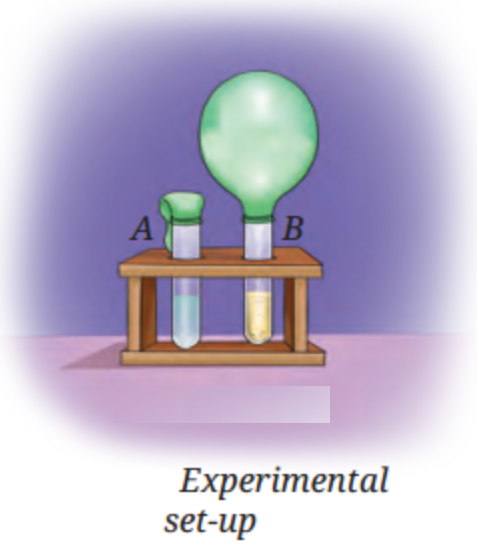
Image
(i) What do you predict will happen after 3-4 days? She observed that the balloon attached to test tube B was inflated. What can be a possible explanation for this?
(a) Water evaporated in test tube B and filled the balloon with the water vapour.
(b) The warm atmosphere expanded the air inside test tube B, which inflated the balloon.
(c) Yeast produced a gas inside test tube B, which inflated the balloon.
(d) Sugar reacted with warm air, which produced gas, eventually inflating the balloon.
(ii) She took another test tube, 1/4 filled with lime water. She removed the balloon from test tube B in such a manner that the gas inside the balloon did not escape. She attached the balloon to the test tube with lime water and shook it well. What do you think she wants to find out?

What is irrigation ? Describe two methods of irrigation which conserve water .
It is believed that height of a child depends upon the genes inherited from parents. However, it is often seen that tall parents may have short children and vice-versa. Are there factors other than genes, that can cause these variations?
What is drag? Give two examples of a drag force.
Snehal dug two pits, A and B, in her garden. In pit A, she put fruit and vegetable peels and mixed them with dried leaves. In pit B, she dumped the same kind of waste without mixing it with dried leaves. She covered both the pits with soil and observed after 3 weeks. What is she trying to test?
Draw a neat, labelled diagram of nitrogen cycle in nature. Which natural phenomenon occurring in the sky is responsible for nitrogen fixation?
An earthquake measures $3$ on Richter Scale:
$i.$ Would it be recorded by a seismograph?
$ii.$ Is it likely to cause much damage?