Question
Define probability of an event.

Answer

The probability of an event denotes the relative frequency of occurrence of an experiment’s outcome, when repeating the experiment.

Definition:

The empirical or experimental definition of probability is that if n be the total number of trials of an experiment and A is an event associated to it such that A happens in m-trials, then the probability of happening of event A is denoted by P(A) and is given by

$\text{P(A)}=\frac{\text{m}}{\text{n}}$

To illustrate the definition, let us take examples:

  1. When two coins are tossed simultaneously, the possible outcomes are HH, HT, TH and TT. The total number of trials is 4. Let A be the event of occurring exactly two heads. The number of times A happens is 1. So, the probability of the event A is

$\text{P(A)}=\frac{\text{m}}{\text{n}}$

$=\frac{1}{4}$

$=0.25$

  1. In the experiment of rolling a dice, the possible outcomes are 1, 2, 3, 4, 5 and 6. Let A be the event of occurring a number greater than 3. The total number of trials is 6. The number of times A happens is 3. So, the probability of the event A is

$\text{P(A)}=\frac{\text{m}}{\text{n}}$

$=\frac{3}{6}$

$=\frac{1}{2}$

$=0.5$

Note that H stands for getting a head and T stands for getting a tail in the experiment of tossing a coin.

Need a full question paper?

Generate a complete, print-ready paper with questions like this in minutes — across 16+ boards, with answer keys.
Start Generating Free

Similar questions

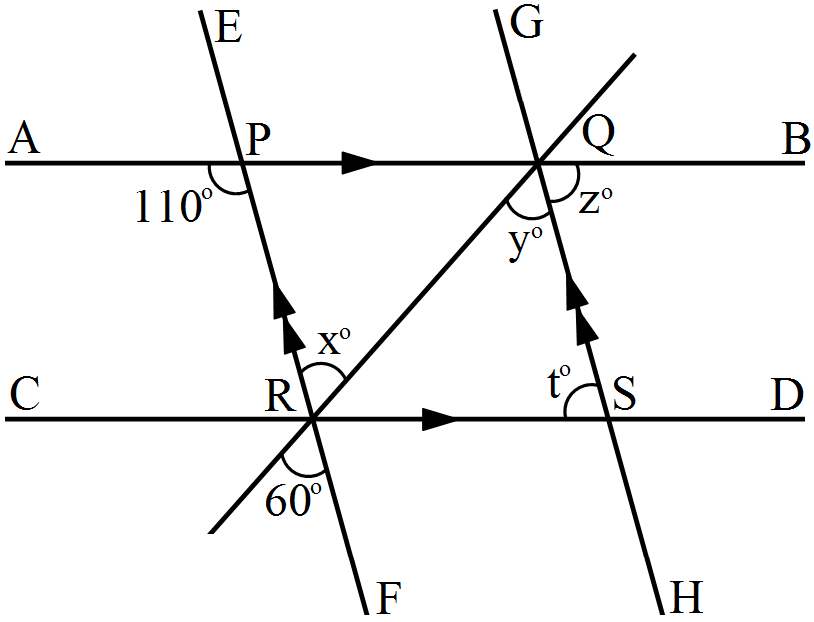
In the given figure, AB || CD and EF || GH. Find the value of x, y, z and t.

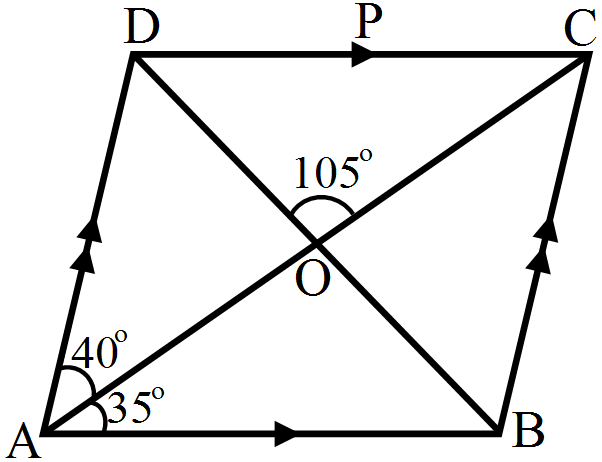
In the adjoining figure, ABCD is a parallelogram in which $\angle\text{BAO}=35^{\circ},\angle\text{DAO}=40^{\circ}$ and $\angle\text{COD}=150^{\circ}.$ Calculate
  1. $\angle\text{ABO},$
  2. $\angle\text{ODC},$
  3. $\angle\text{ACB},$
  4. $\angle\text{CBD}.$

If two straight lines intersect in such a way that one of the angles formed measures 90°, show that each of the remaining angles measures 90°.
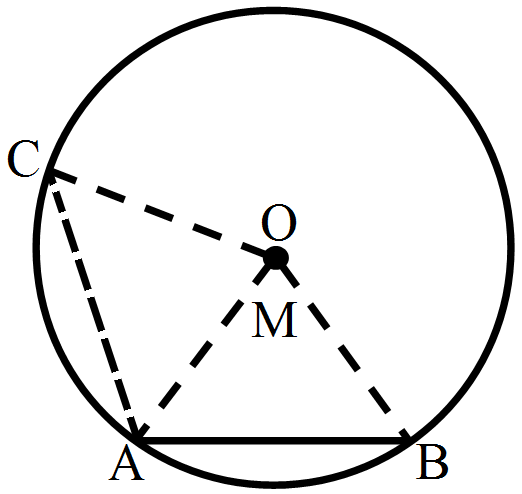
In the adjoining figure, AB and AC are two equal chords of a circle with centre O. Show that O lies on the bisector of $\angle\text{BAC}.$

The ages (in years) of 360 patients treated in a hospital on a particular day are given below:
Age in years
10-20
20-30
30-40
40-50
50-60
60-70
Number of patients
90
40
60
20
120
30
Draw a histogram and a frequency polygon on the same graph to represent the above data.
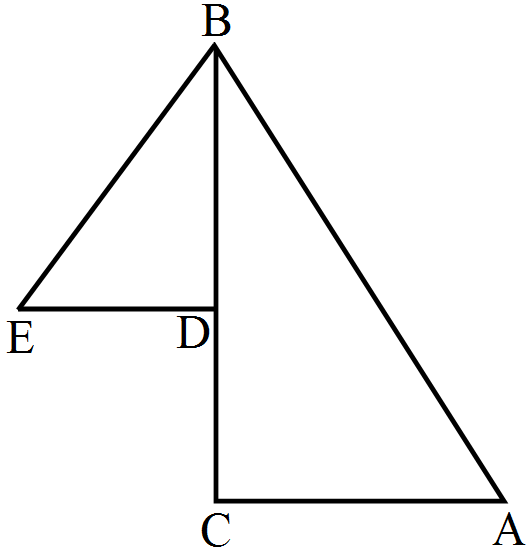
In the given figure, D is a point on side BC of a $\triangle\text{ABC}$ and E is a point such that CD = DE. Prove that AB + AC > BE.

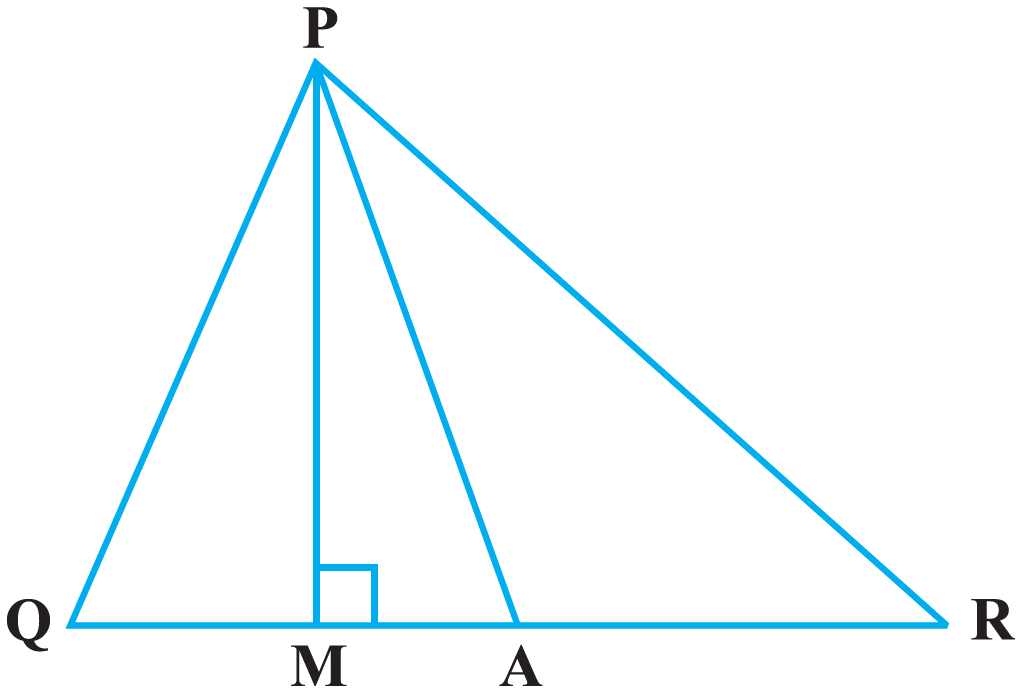
In Fig. $\angle\text{Q}>\angle\text{R},$ PA is the bisector of $\angle\text{QPR}$ and $\text{PM}\perp\text{QR}$ Prove that $\angle\text{APM}=\frac{1}{2}(\angle\text{Q}-\angle\text{R}).$

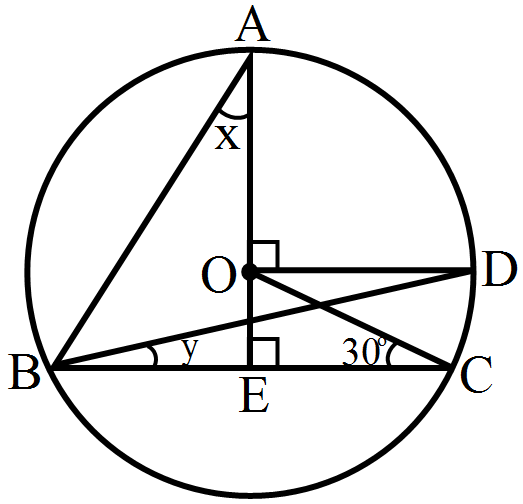
In the given figure, O is the centre of the circle and $\angle\text{BCO}=30^\circ.$ Find x and y.

The base of a triangular field is three times its altitude. If the cost of sowing the field at ₹ 58 per hectare is ₹ 783, find its base and height.
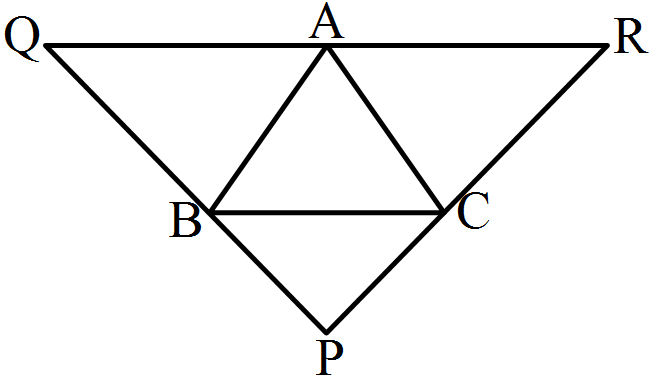
In the adjoining figure, $\triangle\text{ABC}$ is a triangle and through A, B, C, lines are drawn, parallel respectively to BC, CA and AB, intersecting at P, Q and R. Prove that the perimeter of $\triangle\text{PQR}$ is double the perimeter of $\triangle\text{ABC}.$