Question
Define resistivity. Write its unit.

Answer

Resistance of a conductor of length 1 m and area of cross-section 1 m² is equal to its resistivity. Its unit is ohm metre or ohm cm.

Need a full question paper?

Generate a complete, print-ready paper with questions like this in minutes — across 16+ boards, with answer keys.

Start Generating Free

Similar questions

The flux inside a balloon of radius 7.0 cm is 2.0 - $10^3 NmC ^{-1}$. If the radius of the balloon is doubled, what will be the value of flux?
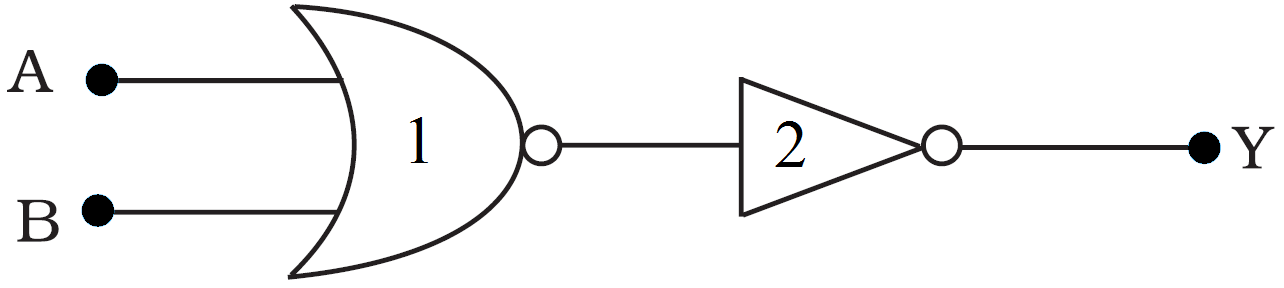
In the given logic circuit, name the logic gates 1 and 2 and write the name of the combination of gates.

Write the ratio of the number of free electrons and holes in an intrinsic semiconductor.
What happens to the power dissipation if the value of electric current passing through a conductor of constant resistance is doubled?
The vertical component of Earth’s magnetic field at a place is $ \sqrt{3}$ times the horizontal component. What is the value of angle of dip at this place?
What is the average number of neutrons obtained per nucleus from the fission of uranium nucleus?
What will be the shape of the wave front emitted by a light source in the form of a narrow slit?
  1. Calculate the energy released if 238U emits an $\alpha$-particle.
  2. Calculate the energy to be supplied to 238U it two protons and two neutrons are to be emitted one by one. The atomic masses of 238U, 234Th and 4He are 238.0508u, 234.04363u and 4.00260u respectively.
Mark the correct options.
  1. The luminous efficiency of a monochromatic source is always greater than that of a white light source of same power.
  2. The luminous efficiency of a monochromatic source of wavelength 555nm is always greater than that of a white light source of same power.
  3. The illuminating power of a monochromatic source of wavelength 555nm is always greater than that of a white light source of same power.
  4. The illuminating power of a monochromatic source is always greater than that of a white light source of same power.
A point charge Q is placed at point ‘O’ as shown in the figure. Is the potential at point A, i.e. VA, greater, smaller or equal to potential, VB, at point B, when Q is (i) positive, and (ii) negative charge?