Question
Define species-area relationship pattern of biodiversity in detail.
Answer

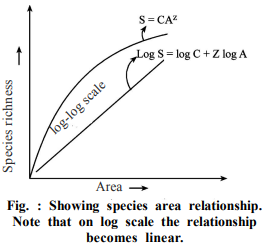
Species area relation : The famous German naturalist and geographer Alexander von Hemboldt, while working in the forests of South America, pointed out that to some extent the species richness of an area depends on increasing the extent of the exploration area. In fact, the relationship between species richness and the area of a wide variety of taxa (gymnosperms, birds, bats, freshwater fishes) is rectangular hyperbola. 
Image
On a logarithmic the relationship is a straight line described by the equation :
$\log S =\log C + Z \log A$
where S = species richness, A = Area,
Z-slope of line (regression coefficient), C = Y—intercept
Ecologist have reported that the value of Z lies in the range of 0.1 to 0.2 regardless the taxonomic group of the region (whether it is the plant in Britain, birds in California, all mollusc in New York State, slopes of the regression line are amazingly similar). But, if we analyze the species area relationship among very large areas like the entire continent, we will find that the slope of the line to be much steeper (as the Z-value in the range of 0.6 to 1.2). For example : for frugivorous (fruit eating) birds and mammals in the tropical forest of the different continents, the slope comes to be 1.15 which represents the dense species richness over the wide area.

Need a full question paper?

Generate a complete, print-ready paper with questions like this in minutes — across 16+ boards, with answer keys.

Start Generating Free

Similar questions

Answer the following questions:
Explain the role of any two accessory glands in human male reproductive system.
How is the placenta connected to the embryo?
Answer the following questions:
With labelled diagrams, depict stages in embryo development in a dicotyledenous plant.
Transcription in eukaryotes is more complex process than in prokaryotes. Justify and compare the initiation, elongation and termination in bacterial cells with eukaryotes.
Explain the different steps in the construction of recombinant DNA.
Describe the structure of a young anther as seen in a transverse section.
Match the items in Column I with those in Column II
S.No.
Column I
S.No.
Column II
(A)
Standing crop
(i)
The amount of mineral nutrients in the soil at a given time
(B)
Standing state
(ii)
Sedementary cycle
(C)
Climax community
(iii)
Herbivores and carnivores
(D)
Primary producers
(iv)
In near equilibrium with the environment
(E)
Phosporus cycle
(v)
Mass of living matter in a trophic level at a given time
(F)
Secondary producers
(vi)
Phytoplanktons
Differentiate between the following:
  1. Polygenic inheritance and Pleiotropy.
  2. Dominance, Codominance and Incomplete dominance.
Explain the difference between prokaryotic and eukaryotic DNA.
Vicky's mother was using the same mosquito repellent cream from last six years. She was regularly complaining that this cream has no effects on mosquitoes now. Hearing this, Vicky advised his mother to change the cream as regular usage has led the mosquitoes to develop resistance against it. His mother changed the cream and could notice its effect on mosquitoes.
  1. Explain how mosquitoes were not affected by the previous cream?
  2. On what factors, Darwin's theory was based?
  3. Can you relate this incident to Darwin's concept? How?
  4. Identify the values shown by Vicky.