Question
Define the absorption transition and emission transition.

Answer

When the electrons in the ground state to reach higher energy states is called absorption transition and moving of electrons from lower energy levels to higher energy levels is called emission transition.

Need a full question paper?

Generate a complete, print-ready paper with questions like this in minutes — across 16+ boards, with answer keys.
Start Generating Free

Similar questions

The drift current in a p-n junction is $20.0\mu\text{A}.$ Estimate the number of electrons crossing a cross-section per second in the depletion region.
Why cannot longitudinal waves be polarized?
Define electric flux. Write its S.I. units. A spherical rubber balloon carries a charge that is uniformly distributed over its surface. As the balloon is blown up and increases in size, how does the total electric flux coming out of the surface change? Give reason.
Two identical coils, radius of each is 8 cm and number of turns is 100 are coaxial and their centers are 12 cm apart. If current of 1 A flows in each coil in the same direction, then calculate the magnetic field at the midpoint on the axial line.
The north pole of a magnet is brought down along the axis of a horizontal circular coil. As a result, the flux through the coil changes from 0.35 weber to 0.86 weber in an interval of half a second. Find the average emf induced during this period. Is the induced current clockwise or anticlockwise as you look into the coil from the side of the magnet?

Current is allowed to flow in a metallic wire at a constant potential difference. When the wire becomes hot, cold water is poured on half of its portion. By doing so, its other half portion becomes still more hot. Explain its reason.
The equation of refraction at a spherical surface is $\frac{\mu_2}{\text{v}}-\frac{\mu_1}{\text{u}}-=\frac{\mu_2-\mu_1}{\text{R}}.$ Taking $\text{R}=\infty,$ show that this equation leads to the equation $\frac{\text{Real depth}}{\text{Apparent depth}}=\frac{\mu_2}{\mu_1}$ for refraction at a plane surface.
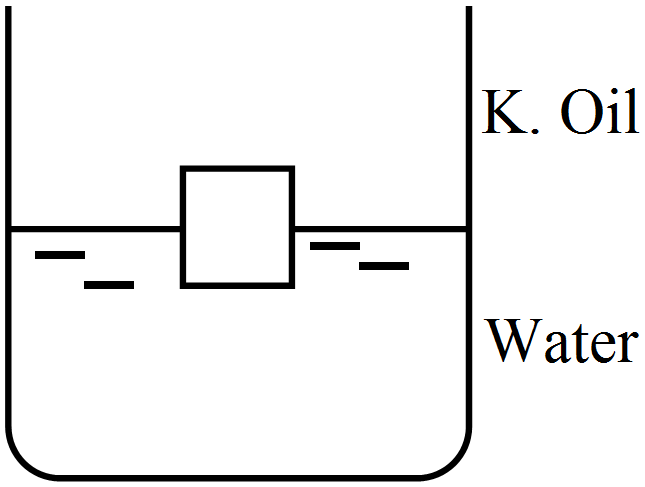
A cube of ice floats partly in water and partly in K. oil  Find the ratio of the volume of ice immersed in water to that in K.oil. Specific gravity of K. oil is 0.8 and that of ice is 0.9.

At room temperature (27.0°C) the resistance of a heating element is $100\ \Omega.$ What is the temperature of the element if the resistance is found to be $117\ \Omega,$ given that the temperature coefficient of the material of the resistor is $1.70\times10^{-4}\ ^\circ\text{C}^{-1}.$
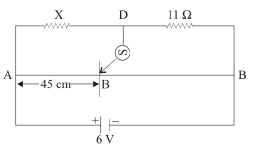
Find the value of X in the given figure.
Image