Question
Define the bond length.

Answer

Bond length is defined as the equilibrium distance between the nuclei of two bonded atoms in a molecule.

Bond lengths are expressed in terms of Angstrom (10–10 m) or picometer (10–12 m) and are measured by spectroscopic X-ray diffractions and electron-diffraction techniques.

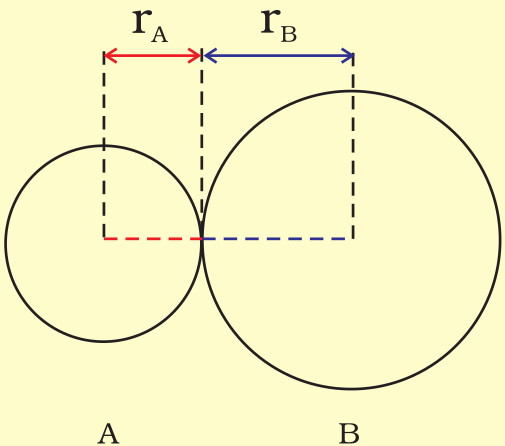
In an ionic compound, the bond length is the sum of the ionic radii of the constituting atoms (d = r+ + r). In a covalent compound, it is the sum of their covalent radii (d = rA + rB).
Need a full question paper?

Generate a complete, print-ready paper with questions like this in minutes — across 16+ boards, with answer keys.

Start Generating Free

Similar questions

Explain the following:
  1. Common ion effect.
  2. Bronsted Lowry concepts of acids and bases.
The Balmer series in the hydrogen spectrum corresponds to the transition from $n_1=2$ to $n_2=3,4$, .... This series lies in the visible region. Calculate the wave number of line associated with the transition in Balmer series when the electron moves to $n =4$ orbit. $\left( R _{ H }=109677 cm^{-1}\right)$
Given

$\text{N}_2(\text{g}) + 3\text{H}_2(\text{g}) \xrightarrow{ \ \ \ \ \ \ }2\text{NH}_3(\text{g}) ; \Delta_{\text{r}}\text{H}^\ominus= –92.4\text{kJ} \ \text{mol}^{–1}$

What is the standard enthalpy of formation of NH3 gas?

Two oxides of a metal contain 27.6% and 30.0% of oxygen respectively. If the formula of the first oxide is M3O4, find that of the second.
Calculate the work done when 11.2g of iron dissolves in hydrochloric acid in:
  1. A closed vessel.
  2. An open beaker at 25°C (Atomic mass of Fe = 56u).
Calculate the pH of a solution containing 0.1M acetic acid and 0.1M benzoic acid, Ka for CH3COOH and C6H5COOH are 1.8 × 10⁻⁵ and 6.5 × 10⁻⁵ respectively.
Find

  1. The total number and.
  2. The total mass of protons in 34mg of NH3 at STP.

Will the answer change if the temperature and pressure are changed?

What are the oxidation number of the underlined elements in the following and how do you rationalise your results?
CH3CH2OH
  1. Define principal quantum number(n).
  2. Write the electronic configuration of Cr+ [Atomic number of Cr = 24].
  3. Define Pauli's exclusion principle.
  1. Why is NH4Cl added before addition of NH4OH in qualitative analysis of 3rd group?
  2. Which will be added to precipitate soap

(RCOONa)? NaCl or KCl and why?'​​​​​​​