Question
Define the current sensitivity of a galvanometer. Write its S.I. unit.
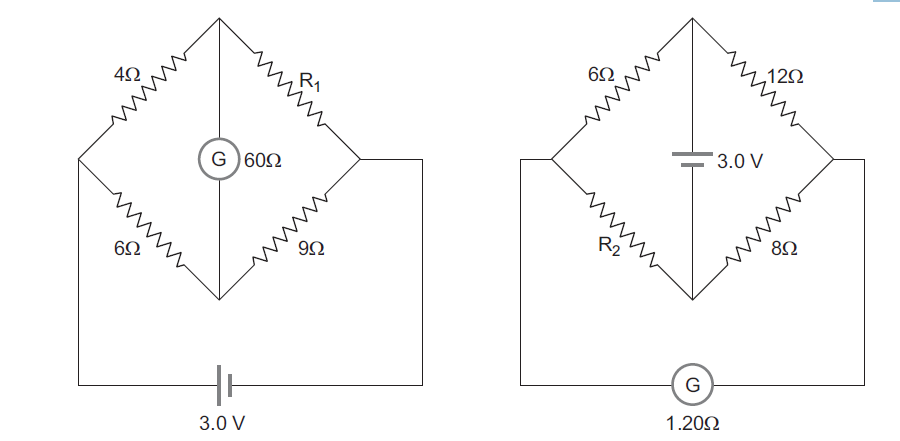
Figure shows two circuits each having a galvanometer and a battery of 3 V. When the galvanometers in each arrangement do not show any deflection, obtain the ratio R/ R2.

Answer

Ratio of deflection produced in the galvanometer to the current flowing through it.
Current sensitivity $\text{S}_{i} = \frac{\theta}{\text{I}}$
S.I. unit of current sensitivity Si is division/ampere or radian/ampere.
For balanced Wheatone bridge, if no current flows through the galvanometer
$\frac{4}{\text{R}_{1}} = \frac{6}{9}\Rightarrow\text{R}_{1} = \frac{4\times9}{6} =6\Omega$
For another current
$\frac{6}{12} = \frac{\text{R}_{2}}{8}\Rightarrow\text{R}_{2} = \frac{6\times8}{12} = 4\Omega$
$\therefore\frac{\text{R}_{1}}{\text{R}_{2}} = \frac{6}{4} = \frac{3}{2}.$

Need a full question paper?

Generate a complete, print-ready paper with questions like this in minutes — across 16+ boards, with answer keys.

Start Generating Free

Similar questions

A 100W sodium lamp radiates energy uniformly in all directions. The lamp is located at the centre of a large sphere that absorbs all the sodium light which is incident on it. The wavelength of the sodium light is 589 nm.
  1. What is the energy per photon associated with the sodium light?
  2. At what rate are the photons delivered to the sphere?
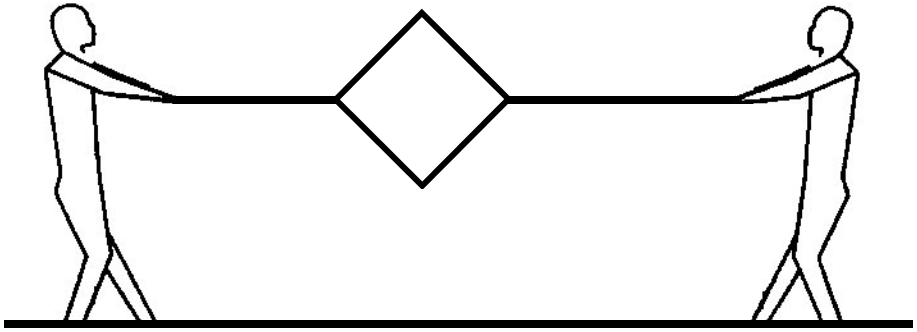
Figure shows a metallic square frame of edge a in a vertical plane. A uniform magnetic field B exists in the space in a direction perpendicular to the plane of the figure. Two boys pull the opposite corners of the square to deform it into a rhombus. They start pulling the corners at t = 0 and displace the corners at a uniform speed u.
  1. Find the induced emf in the frame at the instant when the angles at these corners reduce to 60°.
  2. Find the induced current in the frame at this instant if the total resistance of the frame is R.
  3. Find the total charge which flows through a side of the frame by the time the square is deformed into a straight line.

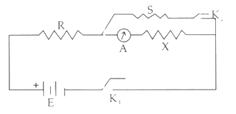
The reading of the (ideal) ammeter, in the circuit shown here, is equal too. 
Image

i. I when key $K_1$ is closed but key $K_2$ is open.
ii. $\frac{I}{n}$ when both keys $K _1$ and $K _2$ are closed.
Find the expression of the resistance of X in terms of the resistances of R and S.
Consider two pairs of neutrons. In each pair, the separation between the neutrons is the same. Can the force between the neutrons have different magnitudes for the two pairs?
A cubical block of mass m and edge a slides down a rough inclined plane of inclination $\theta$ with a uniform speed. Find the torque of the normal force acting on the block about its centre.
A rod is inserted as the core in the current-carrying solenoid of the previous problem.
  1. What is the magnetic intensity H at the centre?
  2. If the magnetization I of the core is found to be 0.12Nm, find the susceptibility of the material of the rod.
  3. Is the material paramagnetic, diamagnetic or ferromagnetic?
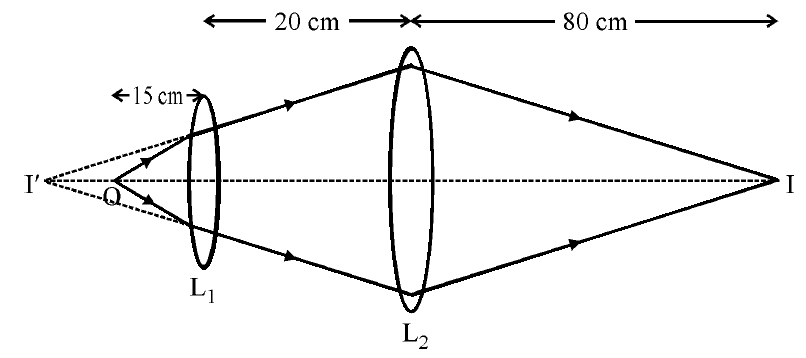
In the following diagram, an object ‘O’ is placed 15 cm in front of a convex lens L1 of focal length 20 cm and the final image is formed at ‘I’ at a distance of 80 cm from the second lens L2. Find the focal length of the lens L2.

A transformer has 50 turns in the primary and 100 in the secondary. If the primary is connected to a 220V DC supply, what will be the voltage across the secondary?
Two particles A and B having charges of +2.00 × 10-6C and of -4.00 × 10-6C respectively are held fixed at a separation of 20.0cm. Locate the point(s) on the line AB where
  1. The electric field is zero.
  2. The electric potential is zero.
Which constituent radiation of the electromagnetic spectrum is used:
  1. In RADAR,
  2. To photograph internal parts of a human body,
  3. For taking photographs of the sky during night and foggy conditions?
Give one reason for your answer in each case.