Question
Define the distance of closest approach.

Answer

The minimum distance upto which an energetic $\alpha$-particle travelling directly towards a nucleus can move before coming to rest and then retracing its path is known as distance of closest approach.
$F=\frac{1}{4 \pi \in_0} \frac{(2 e)(Ze)}{r^2}$
Where $r$ is the distance of $\alpha$-particle from nucleus.

Need a full question paper?

Generate a complete, print-ready paper with questions like this in minutes — across 16+ boards, with answer keys.
Start Generating Free

Similar questions

Find the acceleration due to gravity in a mine of depth 640m if the value at the surface is 9.800m/s2. The radius of the earth is 6400km.
An inductor is connected to a battery through a switch. Explain why the emf induced in the inductor is much larger when the switch is opened as compared to the emf induced when the switch is closed.
Why potentiometer is more effective instrument in measuring electromotive force of cell than voltmeter?
Write any four properties of electric field lines.
Protons with kinetic energy K emerge from an accelerator as a narrow beam. The beam is bent by a perpendicular magnetic field, so that it just misses a plane target kept at a distance l in front of the accelerator. Find the magnetic field.
A capacitor of capacitance C is given a charge Q. At t = 0, it is connected to an ideal battery of emf $\in$ through a resistance R. Find the charge on the capacitor at time t.
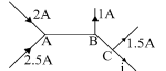
Calculate the value of $i$ as shown in the figure.
Image
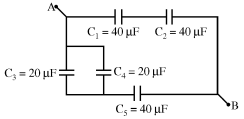
If five capacitors $C_1, C_2, C_3, C_4, C_5$ are connected in an electric circuit as shown in the figure, then calculate the equivalent capacitance of this network between point $A$ and point $B$.
Image
When a person leaves his home for sightseeing by his car, the meter reads 12352km. When he returns home after two hours the reading is 12416km.
  1. What is the average speed of the car during this period?
  2. What is the average velocity?
What are the readings of the ammeters A1 and A2 shown in figure. Neglect the resistance of the meters.