Question
Define the following terms:
  1. Cell inclusions.
  2. Cytosol.
  3. Protoplasm.
  4. Nucleoplasm.

Answer

  1. Cell Inclusions: Cell inclusions are non-living materials present in the cytoplasm.

  2. Cytosol: It is the soluble part of cytoplasm and is located between cell organelles.

  3. Protoplasm: Nucleus and cytoplasm together are called protoplasm.

  4. Nucleoplasm: It is the liquid ground substance present in the nucleus.

Need a full question paper?

Generate a complete, print-ready paper with questions like this in minutes — across 16+ boards, with answer keys.
Start Generating Free

Similar questions

Draw a neat labelled diagram of an animal cell.
In an experiment, 4.90g of copper oxide was obtained form 3.92g of copper. In another experiment, 4.55g of copper oxide gave, on reduction, 3.64g of copper. Show with the help of calculations that these figures verify the law of constant proportions.
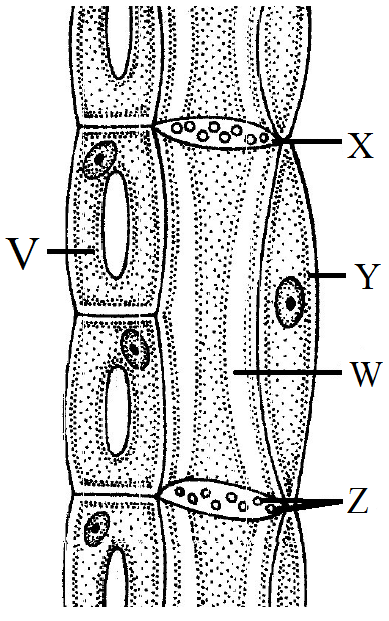
  1. Identify the figure. What is its function?
  2. Label V and W.
  3. Label X, Y and Z.
  4. W loses its nucleus in the mature state, still it remains alive. Explain how?

Name the following compounds. Also write the symbols/ formulae of the ions present in them:
  1. CuSO4
  2. (NH4)2SO4
  3. Na2O
  4. Na2CO3
  5. CaCl2
A body starting from rest travels with uniform acceleration. If it travels 100m in 5s, what is the value of acceleration?

Describe the various levels of causes of disease.

There are three substances X, Y and Z. The substance X does not have a fixed melting point or boiling point and it still shows the individual properties of its constituents. The substance Y is a pure substance which occurs in nature as such. The substance Y has a fixed melting point and boiling point but it cannot be broken down into simpler substances by any chemical means. The substance Z is also a pure substance whose properties are entirely different from those of its constituents. The substance Z can, however, be divided by electrolysis into two substances which belong to the same class of substances as Y.
  1. What type of substance could X be? Name one substance like X.
  2. What type of substance could Y be? Name one substance like Y.
  3. What type of substance could Z be? Name one substance like Z.
  4. Whish process involves absorption or release of an appreciable amount of energy: formation of substance X or formation of substance Z?
  5. Name the three groups into which all the substances like Y are divided on the basis of their properties.
Write the formulae of the following compounds. Also name the elements present in them.
  1. Water.
  2. Ammonia.
  3. Methane.
  4. Sulphur dioxide.
  5. Ethanol.
What does a neuron look like?
How long will it take a force of 10N to stop a mass of 2.5kg which is moving at 20m/s?