Question
  1. Define the following terms:
  1. Mole fraction.
  2. Van’t Hoff factor.
  1. 100 mg of a protein is dissolved in enough water to make 10.0 mL of a solution. If this solution has an osmotic pressure of 13.3 mm Hg at 25° C, what is the molar mass of protein?

(R = 0.0821 L atm mol–1 K–1 and 760 mm Hg = 1 atm.)
Answer

  1.  
  1. Mole fraction is the ratio of number of moles of one component to the total number of moles in a mixture.
  2. Van't Hoff factor is expressed as:

$\text{i}=\frac{\text{norml molar mass (m}_{1})}{\text{abnormal molar mass (m'}_{1})\text{(due to dissociation or association )}}$

  1. $\pi$ = CRT

$\text{M}_{2}=\frac{\text{w2RT}}{\pi\text{ V}}$

$\text{M}_{2}=\frac{100\times10^{-3}\text{g}\times0.0821\text{ L atm mol}^{-1}\text{K}^{-1}\times\text{298 K}\times760\times1000}{\text{13.3 atm}\times\text{10L}}$

M2 = 13980g mol–1 or 1.4 x 10⁴g mol–1.

Need a full question paper?

Generate a complete, print-ready paper with questions like this in minutes — across 16+ boards, with answer keys.

Start Generating Free

Similar questions

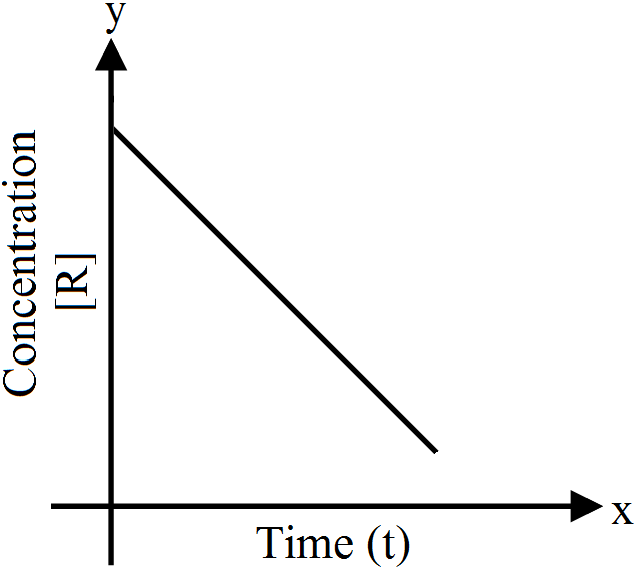
Consider the reaction $\text{R}\xrightarrow{\ \ \text{k}\ \ } \text{P}.$ The change in concentration of R with time is shown in the following plot:

  1. Predict the order of the reaction.
  2. Derive the expression for the time required for the completion of the reaction.
  3. What does the slope of the above line indicate?

What is called a battery? Explain its characteristics and describe dry cell and mercury cell.
(a) What is van't Hoff factor? Explain.
(b) Write the equation of molecular number properties including van't Hoff factor.
  1. Following are the transition metal ions of 3d series:

Ti4+, V2+, Mn3+, Cr3+

(Atomic numbers : Ti = 22, V = 23, Mn = 25, Cr = 24)

Answer the following:

  1. Which ion is most stable in an aqueous solution and why?
  2. Which ion is a strong oxidising agent and why?
  3. Which ion is colourless and why?
  1. Complete the following equations:
  1. $2\text{ }\text{MnO}_4^-+16\text{ }\text{H}^++5\text{ }\text{S}^{2-}\xrightarrow{\text{ }\text{ }\text{ }\text{ }\text{ }\text{ }\text{ }\text{ }\text{ }\text{ }\text{ }}$
  1. $\text{KMnO}_4\xrightarrow{\text{ }\text{ }\text{ }\text{ }\text{ }\text{heat}\text{ }\text{ }\text{ }\text{ }\text{ }}$
Answer the following questions:
Describe the preparation of potassium permanganate from pyrolusite ore. Write balanced chemical equation for one reaction to show the oxidizing nature of potassium permanganate.
Explain why on addition of 1mol of NaCl to 1 litre of water, the boiling point of water increases, while addition of 1mol of methyl alcohol to one litre of water decreases its boiling point.
Explain the elimination reaction of haloalkanes.
Describe the standard hydrogen electrode with diagram.
  1. Account for the following:
    1. Mn shows the highest oxidation state of +7 with oxygen but with fluorine it shows the highest oxidation state of +4.
    2. Cr2+ is a strong reducing agent.
    3. Cu2+ salts are coloured while Zn2+ salts are white.
  2. Complete the following equations:
    1. $2\text{MnO}_{2} + 4\text{KOH} + \text{O}_{2} \xrightarrow{\Delta}$
    2. $\text{Cr}_{2}\text{O}^{2-}_{7}+ 14\text{H}^{+} + 6\text{I}^{-}\rightarrow.$
19.5 g of CH2FCOOH is dissolved in 500 g of water. The depression in the freezing point of water observed is 1.00 C. Calculate the van’t Hoff factor and dissociation constant of fluoroacetic acid.