Question
Define the magnification of a spherical mirror.

Answer

Magnification (m): The ratio of the size of the image $\left(h^{\prime}\right)$ and the size of the object $(h)$ is called the magnification of the spherical mirror, i.e.
$m=\frac{\text { Size of image }\left(h^{\prime}\right)}{\text { Size of object }(h)}$
$\Rightarrow \quad m=\frac{h^{\prime}}{h}=-\frac{v}{u}$

Need a full question paper?

Generate a complete, print-ready paper with questions like this in minutes — across 16+ boards, with answer keys.
Start Generating Free

Similar questions

Why is transmission of electric power at very far distance done at very high voltage ?
Write a short note on Micro waves.
Find the average force needed to accelerate a car weighing 500kg from rest to 72km/h in a distance of 25m.
The charge on a proton is +1.6 × 10-19C and that on an electron is -1.6 × 10-19C. Does it mean that the electron has a charge 3.2 × 10-19C less than the charge of a proton?
X-ray and visible light travel at the same speed in vacuum. Do they travel at the same speed in glass?
A bullet passes past a person at a speed of 220m/s. Find the fractional change in the frequency of the whistling sound heard by the person as the bullet crosses the person. Speed of sound in air = 330m/s.
Provide the classification of semi-conductors with example.
Answer the following questions: Magnifying power of a simple microscope is inversely proportional to the focal length of the lens. What then stops us from using a convex lens of smaller and smaller focal length and achieving greater and greater magnifying power?
The internal resistance of an accumulator battery of emf 6V is $10\Omega$ when it is fully discharged. As the battery gets charged up, its internal resistance decreases to $1\Omega.$
The battery in its completely discharged state is connected to a charger that maintains a constant potential difference of 9V. Find the current through the battery (a) just after the connections are made and (b) after a long time when it is completely charged.
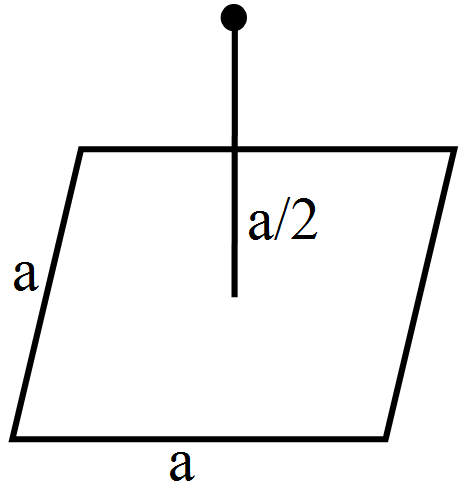
A charge Q is placed at a distance $\frac{\text{a}}{2}$ above the centre of a horizontal, square surface of edge a as shown in figure. Find the flux of the electric field through the square surface.