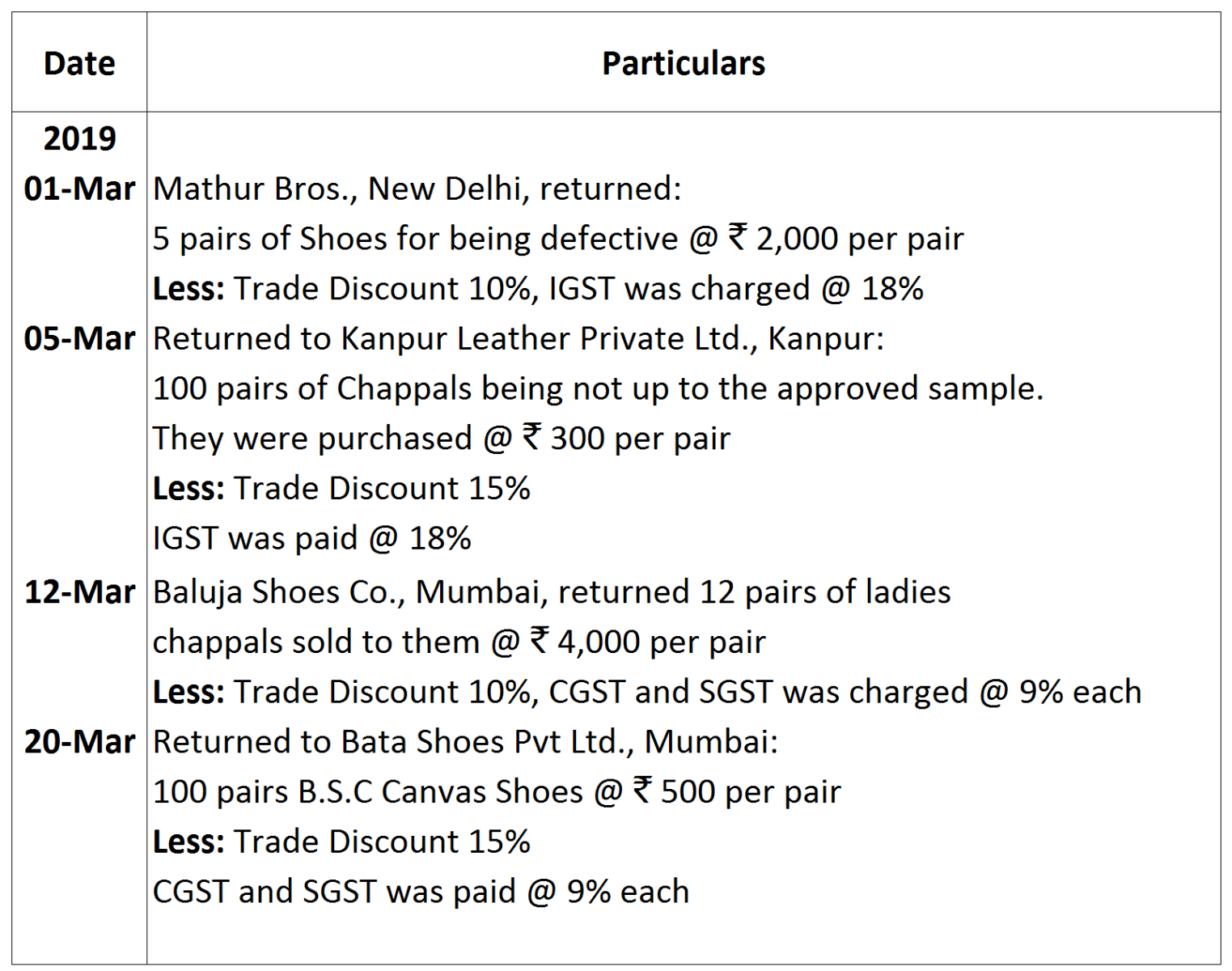
Question
Define the purpose of maintaining subsidiary journal.

Answer

The process of accounting starts from identification of financial and non-financial events. Financial events are first recorded in a Journal. A small business has lesser number of transactions and thereby it may be possible to record these transactions through Journal entry. However, on the contrary, as the business grows, there will be voluminous number of transactions and the firm may experience difficulty, thereby it becomes tedious to record through Journal entry. Thus, in order to save time and effort, it is recommended to sub-divide Journal. Sub-division of Journal provides scope for division of work. This leads to the improvement of efficiency and effectiveness and infuses higher degree of accountability to the accountants for the specific subsidiary Journal assigned to them. The purposes of maintaining subsidiary Journal are given below.
  1. It saves time and efforts in recording.
  2. It enables division of work, leading to an enhancement of efficiency and effectiveness, as particular accountant takes care of particular books.
  3. It also makes each accountant more responsible and accountable for the books assigned to them.
  4. It records routine and repetitive transactions at one place, which leads to easy accessibility of information and hassle-free communication.

Need a full question paper?

Generate a complete, print-ready paper with questions like this in minutes — across 16+ boards, with answer keys.

Start Generating Free

Similar questions

Give any three examples of revenues.
From the following information, prepare an Analytical Petty Cash Book:
2019  
April 1 Received for cash payment 20,000
April 2 Paid for postage 1,600
April 5 Paid for stationery 1,000
April 8 Paid for advertisement 2,000
April 12 Paid for wages 800
April 16 Paid for carriage 600
April 20 Paid for conveyance 880
April 25 Paid for travelling expenses 3,200
April 27 Paid for postage 480
April 28 Paid for office cleaning 400
April 29 Paid for courier 800
April 30 Sent registered notice to landlord 190
Put the following on the proper side of Cash account, Debtor's account and Creditor's account:
  1. Sold goods for cash ₹ 60,000.
  2. Sold goods to Hari on credit ₹ 20,000.
  3. Purchased goods from Krishan on credit ₹ 36,000.
  4. Purchased goods from Krishan for cash ₹ 10,000.
  5. Cash received from Hari ₹ 15,000.
  6. Cash paid to Krishan ₹ 28,000.
Prepare Returns Inward and Return Outward Books of Manoj, Mumbai from the following transactions and post them into Ledger Accounts:
Distinguish between Bills of Exchange and Promissory note on the following basis:
  1. Order or Promise and Parties.
  2. Acceptance.
  3. Parties.
  4. Noting.
Prepare the Accounting Equation on the basis of the following:
  1. Started business with cash ₹ 1,40,000 and Stock ₹ 2,50,000.
  2. Sold goods (costing ₹ 50,000) at a profit of 25% on the cost.
  3. Deposited into bank account ₹ 1,80,000.
  4. Purchased goods from Mohan ₹ 80,000.
Prepare accounting equation from the following:
 
 
(a)
Kunal started business with cash
2,50,000
(b)
He purchased furniture for cash
35,000
(c)
He paid commission
2,000
(d)
He purchases goods on credit
40,000
(e)
He sold goods (costing ₹ 20,000) for cash
26,000
Asset = Cash ₹ 2,39,000 + Furniture ₹ 35,000 + Goods ₹ 20,000 = ₹ 2,94,000; Liabilities = Creditors ₹ 40,000 + Capital ₹ 2,54,000 = ₹ 2,94,000
On 30th June, 2014 the Pass Book of Sh. Mahabir Prashad showed a balance of ₹ 22,000. On comparing the Pass Book with Cash Book the following differences were found:-
  1. Mahabir Prashad had paid into the Bank on 26th June four cheques for ₹ 3,000; ₹ 6,000; ₹ 8,000 and ₹ 10,000. Of these, the cheque for ₹ 6,000 was credited by the bank in July 2014.
  2. On 23rd June three cheques were drawn for ₹ 12,000; ₹ 13,000 and ₹ 16,000. The first two cheques were presented to the bank for payment in June and the third in July 2014.
  3. Cheques amounting to ₹ 3,600 were deposited in the bank but no entry was passed in the Cash Book.
  4. Bank charges entered in Cash Book twice ₹ 50.
  5. Cheque received entered twice in the Cash Book ₹ 3,200.
Prepare a Bank Reconciliation Statement as on 30th June 2014.
Rectify the following errors:
  1. Bought Radio for ₹ 1,000 for the proprietor was debited to General Expenses A/c.
  2. Bought goods from Mohan ₹ 2,000 was passed through the Sales Book, however, the account of Mohan was credited correctly.
  3. Wages due ₹ 1,500 has not been taken into account.
  4. Goods Returned by Kamal ₹ 240 has been debited to his account ₹ 420.
Prepare a Sales Book with atleast two items in it and show its posting.