Question
  1. Define the term ‘conductivity’ of a metallic wire. Write its SI unit.
  2. Using the concept of free electrons in a conductor, derive the expression for the conductivity of a wire in terms of number density and relaxation time. Hence obtain the relation between current density and the applied electric field E.

Answer

  1. Conductivity of a metallic wire is defined as the conductance (reciprocal of resistance) of a metallic wire of unit side and unit cross sectional area perpendicular to the current flow.

Alternate Answer

Conductivity is defined as the reciprocal of resistvity of a metallic wire.

S.I. unit $\Omega^{-1}\text{m}^{-1}\ \text{or mho (m}^{-1}).$

  1. $\text{R}=\frac{\rho\text{l}}{\text{A}}$

$\rho=\frac{\text{RA}}{\text{l}}$

but $\text{R}=\frac{\text{ml}}{\text{ne}^2\text{A}\tau}$

So, $\rho=\Big(\frac{\text{ml}}{\text{ne}^2\text{A}\tau}\Big)\frac{\text{A}}{\text{l}}$

$\rho=\frac{\text{m}}{\text{ne}^2\tau}\ \text{or}\ \sigma=\frac{\text{ne}^2\tau}{\text{m}}\ ....(1)$

where $\sigma=\frac{1}{\rho}=$ conductivity

$\tau=$ relaxation time.

n = number density of electron.

e = charge on one electron.

m = mass of one elecrtron.

Now, current density is given by:

$\text{J}=\text{neV}_\text{d}$

$\text{J}=\text{ne}\Big(\frac{\text{eE}\tau}{\text{m}}\Big)$ $\Big[\because\ \text{V}_{\text{d}}=\frac{\text{eE}\tau}{\text{m}}\Big]$

$\text{J}=\frac{\text{ne}^2\tau}{\text{m}}\text{E}$

From equation (1)

$\text{J}=\sigma\text{E}\ \text{or }\ \vec{\text{J}}=\sigma\vec{\text{E}}$
Need a full question paper?

Generate a complete, print-ready paper with questions like this in minutes — across 16+ boards, with answer keys.

Start Generating Free

Similar questions

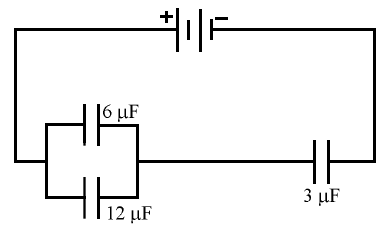
  1. In the following arrangement of capacitors, the energy stored in the 6 μF capacitor is E. Find the value of the following:
  2. Energy stored in 12 μF capacitor.
  3. Energy stored in 3 μF capacitor.
  4. Total energy drawn from the battery.

A convex lens of focal length 20 cm is placed coaxially with a convex mirror of radius of curvature 20 cm. The two are kept at 15 cm from each other. A point object lies 60 cm in front of the convex lens. Draw a ray diagram to show the formation of the image by the combination. Determine the nature and position of the image formed.
A square loop of side $10 cm$ and resistance $0.5 \Omega$ is placed vertically in the east-west plane. A uniform magnetic field of $0.10 T$ is set up across the plane in the north-east direction. The magnetic field is decreased to zero in $0.70 s$ at a steady rate. Determine the magnitudes of induced emf and current during this time-interval.
If the frequency of light falling on a metal is doubled, what will be the effect on photocurrent and the maximum kinetic energy of emitted photoelectrons?
A block hangs from a string wrapped on a disc of radius 20cm free to rotate about its axis which is fixed in a horizontal position. If the angular speed of the disc is 10rad/s at some instant, with what speed is the block going down at that instant?
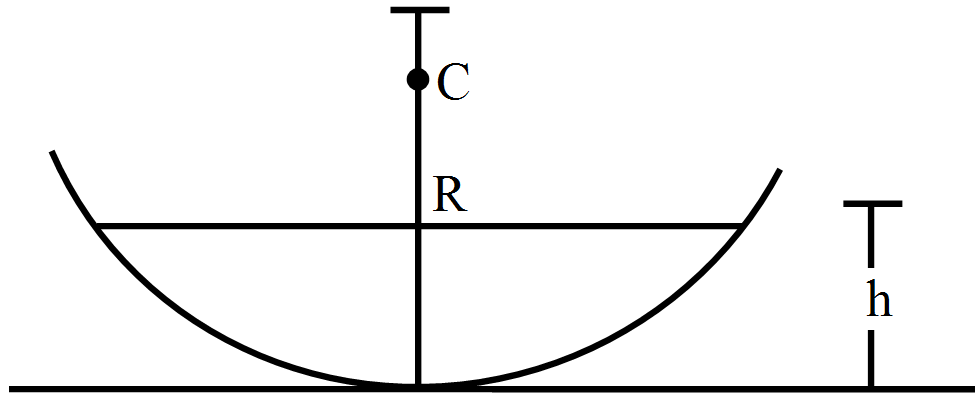
A concave mirror of radius R is kept on a horizontal. Water $\big($refractive index $=\mu\big)$ is poured into it upto a height h. Where should an object be placed so that its image is formed on itself?

Define the term self-inductance. Write its SI unit. Give two factors on which self inductance of an air-core coil depends.
An ideal diode should pass a current freely in one direction and should stop it completely in the opposite direction. Which is closer to ideal-vacuum diode or a p-n junction diode?
A hydrogen atom in ground state absorbs a photon of ultraviolet radiation of wavelength 50nm. Assuming that the entire photon energy is taken up by the electron with what kinetic energy will the electron be ejected?
A concave mirror has a focal length of 20cm. Find the position or positions of an object for which the imagesize is double of the object-size.