- Define the term ‘intensity of radiation’ in terms of photon picture of light.
- Two monochromatic beams, one red and the other blue, have the same intensity. In which case (i) The number of photons per unit area per second is larger, (ii) The maximum kinetic energy of the photoelectrons is more? Justify your answer.
CBSE OUTSIDE DELHI - SET 2 PATNA 2015
Download our app for free and get started
- Intensity of radiation is determined by the number of photons incident per unit area per unit time.
- Red Light.
Alternate Answer
$\text{hv}_{red} < \text{hv}_{blue}$
- Blue Light.
Alternate Answer
$\text{hv}_{red} > \text{hv}_{blue}$
Note: [The Einstein's photoelectric equation:
$\text{hv} = \text{hv}_{\circ} + \frac{1}{2}\text{mv}^{2}_{max}$
Instead of the reason in part.]

Download our appand get started for free
Experience the future of education. Simply download our apps or reach out to us for more information. Let's shape the future of learning together!No signup needed.*
Similar Questions
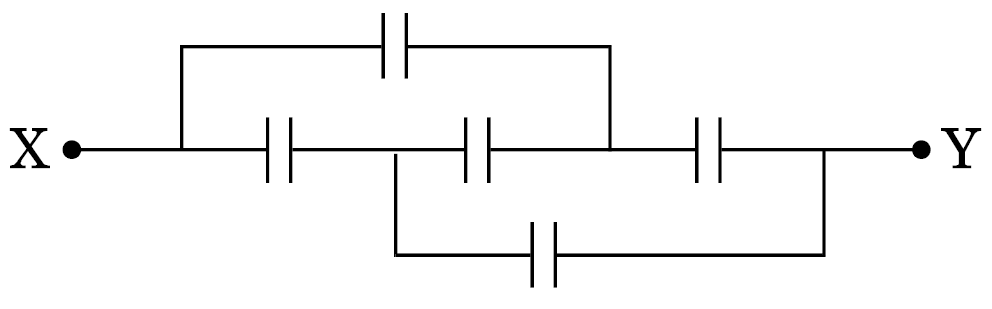
- 1Find the equivalent capacitance of the network shown in the figure, when each capacitor is of $1\mu\text{F}$. When the ends X and Y are connected to a 6 V battery, find out (i) The charge and (ii) The energy stored in the network.View Solution
- 2Draw a circuit diagram of a common emitter amplifier using n-p-n transistor. Derive an expression for the current gain $\beta_{ac}.$View Solution
- 3View Solution
- In Young's double slit experiment, two slits are 1 mm apart, and the screen is placed 1 m away from the slits. Calculate the fringe width when light of wavelength 500 nm is used.
- What should be the width of each slit in order to obtain 10 maxima of the double slits pattern within the central maximum of the single slit pattern?
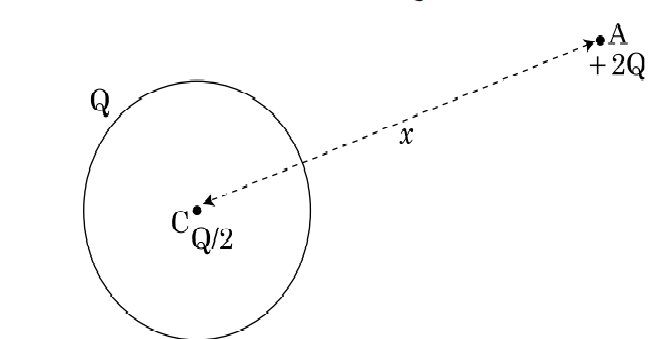
- 4View SolutionA thin metallic spherical shell of radius R carries a charge Q on its surface. A point charge Q/2 is placed at the centre C, and another charge + 2Q is placed outside the shell at A at a distance x from the centre as shown in the figure.
- Find the electric flux through the shell.
- State the law used.
- Find the force on the charges at the centre C of the shell and at the point A.
- 5View Solution
- Name two important processes that occur during the formation of a pn junction.
- Draw the circuit diagram of a full wave rectifier along with the input and output waveforms. Briefly, explain how the output voltage/current is unidirectional.
- 6View Solution
- What are the three basic units in communication systems? Write briefly the function of each of these.
- Write any three applications of the internet used in communication systems.
- 7View SolutionDraw a circuit diagram to study the input and output characteristics of an n-p-n transistor in common emitter configuration. Explain briefly how this arrangement is used to obtain the typical input/output characteristics of a transistor. Draw the graphs showing the nature of input/output curves.
- 8Use Bohr's postulates hydrogen atom to deduce the expression for the kinetic energy (K.E.) of the electron revolving in the $\mathrm{n}^{\text {th }}$ orbit and show that, K.E. $\frac{\mathrm{e}^2}{8 \pi \varepsilon_0 e_n}$, where $r_n$ is the radius of the $n^{\text {th }}$ orbit. How is the orbit. How is the potential energy in the orbit related to the orbital radius orbit related to the orbital radius $r_n$ ?View Solution
- 9View SolutionBoth alternating current and direct current are measured in amperes. But how is the ampere defined for an alternating current?
- 10View SolutionExplain why the reactance provided by a capacitor to an alternating current decreases with increasing frequency.