Question
Define the term magnetic moment of a current loop. Write the expression for the magnetic moment when an electron revolves at a speed v around an orbit of radius ‘r’ in hydrogen atom.

Answer

Magnetic moment of a current loop:

The torque on current loop is $\tau=\text{MB}\sin\theta$, where $\theta$ is angle between magnetic moment and magnetic field.

$\Rightarrow\text{M}=\frac{\tau}{\text{B}\sin\theta}$

If B or 1 T, $\sin\theta=1$ or $\theta=90^\circ$ then $\text{M}=\tau$.

That is the magnetic moment of a current loop is defined as the torque acting on the loop when placed in a magnetic field of 1 T such that the loop is oriented with its area vector normal to the magnetic field.

Also, M = IA

i.e., magnetic moment of a current loop is the product of current flowing in the loop and area of loop. Its direction is perpendicular to the plane of the loop and determined by using right hand thumb rule.

Magnetic moment of revolving electron,

$\text{M}=\frac{\text{evr}}{2}$

Need a full question paper?

Generate a complete, print-ready paper with questions like this in minutes — across 16+ boards, with answer keys.
Start Generating Free

Similar questions

A parallel-plate capacitor of plate area A and plate separation d is charged to a potential difference V and then the battery is disconnected. A slab of dielectric constant K is then inserted between the plates of the capacitor so as to fill the space between the plates. Find the work done on the system in the process of inserting the slab.
The equation of motion of a particle started at t = 0 is given by $\text{x}=5\sin\big(20\text{t}+\frac{\pi}{3}\big)$ where x is in centimetre and t in second. When does the particle.
  1. First come to rest.
  2. First have zero acceleration.
  3. First have maximum speed?
The plates of a capacitor of capacitance $10\mu\text{F},$ charged to $60\mu\text{C},$ are joined together by a wire of resistance $10\Omega$ at t = 0. Find the charge on the capacitor in the circuit at (a) t = 0 (b) $\text{t}=30\mu\text{s}$ (c) $\text{t}=120\mu\text{s}$ and (d) t = 1.0ms.
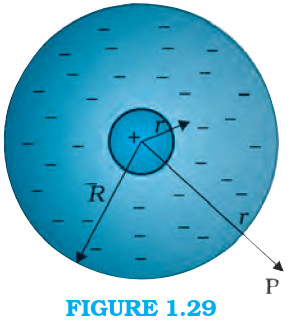
An early model for an atom considered it to have a positively charged point nucleus of charge $Z e$, surrounded by a uniform density of negative charge up to a radius $R$. The atom as a whole is neutral. For this model, what is the electric field at a distance $r$ from the nucleus?
Image
The angle between the resultant contact force and the normal force exerted by a body on the other is called the angle of friction. Show that, if $\lambda$ be the angle of friction and la the coefficient of static friction, $\lambda\leq\tan^{-1}\mu.$
A resistor of $400 \Omega$, an inductor of $\frac{5}{\pi} H$ and a capacitor of $\frac{50}{\pi} \mu F$ are connected in series across a source of alternating voltage of $140 \sin 100 \pi t V$. Find the voltage (rms) across the resistor, the inductor and the capacitor. Is the algebraic sum of these voltages more than the source voltage? If yes, resolve the paradox. (Given, $\sqrt{2}=1.414$ ).
A compound microscope consists of an objective of focal length 1cm and an eyepiece of focal length 5cm. An object is placed at a distance of 0.5cm from the objective. What should be the separation between the lenses so that the microscope projects an inverted real image of the object on a screen 30cm behind the eyepiece?
  1. State Kirchhoff’s rules for an electric network. Using Kirchhoff’s rules, obtain the balance condition in terms of the resistances of four arms of Wheat sone bridge.
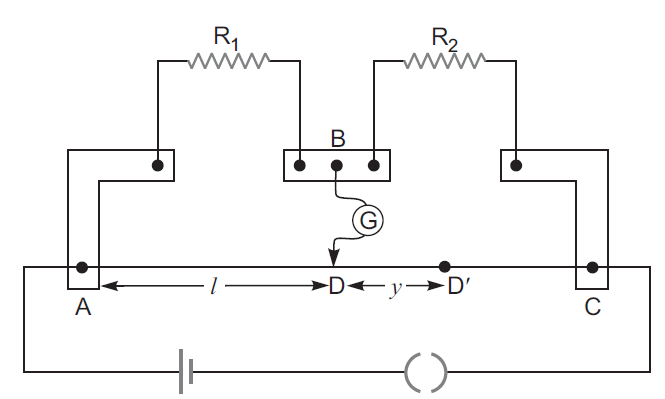
  2. In the meter bridge experimental set up, shown in the figure, the null point ‘D’ is obtained at a distance of 40 cm from end A ofthe meter bridge wire. If a resistance of 10 Ω is connected in series with R1, null point is obtained at AD = 60 cm. Calculate the value of R1 and R2.

A uniform disc of radius r is to be suspended through a small hole made in the disc. Find the minimum possible time period of the disc for small oscillations. What should be the distance of the hole from the centre for it to have minimum time period?