Question
Define the term resistivity and write the SI unit.

Answer

The resistivity of a material of a conductor is defined as the resistance offered by a conductor of length 1 m and area of cross-section $1 \mathrm{~m}^2$. Its SI unit is ohm $\times$ metre $(\Omega \mathrm{m})$.

Need a full question paper?

Generate a complete, print-ready paper with questions like this in minutes — across 16+ boards, with answer keys.
Start Generating Free

Similar questions

The angle made by the string of a simple pendulum with the vertical depends on time as $\theta=\frac{\pi}{90}\sin[(\pi\text{s}^{-1})\text{t}].$ Find the length of the pendulum if $\text{g}=\pi^2\text{m/s}^2.$
The force acting on a particle moving along X-axis is $F = -k(x - u_0t)$ where k is a positive constant. An observer moving at a constant velocity $v_0$, along the X-axis looks at the particle. What kind of motion does he find for the particle?
The first overtone frequency of a closed organ pipe $\mathrm{P}_1$ is equal to the fundamental frequency of an open organ pipe $P_2$. If the length of the pipe $P_1$ is 30 cm , what will be the length of $P_2$ ?
An aeroplane travels over a rectangular field 100m × 50m, parallel to its length. What should be the speed of the plane so that the field becomes square in the plane frame?
Answer the following question:
Ray optics is based on the assumption that light travels in a straight line. Diffraction effects (observed when light propagates through small apertures/slits or around small obstacles) disprove this assumption. Yet the ray optics assumption is so commonly used in understanding location and several other properties of images in optical instruments. What is the justification?
Two identical coils, radius of each is 8 cm and number of turns is 100 are coaxial and their centers are 12 cm apart. If current of 1 A flows in each coil in the same direction, then calculate the magnetic field at the midpoint on the axial line.
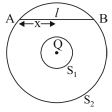
Calculate the electric flux passing through the spheres $S_1$ and $S_2$ shown in the figure. The linear charge density of the wire $A B$ shown in the figure is $\lambda=K x$ where $x=$ distance from the end $A$ of the wire measured along its length.
Image
Find the electric potential energy of a system made up of three point charges.
A potential difference of 12 volt is applied across the ends of 0.24 m long conductor. Calculate the drift velocity of the electrons. Mobility of electron is $5.6 \times 10^{-6} m^2 V^{-1} s^{-1}$.
Can a vector have zero component along a line and still have nonzero magnitude?