Question
Define the terms
$(i)$ 'cut$-$off voltage' and
$(ii)$ 'threshold frequency' in relation to the phenomenon of photoelectric effect.
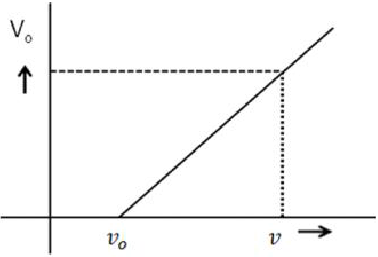
Using Einstein's photoelectric equation show how the cut$-$off voltage and threshold frequency for a given photosensitive material can be determined with the help of a suitable plot/graph.
Answer

Cut $-$ off voltage : The minimum negative potential $(V_0)$ applied to the plate or anode $(A)$ for which the photoelectric current just becomes zero,
Threshold frequency : The minimum frequency of incident radiation which is required to have photo electrons emitted from a given metal surface.
As per Einstein's photoelectric equation. $\text{eV}_{0} = \text{hv} - \text{hv}_{0},$ for $\text{v} > \text{v}_{0}$
$\text{v}_{0} = \frac{\text{h}}{\text{e}}(\text{v} - \text{v}_{o} ) $
Hence the intercept, on the $v-$ axis, gives $v_0$.​​​​​​​

Need a full question paper?

Generate a complete, print-ready paper with questions like this in minutes — across 16+ boards, with answer keys.

Start Generating Free

Similar questions

The horn of a car emits sound with a dominant frequency of 2400Hz. What will be the apparent dominant frequency heard by a person standing on the road in front of the car if the car is approaching at 18.0km/h? Speed of sound in air = 340m/s.
A beam of light consisting of two wavelengths, $650 \ nm$ and $520 \ nm$, is used to obtain interference fringes in a Young’s double-slit experiment.
  1. Find the distance of the third bright fringe on the screen from the central maximum for wavelength $650 \ nm.$
  2. What is the least distance from the central maximum where the bright fringes due to both the wavelengths coincide?
A railway track $($made of iron$)$ is laid in winter when the average temperature is $18^\circ C$. The track consists of sections of $12.0m$ placed one after the other. How much $pp$ should be left between two such sections $80$ that there is no compression during summer when the maximum temperature goes to $48^\circ C$? Coefficient of linear expansion of iron $= 11 \times 10^{-6 }{}^{\circ} C^{-1}$.
An ammeter and a milliammeter are converted from the same galvanometer. Out of the two, which current measuring instrument has a higher resistance?
A long straight wire in the horizontal plane carries a current of 50 A in north to south direction. Give the magnitude and direction B at a point 2.5 m east of the wire.
A nearsighted person cannot see beyond 25cm. Assuming that the separation of them glass from the eye is 1cm, find the power of lens needed to see distant objects.
i. What characteristic property of nuclear force explains the constancy of binding energy per nucleon (BE/A) in the range of mass number $A$ lying $30<A<170$ ?
ii. Show that the density of nucleus over a wide range of nuclei is constant and independent of mass number A
In a common emitter mode of a transistor, the d.c. current gain is 20, the emitter current is 7mA. Calculate (i) base current and (ii) collector current.
Trace the rays which are passing through a convex lens and a concave lens.
A tank is filled with water to a height of 12.5 cm. The apparent depth of a needle lying at the bottom of the tank is measured by a microscope to be 9.4 cm. What is the refractive index of water? If water is replaced by a liquid of refractive index 1.63 up to the same height, by what distance would be the microscope have to be moved to focus on the needle again?