MCQ
Definition of chemistry is:
  • A
    Physical science that studies the composition, structure, properties and change of matter.
  • B
    Biological science that helps to study the basic functioning of nervous system.
  • C
    Science that helps in studying the galaxy.
  • D
    Physical science that studies the biotic and abiotic aspects of environment.
Answer

  1. Physical science that studies the composition, structure, properties and change of matter.

Explanation:

Chemistry is a branch of physical science that studies the composition, structure, properties and change of matter. Chemistry deals with such topics as the properties of individual atoms, how atoms form chemical bonds to create chemical compounds, the interactions of substances through intermolecular forces that give matter its general properties, and the interactions between substances through chemical reactions to form different substances.

Need a full question paper?

Generate a complete, print-ready paper with questions like this in minutes — across 16+ boards, with answer keys.

Start Generating Free

Similar questions

A metal surface is exposed to solar radiations
Identify the correct statements about p-block elements and their compounds.

$(A)$ Non metals have higher electronegativity than metals.

$(B)$ Non metals have lower ionisation enthalpy than metals.

$(C)$ Compounds formed between highly reactive nonmetals and highly reactive metals are generally ionic.

$(D)$ The non-metal oxides are generally basic in nature.

$(E)$ The metal oxides are generally acidic or neutral in nature.

Electrovalent compounds do not have
SO2​ + O​⇌ 2SO3​ + Heat
The equilibrium reaction proceeds in forward direction by:
In the Kjeldahl's method for estimation of nitrogen present in a soil sample, ammonia evolved from 0.75g of sample neutralised 10mL of 1M H2SO. The percentage of nitrogen in the soil is:
In mole of C2H6.__________ are present:
In an isobaric process, the ratio of heat supplied to the system $(dQ)$ and work done by the system $(dW)$ for diatomic gas is
The electronic configuration of three elements $A,B$ and $C$ are given below. The molecular formula of the compound formed from $B$ and $C$ will be

$A : 1s^2\, 2s^2\, 2p^6$

$B : 1s^2\, 2s^2\, 2p^6\, 3s^2\, 3p^3$

$C : 1s^2\, 2s^2\, 2p^6\, 3s^2\, 3p^5$

Possible number of orientations of a subshell is
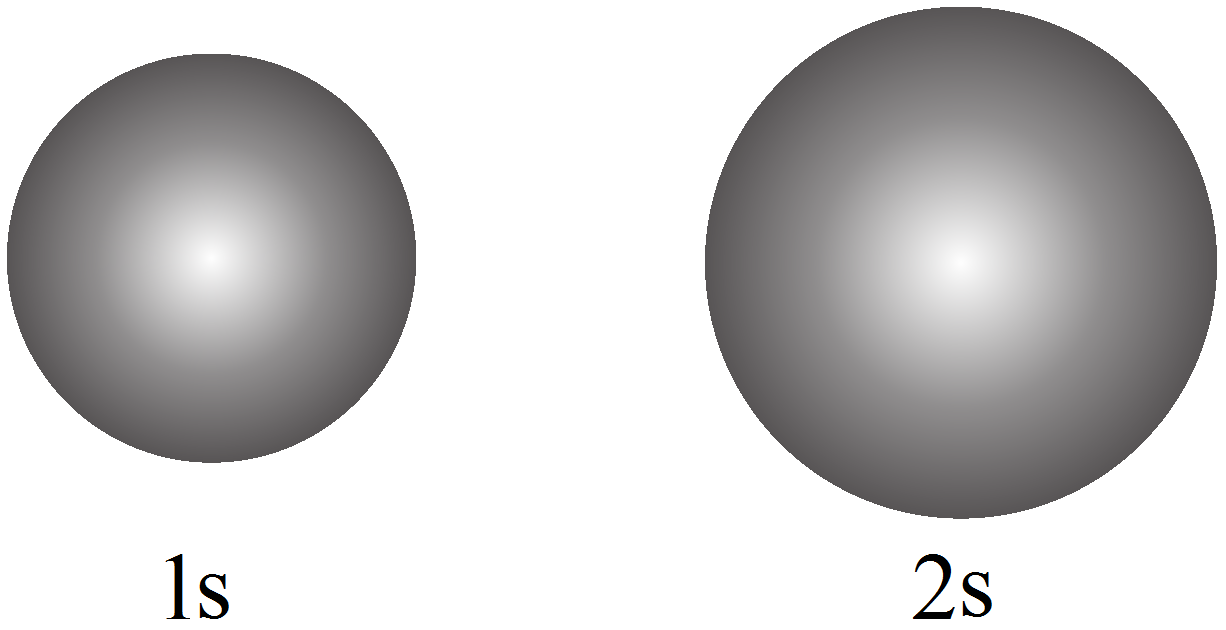
The probability density plots of 1s and 2s orbitals are given in figure.

The density of dots in a region represents the probability density of finding electrons in the region.
On the basis of above diagram which of the following statements is incorrect?