Question
Definitions needed to understand reflection from a Spherical mirror :

Answer

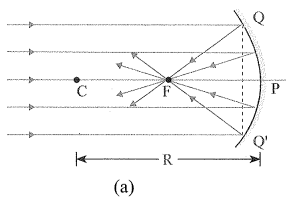
→(1) Centre of Curvature (C): The centre of the spherical shell from which the mirror is made, is called the centre of curvature (C) of the mirror.
(2) Radius of Curvature (R): The radius of the spherical shell from which the mirror is made is called the radius of curvature (R).
(3) Pole (P): The centre of the reflecting surface of a mirror is called pole (P).
(4) Principal Axis: The imaginary line passing through the pole and the centre of curvature is called the principal axis of the mirror.
(5) Aperture: The diameter of the reflecting surface is called aperture of the mirror (QQ').
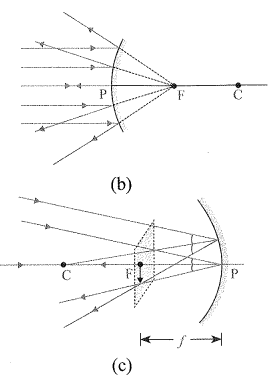
(6) Principal Focus (F): The point where the rays parallel to the principal axis meet (concave mirror), or appear to meet (convex mirror), after reflection is called the principal focus of the mirror.
Image
Image
(7) Focal Plane: A plane passing through the principal focus and normal to the principal axis is called the focal plane of the mirror.
(8) Focal Length (f): This distance between the pole and the principal focus of a mirror is called focal length.
(9) Paraxial Rays: Rays close to the principal axis are called paraxial rays.

Need a full question paper?

Generate a complete, print-ready paper with questions like this in minutes — across 16+ boards, with answer keys.

Start Generating Free

Similar questions

Which of the following two statements is more appropriate?
  1. Two forces are added using triangle rule because force is a vector quantity.
  2. Force is a vector quantity because two forces are added using triangle rule.
A convex lens of focal length f1 is kept in contact with a concave lens of focal length f2. Find the focal length of the combination.
The contact angle between water and glass is 0º. When water is poured in a glass to the maximum of its capacity, the water surface is convex upward. The angle of contact in such a situation is more than 90º. Explain.
Given: Wavelength of light in mercury is $5.5 \times 10^{-5} cm$.
i. Calculate its frequency and period.
ii. What is the wavelength of the light in the glass, if the refractive index of glass is 1.5 ?
A Young's double slit apparatus has slits separated by 0.28mm and a screen 48cm away from the slits. The whole apparatus is immersed in water and the slits are illuminated by the red light ($\lambda=700\text{nm}$ in vacuum). Find the fringe-width of the pattern formed on the screen.
White light is used in a Young's double slit experiment. Find the minimum order of the violet fringe $(\lambda=400\text{nm}),$ which overlaps with a red fringe $(\lambda=700\text{nm}).$
A single lens is mounted in a tube. A parallel beam enters the tube and emerges out of the tube as a divergent beam. Can you say with certainty that there is a diverging lens in the tube?
An ordinary electric fan does not cool the air, still it gives comfort in summer. Explain.
A ball is projected from a point on the floor with a speed of 15m/s at an angle of 60° with the horizontal. Will it hit a vertical wall 5m away from the point of projection and perpendicular to the plane of projection without hitting the floor? Will the answer differ if the wall is 22m away?
What is linear magnification? Obtain equation of linear magnification for mirror.