MCQ
$\Delta U + \Delta W = 0$ is valid for
  • Adiabatic process
  • B
    Isothermal process
  • C
    Isobaric process
  • D
    Isochoric process

Answer

Correct option: A.
Adiabatic process
a
(a) In adiabatic process $\Delta Q = 0 $ ==> $\Delta U + \Delta W = 0$

$(\because \,\Delta Q = \Delta U + \Delta W)$

Need a full question paper?

Generate a complete, print-ready paper with questions like this in minutes — across 16+ boards, with answer keys.
Start Generating Free

Similar questions

When a $4\, kg$ mass is hung vertically on a light spring that obeys Hooke's law, the spring stretches by $2\, cms$. The work required to be done by an external agent in stretching this spring by $5\, cms$ will be ......... $joule$       $(g = 9.8\,metres/se{c^2})$
A man of mass 40kg is standing on a uniform plank of mass 60kg lying on horizontal frictionless ice. The man walks from one end to the other end of the plank. the distance walked by the man relative to ice is (given length of plank = 5m)
During an adiabatic process, the pressure of a gas is found to be proportional to the cube of its absolute temperature. The ratio $\frac{\text{C}_\text{P}}{\text{C}_\text{V}}$ for gas is:
The force required to take away a flat circular plate of radius $2\, cm$ from the surface of water, will be (the surface tension of water is $70\, dyne/cm$)
Two cars are approaching each other at an equal speed of $7.2\, km / hr$. When they see each other, both blow horns having frequency of $676\, Hz$. The beat frequency heard by each driver will be $.....\, Hz$. [Velocity of sound in air is $340\,m / s .]$
Which of the following graphs is/are correct.
A sphere strikes a wall and rebounds with coefficient of restitution $1/3$. If it rebounds with a velocity of $0.1\, m/sec$ at an angle of $60^o$ to the normal to the wall, the loss of kinetic energy is
A uniform thin wooden plank $A B$ of length $L$ and mass $M$ is kept on a table with its $B$ end slightly outside the edge of the table. When an impulse $J$ is given to the end $B$, the plank moves up with centre of mass rising a distance $h$ from the surface of the table. Then,
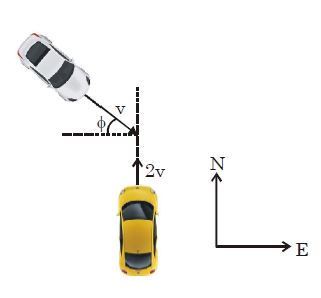
Two cars, both of mass $m$ , collide and stick together. Prior to the collision, one car had been traveling north at speed $2v$ , while the second was traveling at speed $v$ at an angle $\phi $ south of east (as indicated in the figure). The magnitude of the velocity of the two car system immediately after the collision is 
First law thermodynamics states that