MCQ
Density of ice is $\rho$ and that of water is $\sigma$. What will be the decrease in volume when a mass $M$ of ice melts
  • A
    $\frac{M}{\sigma-\rho}$
  • B
    $\frac{\sigma-\rho}{M}$
  • $M\left[\frac{1}{\rho}-\frac{1}{\sigma}\right]$
  • D
    $\frac{1}{M}\left[\frac{1}{\rho}-\frac{1}{\sigma}\right]$

Answer

Correct option: C.
$M\left[\frac{1}{\rho}-\frac{1}{\sigma}\right]$
(c)$\text { Volume of ice }=\frac{M}{\rho}, \text { volume of water }=\frac{M}{\sigma} . $
$\therefore \text { Change in volume }=\frac{M}{\rho}-\frac{M}{\sigma}=M\left(\frac{1}{\rho}-\frac{1}{\sigma}\right)$

Need a full question paper?

Generate a complete, print-ready paper with questions like this in minutes — across 16+ boards, with answer keys.

Start Generating Free

Similar questions

The coefficient of performance of a Carnot refrigerator working between $30^{\circ} \mathrm{C}$ and $0^{\circ} \mathrm{C}$ is
The specific resistance of manganin is $50 \times 10^{-8} \mathrm{ohm} \times \mathrm{m}$. The resistance of a cube of length $50 \mathrm{~cm}$ will be
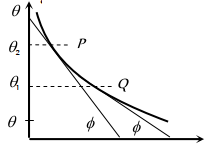
A body cools in a surrounding which is at a constant temperature of $\theta_0$. Assume that it obeys Newton's law of cooling. Its temperature $\theta$ is plotted against time $t$. Tangents are drawn to the curve at the points $P\left(\theta=\theta_1\right)$ and $Q\left(\theta=\theta_2\right)$. These tangents meet the time axis at angles of $\phi_2$ and $\phi_1$, as shown
Image
A thermos flask is polished well
Two identical solid copper spheres of radius $R$ placed in contact with each other. The gravitational attracton between them is proportional to
Wavelength of light of frequency $100 Hz$
A $10$ H.P. motor pumps out water from a well of depth $20 \mathrm{~m}$ and fills a water tank of volume $22380$ litres at a height of $10 \mathrm{~m}$ from the ground. the running time of the motor to fill the empty water tank is $\left(g=10 \mathrm{~ms}^{-2}\right)$
A person moves $30 m$ north and then $20 m$ towards east and finally $30 \sqrt{2} m$ in south-west direction. The displacement of the person from the origin will be
A motor car blowing a horn of frequency $124 \mathrm{vib} / \mathrm{sec}$ moves with a velocity $72 \mathrm{~km} / \mathrm{hr}$ towards a tall wall. The frequency of the reflected sound heard by the driver will be (velocity of sound in air is 330 $\mathrm{m} / \mathrm{s})$
Which pair of the following forces will never give resultant force of $2 N$