Question
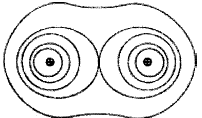
  1. Depict the equipotential surfaces for a system of two identical positive point charges placed a distance $‘d\ ’$ apart.
  2. Deduce the expression for the potential energy of a system of two point charges $q_1$ and $q_2$ brought from infinity to the points$\overrightarrow{\text{r}_{1}}$ and $\overrightarrow{\text{r}_{2}}$ respectively in the presence of external electric field $\overrightarrow{\text{E}}.$
Answer


Equipotential surfaces for a system of two identical positive charges:
Expression for the potential energy of a system of two point charges in external field: Work done in bringing the charge $q_1$ from infinity to $r_1$ Work done $= q_1 V(r_1)$ Work done in bringing the charge $q_1$ from infinity to $r_2.$ Work done against the external electric field $= q_2V (r_2)$ Work done $=$ work done against the external electric field $+$ Work done on $q_2$ against the field due to $q_1 = \text{q}_{2}\text{V}(\text{r}_{2}) + \frac{\text{q}_{1}\text{q}_{2}}{4\pi\varepsilon_{0}\text{r}_{12}}$
Potential energy of the system
$=$ the total work done in assembling the configuration$ = \text{q}_{1}\text{V}(\text{r}_{1}) + \text{q}_{2}\text{V}(\text{r}_{2}) + \frac{\text{q}_{1}\text{q}_{2}}{4\pi\varepsilon_{0}\text{r}_{12}}.$

Need a full question paper?

Generate a complete, print-ready paper with questions like this in minutes — across 16+ boards, with answer keys.

Start Generating Free

Similar questions

An ac circuit is made from series combination of components of circuits X and Y . Current is ahead of voltage by $\frac{\pi}{4}$. If component $X$ is pure resistor whose value is $100 \Omega$ then (i) what is the name of component $Y$ ? (ii) If root mean square value of voltage is 141 V , then find the root mean square value of the current.
“Gauss’s law in electrostatics is true for any closed surface, no matter what its shape or size is”. Justify this statement with the help of a suitable example.
What should be the condition for the efficiency of a Carnot engine to be equal to $1?$
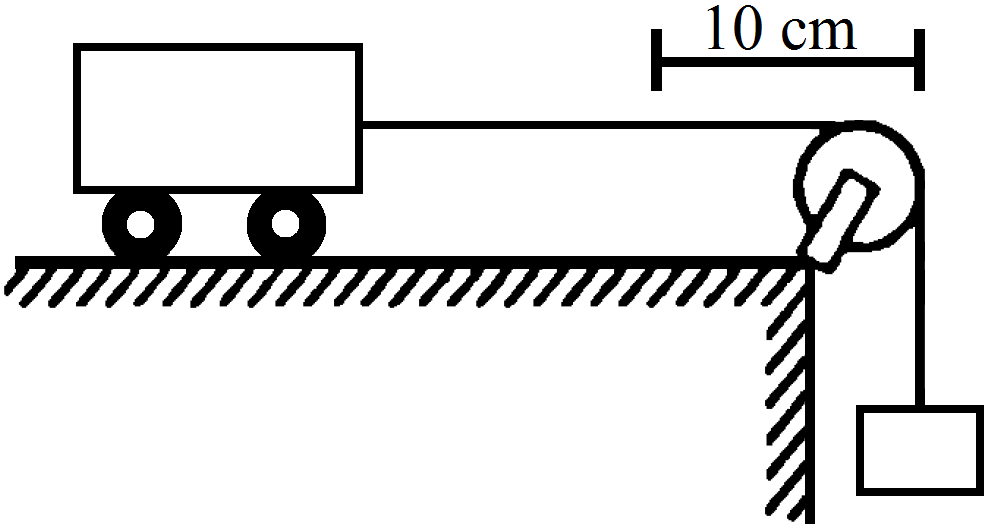
A heavy string is tied at one end to a movable support and to a light thread at the other end as shown in figure, The thread goes over a fixed pulley and supports a weight to produce a tension. The lowest frequency with which the heavy string resonates is 120Hz. If the movable support is pushed to the right by 10cm so that the joint is placed on the pulley, what will be the minimum frequency at which the heavy string can resonate?
A system has two charges $q_A=2.5$$\times 10^{-7} C$ and $q_B=-2.5 \times 10^{-7} C$ located at points A: $(0$,$0,-15 cm)$and $B :( 0 , 0 ,+15 cm)$, respectively. What are the total charge and electric dipole moment of the system?
A source emits light of wavelengths $555\ nm$ and $600\ nm$. The radiant flux of the $555\ nm$ part is $40W$ and of the $600\ nm$ part is $30W$. The relative luminosity at $600\ nm$ is $0\ '6$. Find:
  1. The total radiant flux.
  2. The total luminous flux.
  3. The luminous efficiency.
A straight wire of length l can slide on two parallel plastic rails kept in a horizontal plane with a separation d. The coefficient of friction between the wire and the rails is $\mu.$ If the wire carries a current i, what minimum magnetic field should exist in the space in order to slide the wire on the rails?
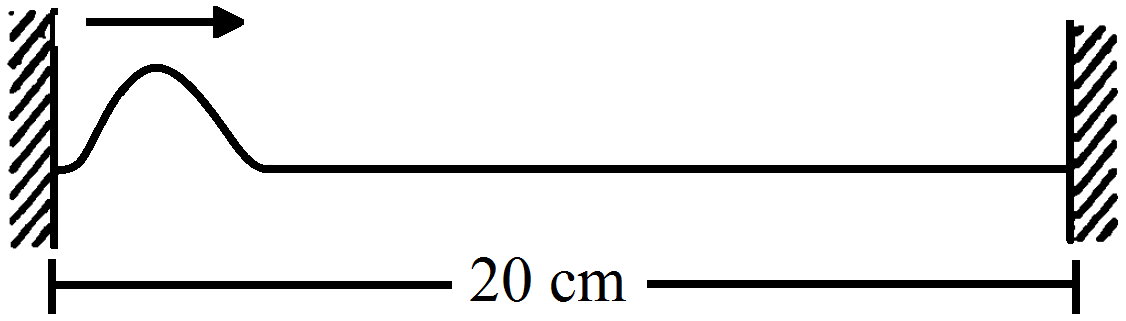
A string of length 20cm and linear mass density 0.40g/cm is fixed at both ends and is kept under a tension of 16N. A wave pulse is produced at t = 0 near an end as shown in figure, which travels towards the other end.
  1. When will the string have the shape shown in the figureagain
  2. Sketch the shape of the string at a time half of that found in part (a).
A simple pendulum of lerigth $1$ feet suspended from the ceiling of an elevator takes $\frac{\pi}{3}$ seconds to complete one oscillation. Find the acceleration of the elevator.
How are electromagnetic waves produced? What is the source of energy of these waves? Draw a schematic sketch of the electromagnetic waves propagating along the + x-axis. Indicate the directions of the electric and magnetic fields. Write the relation between the velocity of propagation and the magnitudes of electric and magnetic fields.