Question
Derive an expression for decrease in potential energy when a charge flows through an external resistance in a circuit.

Answer

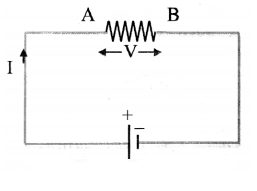
i. Consider a resistor AB connected to a cell in a circuit with current flowing from A to B.
Image
ii. The cell maintains a potential difference V between the two terminals of the resistor, higher potential at $A$ and lower at $B$.
iii. Let Q be the charge flowing in time $\Delta t$ through the resistor from A to B .
iv. The potential difference $V$ between the two points $A$ and $B$, is equal to the amount of work (W) done to carry a unit positive charge from $A$ to $B$.
$\therefore V =\frac{W}{Q}$
v. The cell provides this energy through the charge $Q$, to the resistor $A B$ where the work is performed.
vi. When the charge $Q$ flows from the higher potential point $A$ to the lower potential point $B$, there is decrease in its potential energy by an amount
$\Delta U = QV = I \Delta tV$
where $I$ is current due to the charge $Q$ flowing in time $\Delta t$.

Need a full question paper?

Generate a complete, print-ready paper with questions like this in minutes — across 16+ boards, with answer keys.
Start Generating Free

Similar questions

Water is flowing in a stream with velocity $5 \ km/hr$ in an easterly direction relative to the shore. Speed of a boat relative to still water is $20 \ km/hr.$ If the boat enters the stream heading north, with what velocity will the boat actually travel?
Derive expression for electric field when an electron of mass $m$ is subjected to an electric field $(E).$
Describe the working of the experiment performed to measure the value of gravitational constant.
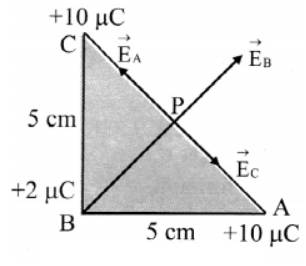
Three point charges are placed at the vertices of a right angled isosceles triangle as shown in the given figure. What is the magnitude and direction of the resultant electric field at point $P$ which is the mid point of its hypotenuseImage
Focal power of the eye lens of a compound microscope is 6 dioptre. The microscope is to be used for maximum magnifying power (angular magnification) of at least $12.5.$ The packing instructions demand that length of the microscope should be $25\ cm.$ Determine minimum focal power of the objective. How much will its radius of curvature be if it is a biconvex lens of $n = 1.5.$
A bullet of mass $m1$ travelling with a velocity u strikes a stationary wooden block of mass $m2$ and gets embedded into it. Determine the expression for loss in the kinetic energy of the system. Is this violating the principle of conservation of energy? If not, how can you account for this loss?
What is Young’s modulus? Describe an experiment to find out Young’s modulus of material in the form of a long straight wire.
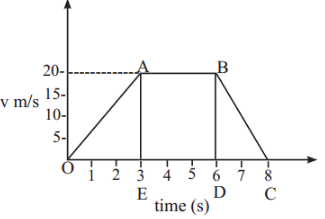
A velocity-time graph is shown in the adjoining figure.

Image
Determine:
  1. initial speed of the car
  2. maximum speed attained by the car
  3. part of the graph showing zero acceleration
  4. part of the graph showing constant retardation
  5. distance travelled by the car in first 6 sec.
Why do astronauts in an orbiting satellite have a feeling of weightlessness?
A batsman deflects a ball by an angle of $45^\circ$ without changing its initial speed which is equal to $54 \ km/h.$ What is the impulse imparted to the ball? $($Mass of the ball is $0.15 \ kg).$