Question
  1. Derive an expression for equivalent capacitance of three capacitors when connected in series.
  2. Derive an expression for equivalent capacitance of three capacitors when connected in parallel.
Answer

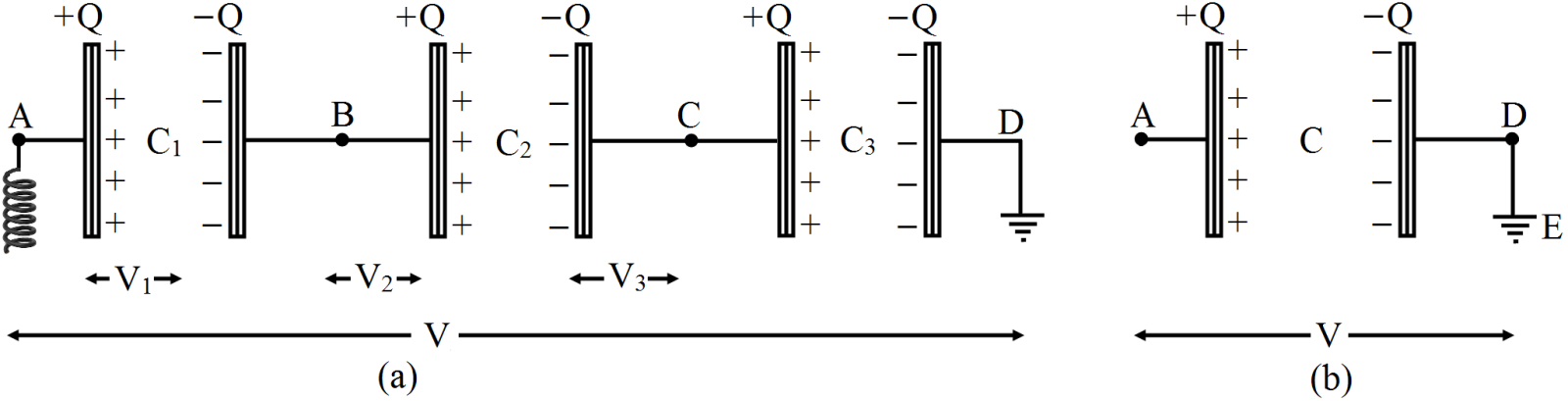
In fig. $(a) $ Three capacitors of capacitances $C_1, C_2, C_3$ are connected in series between points $A$ and $D$.
In 'series’ first plate of each capacitor has charge $+Q$ and second plate of each capacitor has charge $-Q$ i.e., charge on each capacitor is $Q$.
Let the potential differences across the capacitors $C_1, C_2, C_3$ be $V_1, V_2, V_3$ respectively.
As the second plate of first capacitor $C_1$ and first plate of second capacitor $C_2$ are connected together, their potentials are equal.
Let this common potential be $V_B$.
Similarly the common potential of second plate of $C_2$ and first plate of $C_3$ is $V_C$.
The second plate of capacitor $C_3$ is connected to earth, therefore its potential $V_D = 0$.
As charge flows from higher potential to lower potential, therefore $V_A > V_B > V_C > V_D$.
For the frist capacitor, $\text{V}_1=\text{V}_\text{A}-\text{V}_\text{B}=\frac{\text{Q}}{\text{C}_1}\ ...(\text{i)}$ For the second capacitor, $\text{V}_1=\text{V}_\text{B}-\text{V}_\text{C}=\frac{\text{Q}}{\text{C}_2}\ ...(\text{ii)}$ For the third capacitor, $\text{V}_3=\text{V}_\text{C}-\text{V}_\text{D}=\frac{\text{Q}}{\text{C}_3}\ ...(\text{iii)}$ Adding $(i), (ii)$ and $(iii), $ we get, $\text{V}_1+\text{V}_2+\text{V}_3=\text{V}_\text{A}-\text{V}_\text{D}=\text{Q}\Big[\frac{1}{\text{C}_1}+\frac{1}{\text{C}_2}+\frac{1}{\text{C}_3}\Big]\ ...(\text{iv)}$ If $V $ be the potential difference between $A$ and $D,$ then, $\text{V}_\text{A}-\text{V}_\text{D}=\text{V}$
$\therefore$ From $(iv),$ we get, $\text{V}=\big(\text{V}_1+\text{V}_2+\text{V}_3=\text{Q}\Big[\frac{1}{\text{C}_1}+\frac{1}{\text{C}_2}+\frac{1}{\text{C}_3}\Big]\ ...(\text{v})$ If in place of all the three capacitors, only one capacitor is placed between $A$ and $D$ such that on giving it charge $Q,$ the potential difference between its plates become $V,$ then it will be called equivalent capacitor. If its capacitance is $C,$ then, $\text{V}=\frac{\text{Q}}{\text{C}}\ ...(\text{vi})$ Comparing $(v)$ and $(vi),$ we get, $\frac{\text{Q}}{\text{C}}=\text{Q}\Big[\frac{1}{\text{C}_1}+\frac{1}{\text{C}_2}+\frac{1}{\text{C}_3}\Big]$ Or $ \frac{1}{\text{C}}=\frac{1}{\text{C}_1}+\frac{1}{\text{C}_2}+\frac{1}{\text{C}_3}$

Need a full question paper?

Generate a complete, print-ready paper with questions like this in minutes — across 16+ boards, with answer keys.
Start Generating Free

Similar questions

A hole of radius $r_1$ is made centrally in a uniform circular disc of thickness $d$ and radius $r_2.$ The inner surface $($a cylinder of length $d$ and radius $r_1)$ is maintained at a temperature $\theta_1$ and the outer surface $($a cylinder of length $d$ and radius $r_2)$ is maintained at a temperature $\theta_2(\theta_1>\theta_2).$ The thermal conductivity of the material of the disc is $K.$ Calculate the heat flowing per unit time through the disc.
Consider a straight piece of length x of a wire carrying a current i. Let P be a point on the perpendicular bisector of the piece, situated at a distance d from its middle point. Show that for d >> x, the magnetic field at P varies as $\frac{1}{\text{d}^2}$ whereas ford d << x, it varies as $\frac{1}{\text{d}}.$
What are coherent sources of light? Why are coherent sources required to produce interference of light? Give an example of interference in everyday life.
A copper wire having resistance $0.01$ ohm in each metre is used to wind a $400-$turn solenoid of radius $1.0\ cm$ and length $20\ cm$. Find the emf of a battery which when connected the solenoid will eauee a magnetic field of $1.0 \times 10^{-2}T$ near the centre of the solenoid.
On the basis of band theory, differentiate between conductors, insulators and conductors.
Figure, shows water in a container having $2.0\ mm$ thick walls made of a material of thermal conductivity $0.50\text{Wm}^{-1}{^{\circ}}\text{C}^{-1}.$ The container is kept in a melting$-$ice bath at $0^\circ C.$ The total surface area in contact with water is $0.05m^2.$ A wheel is clamped inside the water and is coupled to a block of mass $M$ as shown in the figure. As the block goes down, the wheel rotates. It is found that after some time a steady state is reached in which the block goes down with a constant speed of $10\ cms^{-1}$ and the temperature of the water remains constant at $1.0^\circ C.$ Find the mass $M$ of the block. Assume that the heat flows out of the water only through the walls in contact. Take $g = 10\ ms^{-2}.$
Figure. shows a cylindrical tube of length 30cm which is partitioned by a tight-fitting separator. The separator is very weakly conducting and can freely slide along the tube. Ideal gases are filled in the two parts of the vessel. In the beginning, the temperatures in the parts A and B are 400K and 100K respectively. The separator slides to a momentary equilibrium position shown in the figure. Find the final equilibrium position of the separator, reached after a long time.
Draw a schematic diagram of a cyclotron. Explain its underlying principle and working, stating clearly the function of the electric and magnetic fields applied on a charged particle. Deduce an expression for the period of revolution and show that it does not depend on the speed of the charged particle.
A coil of inductance $0.50H$ and resistance $100\Omega $ is connected to a $240V, 50Hz \ \ ac $supply.
  1. What is the maximum current in the coil?
  2. What is the time lag between the voltage maximum and the current maximum?
A particle A having a charge of $2.0 \times 10^{-6}C$ is held fixed on a horizontal table. A second charged particle of mass $80g$ stays in equilibrium on the table at a distance of $10\ cm$ from the first charge. The coefficient of friction between the table and this second particle is $\mu=0.2.$ Find the range within which the charge of this second particle may lie.