Question
  1. Derive an expression for equivalent capacitance of three capacitors when connected in series.
  2. Derive an expression for equivalent capacitance of three capacitors when connected in parallel.
Answer

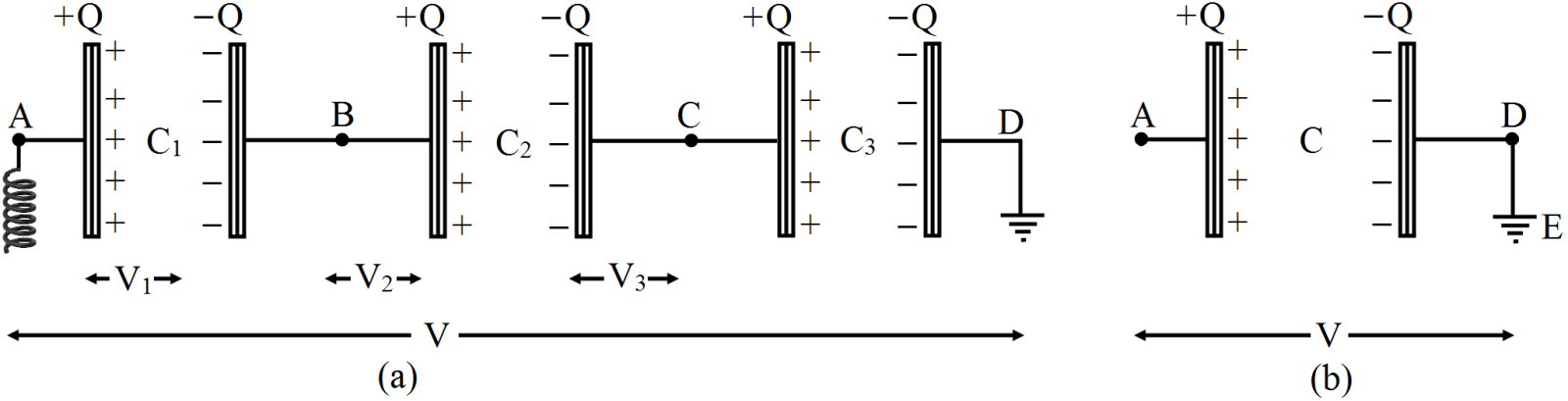
In fig. (a) Three capacitors of capacitances C1, C2, C3 are connected in series between points A and D.

In 'series’ first plate of each capacitor has charge +Q and second plate of each capacitor has charge -Q i.e., charge on each capacitor is Q.

Let the potential differences across the capacitors C1, C2, C3 be V1, V2, V3 respectively. As the second plate of first capacitor C1 and first plate of second capacitor C2 are connected together, their potentials are equal. Let this common potential be VB. Similarly the common potential of second plate of C2 and first plate of C3 is VC. The second plate of capacitor C3 is connected to earth, therefore its potential VD = 0. As charge flows from higher potential to lower potential, therefore VA > VB > VC > VD.

For the frist capacitor, $\text{V}_1=\text{V}_\text{A}-\text{V}_\text{B}=\frac{\text{Q}}{\text{C}_1}\ ...(\text{i)}$

For the second capacitor, $\text{V}_1=\text{V}_\text{B}-\text{V}_\text{C}=\frac{\text{Q}}{\text{C}_2}\ ...(\text{ii)}$

For the third capacitor, $\text{V}_3=\text{V}_\text{C}-\text{V}_\text{D}=\frac{\text{Q}}{\text{C}_3}\ ...(\text{iii)}$

Adding (i), (ii) and (iii), we get,

$\text{V}_1+\text{V}_2+\text{V}_3=\text{V}_\text{A}-\text{V}_\text{D}=\text{Q}\Big[\frac{1}{\text{C}_1}+\frac{1}{\text{C}_2}+\frac{1}{\text{C}_3}\Big]\ ...(\text{iv)}$

If V be the potential difference between A and D, then,

$\text{V}_\text{A}-\text{V}_\text{D}=\text{V}$

$\therefore$ From (iv), we get,

$\text{V}=\big(\text{V}_1+\text{V}_2+\text{V}_3=\text{Q}\Big[\frac{1}{\text{C}_1}+\frac{1}{\text{C}_2}+\frac{1}{\text{C}_3}\Big]\ ...(\text{v})$

If in place of all the three capacitors, only one capacitor is placed between A and D such that on giving it charge Q, the potential difference between its plates become V, then it will be called equivalent capacitor. If its capacitance is C, then,

$\text{V}=\frac{\text{Q}}{\text{C}}\ ...(\text{vi})$

Comparing (v) and (vi), we get,

$\frac{\text{Q}}{\text{C}}=\text{Q}\Big[\frac{1}{\text{C}_1}+\frac{1}{\text{C}_2}+\frac{1}{\text{C}_3}\Big]\ \text{Or}\ \frac{1}{\text{C}}=\frac{1}{\text{C}_1}+\frac{1}{\text{C}_2}+\frac{1}{\text{C}_3}$

Need a full question paper?

Generate a complete, print-ready paper with questions like this in minutes — across 16+ boards, with answer keys.
Start Generating Free

Similar questions

The wavelengths of $\text{K}_\alpha$ and $\text{L}_\alpha$ X-rays of a material are 21.3pm and 141pm respectively. Find the wavelength of $\text{K}_\beta$ X-ray of the material.
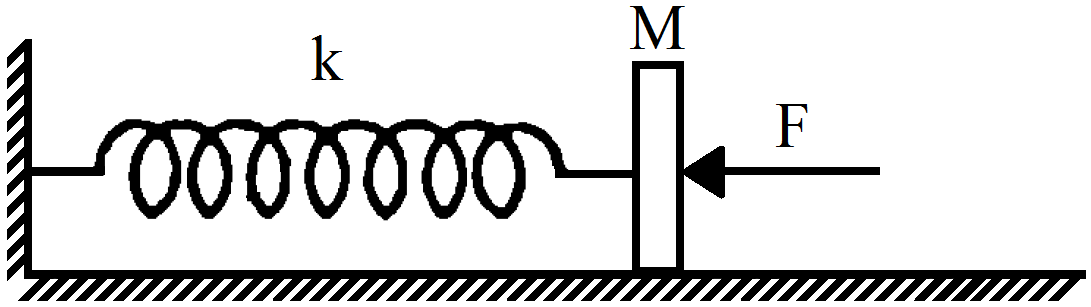
In figure k = 100N/m, M = 1kg and F = 10N,
  1. Find the compression of the spring in the equilibrium position.
  2. A sharp blow by some external agent imparts a speed of 2m/s to the block towards left. Find the sum of the potential energy of the spring and the kinetic energy of the block at this instant.
  3. Find the time period of the resulting simple harmonic motion.
  4. Find the amplitude.
  5. Write the potential energy of the spring when the block is at the left extreme.
  6. Write the potential energy of the spring when the block is at the right extreme.
The answers of (b), (e) and (f) are different. Explain why this does not violate the principle of conservation of energy.

  1. Draw the ray diagram of an astronomical telescope when the final image is formed at infinity. Write the expression for the resolving power of the telescope.
  2. An astronomical telescope has an objective lens of focal length 20m and eyepiece of focal length 1cm.
  1. Find the angular magnification of the telescope.
  2. If this telescope is used to view the Moon, find the diameter of the image formed by the objective lens. Given the diameter of the Moon is 3.5 × 10⁶m and radius of lunar orbit is 3.8 × 10⁸m.
A wave travels along the positive x-direction with a speed of 20m/s. The amplitude of the wave is 0.20cm and the wavelength 2.0cm.
  1. Write a suitable wave equation which describes this wave.
  2. What is the displacement and velocity of the particle at x = 2.0cm at time t = 0 according to the wave equation written? Can you get different values of this quantity if the wave equation is written in a different fashion?
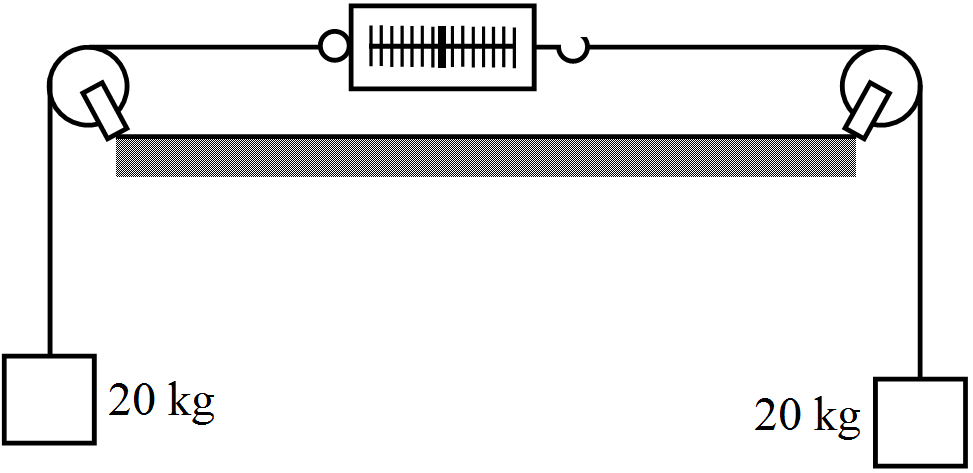
Figure shows a light spring balance connected to two blocks of mass 20kg each. The graduations in the balance measure the tension in the spring.
  1. What is the reading of the balance?
  2. Will the reading change if the balance is heavy, say 2.0kg?
  3. What will happen if the spring is light but the blocks have unequal masses?
​​​​​​​
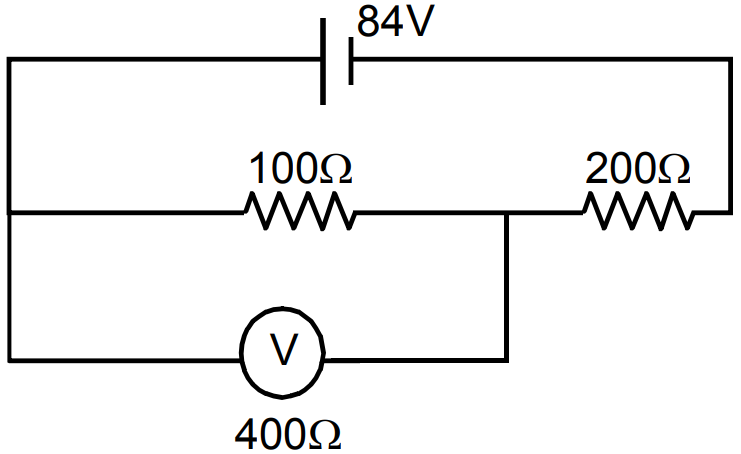
A voltmeter of resistance $400\Omega$ is used to measure the potential difference across the $100\Omega$ resistor in the circuit shown in the figure. (a) What will be the reading of the voltmeter? (b) What was the potential difference across $100\Omega$ before the voltmeter was connected?

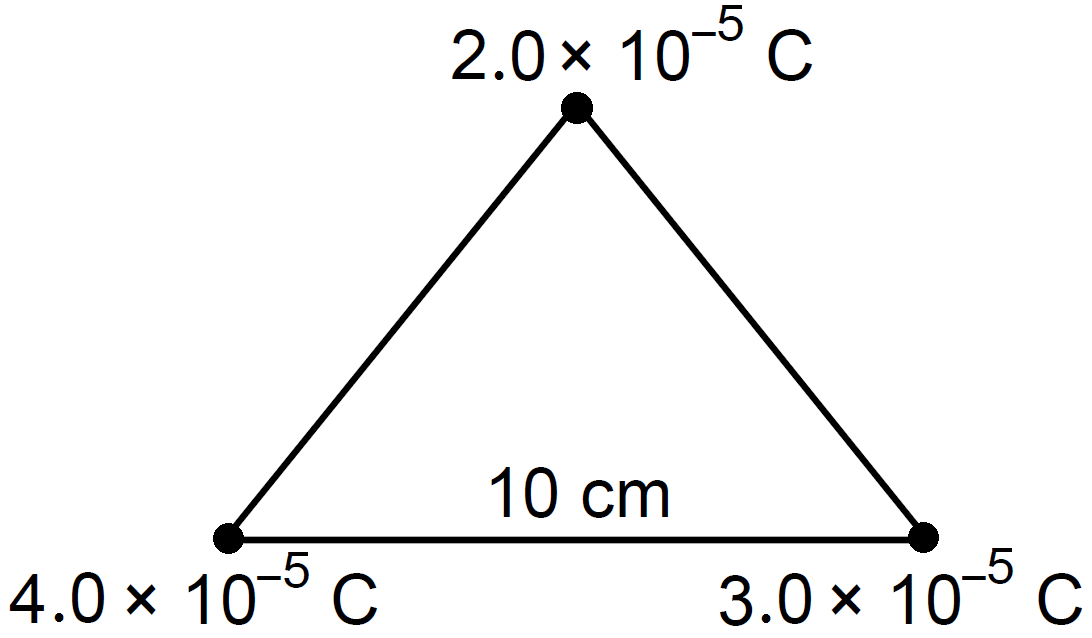
How much work has to be done in assembling three charged particles at the vertices of an equilateral triangle as shown in figure?

A 10g bullet with a charge of $4.00\mu\text{C}$ is fired at a speed of 270m/s-1 in a horizontal direction. A vertical magnetic field of $500\mu\text{T}$ exists in the space. Find the deflection of the bullet due to the magnetic field as it travels through 100m. Make appropriate approximations.
Calculate the increase in the internal energy of 10g of water when it is heated from 0°C to 100°C and converted into steam at 100kPa. The density of steam= 0.6kg/ m-3. Specific heat capacity of water = 4200J/ kg-1°C-1 and the Jatent heat of vaporization of water = 2.25 × 10⁶J/kg-1.
A coil of 0.01 henry inductance and 1ohm resistance is connected to 200volt, 50Hz ac supply. Find the impedance of the circuit and time lag between max. alternating voltage and current.