Question
Derive an expression for maximum work obtainable during isothermal reversible expansion of an ideal gas from initial volume $(V_1)$ to final volume $(V_2).$
Answer

Image
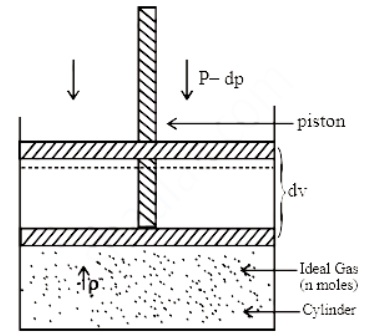
$1.$ Consider the expansion of $‘n \ ’$ moles of an ideal gas enclosed in a cylinder fitted with a weightless and frictionless piston at a constant temperature $T.$
$2.$ Let the pressure of the gas be $P$ which is equal to the external pressure.
$3.$ Let the external pressure be reduced by an infinitesimally small amount $dp$ so that the new external pressure becomes $(P-dp).$
$4.$ Let the corresponding small increase in volume by $dv.$
$5.$ Therefore amount of work done in the expansion of the gas, $dw = - [(p dp)dv] = -[pdv -dp.dv] ..(i)$
$6.$ Since $dp$ and $dv$ are very small, their product $(dp.dv)$ will be much smaller and can be neglected
$\therefore dw= -pdv ...(ii)$
$7.$ During expansion of the gas, if the initial volume $V_1$ changes to volume $V_2$ then total amount of work alone $(Wmax)$ can be obtained by integrating the work, $dw$ between the two limits, $V_1$ and $V_2.$
$ \therefore W_{\max }=\int_{v_2}^{v_1}-d w$
$=\int_{v_1}^{v_2}-p d v \ldots \text { (iii) } $
But $pv = nRT ($Ideal gas Equation for n moles of a gas$)$
$\therefore p=\frac{nRT}{v}$
Substitute pressure value in equation$ (iii)$
$\therefore W_{\max }=\int_{v_1}^{v_2}-\frac{nRT}{v} dv$
$=n R T \int_{v_1}^{v_2} \frac{d v}{v}(n, R, T$ are constatnt$)$
$=-n R T(\log v)_{v_1}^{v_2}$
$=-n R T \ln \frac{v_2}{v_1}$
$\therefore W_{\max }=-2.303 n R T \log \frac{v_2}{v_1}$
$\left(\ln =2.303 \log _{10}\right) \ldots( \text{iv} )$

Need a full question paper?

Generate a complete, print-ready paper with questions like this in minutes — across 16+ boards, with answer keys.
Start Generating Free