Question
Derive an expression for potential due to a dipole for distances large compared to the size of the dipole. How is the potential due to dipole different from that due to a single charge?
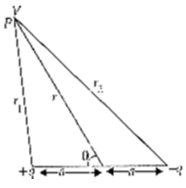
Image

Answer

Consider origin at the centre of dipole. As per superposition principle, potential due to dipole will be the sum of potentials due to charges $q$ and $-q$
$V=\frac{1}{4 \pi \varepsilon_0}\left[\frac{q}{r_1}-\frac{q}{r_2}\right]$
Where,
$r_1$ and $r_2=$ distances of point $P$ from $q$ and $-q$.
$ r_1^2=r^2+a^2-2 \operatorname{arcos} \theta $
$ r_2^2=r^2+a^2+2 \operatorname{arcos} \theta $
If r is greater than a, and taking terms upto first order in $a / r$
$ r _1^2= r ^2\left[1-\frac{2 a \cos \theta}{r}+\frac{a^2}{r^2}\right]$
$=r^2\left[1-\frac{2 a \cos \theta}{r}\right]$
Also, $r _2^2= r ^2\left[1+\frac{2 a \cos \theta}{r}\right]$
With the help of Binomial theorem, keeping terms upto first order is shown below:
$\frac{1}{r_1} \equiv \frac{1}{r}\left[1-\frac{2 a \cos \theta}{r}\right]^{\frac{1}{2}}$
$\equiv \frac{1}{r}\left[1+\frac{a}{r} \cos \theta\right]$
$\frac{1}{r_2} \equiv \frac{1}{r}\left[1+\frac{2 a \cos \theta}{r}\right]^{\frac{1}{2}}$
$\equiv \frac{1}{r}\left[1-\frac{a}{r} \cos \theta\right] $
As $p = qa$
$ V=\frac{1}{4 \pi \varepsilon_0} \frac{q(2 a) \cos \theta}{r^2}$
$V=\frac{p}{4 \pi \varepsilon_0} \cdot \frac{\cos \theta}{r^2} $
Now, $p \cos \theta=\vec{p} . \hat{r}$
Hence electric potential of dipole for distances large compared to size of dipole is given as below :
$ V=\frac{1}{4 \pi \varepsilon_0} \cdot \frac{\vec{p} \hat{r}}{r^2} \text { for } r \gg a$
For potential at any point on axis, $\theta=[0, \pi]$
$V= \pm \frac{1}{4 \pi \varepsilon_0} \cdot \frac{q}{r} $
potential is positive when $\theta=0$
potential is negative when $\theta=\pi$
Hence, electric potential falls at large distance, as $\frac{1}{r^2}$ and not as $\frac{1}{r}$
 

Need a full question paper?

Generate a complete, print-ready paper with questions like this in minutes — across 16+ boards, with answer keys.
Start Generating Free

Similar questions

A capacitance C, a resistance R and an emf $\in$ are connected in series at t = 0. What is the maximum value of (a) the potential difference across the resistor (b) the current in the circuit (c) the potential difference across the capacitor (d) the energy stored in the capacitor (e) the power delivered by the battery and (f) the power converted into heat?
A long wire carrying a current i is bent to form a plane angle $\alpha.$ Find the magnetic field B at a point on the bisector of this angle situated at a distance x from the vertex.
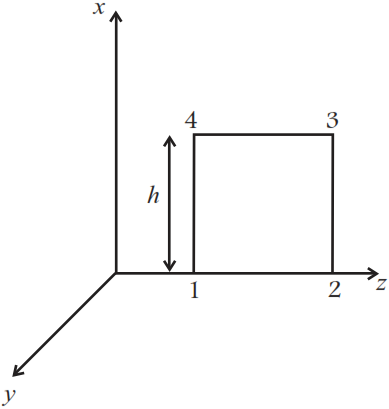
A plane EM wave travelling in vacuum along z direction is given by $\text{E}=\text{E}_0\sin(\text{kz}-\omega\text{t})\hat{\text{i}}\text{ and }\text{B}=\text{B}_0\sin(\text{kz}-\omega\text{t})\hat{\text{j}}$.
  1. Evaluate $\oint\text{E.dl}$ over the rectangular loop 1234 shown in Fig.
  2. Evaluate $\int\text{B.ds}$ over the surface bounded by loop 1234.
  3. Use equation $\oint\text{E.dl}=\frac{-\text{d}\phi_\text{B}}{\text{dt}}$ to prove $\frac{\text{E}_0}{\text{B}_0}=\text{c}$.
  4. By using similar process and the equation $\oint\text{B.dl}=\mu_0\text{I}+\in_0\frac{\text{d}\phi_\text{E}}{\text{dt}}$, prove that $\text{c}=\frac{1}{\sqrt{\mu_0\in_0}}$.
​​​​​​​
A capacitor of capacitance $10\mu\text{F}$ is connected to a battery of emf 2V. It is found that it takes 50ms for the charge of the capacitor to become $12.6\mu\text{C}.$ Find the resistance of the circuit.
Gautam went for a vacation to the village where his grandmother lived. His grandmother took him to watch ‘nautanki’ one evening. They noticed a blackbox connected to the mike lying nearby. Gautam’s grandmother did not know what that box was. When she asked this question to Gautam, he explained to her that it was an amplifier.
  1. Which values were displayed by the grandmother? How can inculcation of these values in students be promoted?
  2. What is the function of an amplifier?
  3. Which basic electronic device is used in the amplifier?
Consider $N = n_1n_2$ identical cells, each of emf $\in$ and internal resistance r. Suppose $n_1$ cells are joined in series to form a line and $n_2$ such lines are connected in parallel. The combination drives a current in an external resistance R. (a) Find the current in the external resistance. (b) Assuming that $n_1$ and $n_2$ can be continuously varied, find the relation between $n_1, n_2$, R and r for which the current in R is maximum.
A reference frame attached to the earth:
  1. Is an inertial frame by definition.
  2. Cannot be an inertial frame because the earth is revolving around the sun.
  3. Is an inertial frame because Newton's laws are applicable in this frame.
  4. Cannot be an inertial frame because the earth is rotating about its axis.
A cube of side b has a charge q at each of its vertices. Determine the potential and electric field due to this charge array at the centre of the cube.
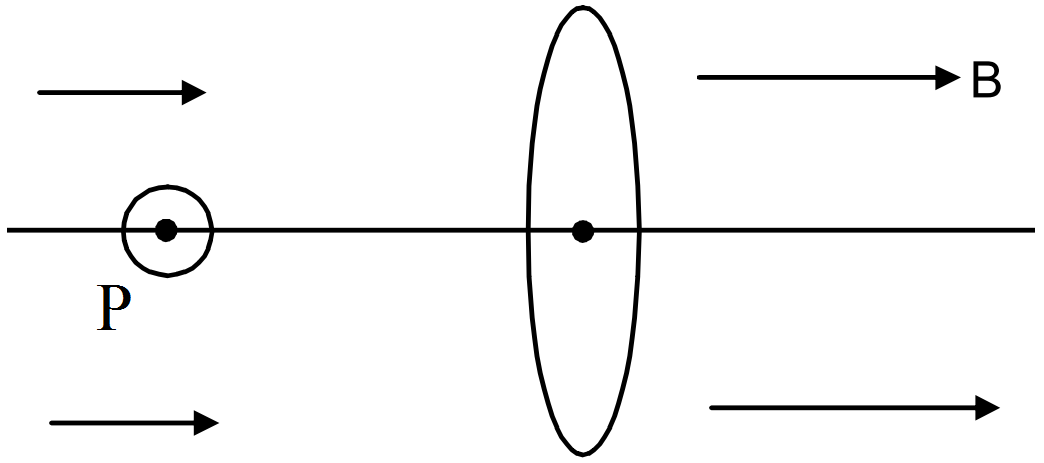
Shows a convex lens of focal length 12cm lying in a uniform magnetic field B of magnitude 1.2T parallel to its principal axis. A particle with charge $2.0 \times 10^{-3}C$ and mass $2.0 \times 10^{-5}$ kg is projected perpendicular to the plane of the diagram with a speed of $4.8 ms^{-1}$. The particle moves along a circle with its centre on the principal axis at a distance of 18cm from the lens. Show that the image of the particle moves along a circle and find the radius of that circle.
A card sheet divided into squares each of size $1\ mm^2$ is being viewed at a distance of 9 cm through a magnifying glass (a converging lens of focal length 9 cm) held close to the eye.
  1. What is the magnification produced by the lens? How much is the area of each square in the virtual image?
  2. What is the angular magnification (magnifying power) of the lens?
  3. Is the magnification in (a) equal to the magnifying power in (b)? Explain.