Question
Derive an expression for pressure exerted by a liquid column.

Answer

Get the step-by-step solution for this question inside the Vidyadip app.

Get the answer in the app

Need a full question paper?

Generate a complete, print-ready paper with questions like this in minutes — across 16+ boards, with answer keys.
Start Generating Free

Similar questions

Write the differential equation of motion for an oscillator in the presence of a damping force directly proportional to the velocity. Under what condition is the motion oscillatory? Hence, discuss the frequency, amplitude and energy of the damped oscillations.
OR
Oscillations in the presence of a force proportional to the velocity are periodic but not simple harmonic. Explain.
OR
The presence of a damping force changes the character of a simple harmonic motion. Explain this qualitatively.
Obtain the expression for the resonant frequency of the LCR series circuit and explain electrical resonance in an LCR series circuit.
With a neat labelled energy flow diagram, explain the working of a refrigerator.
Prove that an ideal capacitor in an AC circuit does not dissipate power
State the characteristics of stationary waves.
A galvanometer of resistance $50 \Omega$ has a current sensitivity of $5 div / mA$. The instrument has $25$ divisions. How will you convert it into a voltmeter of range $0-50 V$ ?
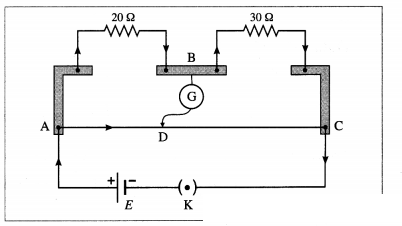
Two resistances, $20 \Omega$ and $30 \Omega$, are connected across the two gaps of a metre bridge as shown in the following figure.
Image
The bridge wire has diameter $0.5\ mm$ and resistance $2 \Omega$. The emf of the cell is $2 V$. Assume that the internal resistance of the cell is zero. Calculate $(I)$ the resistivity $($specific resistance$)$ of the material of the bridge wire $(ii)$ the current provided by the cell when the bridge is balanced.
Express the ideal gas equation in terms of the density of the gas.
Obtain an expression for the self inductance of a solenoid.
Explain the origin of magnetism in material, hence find a magnetic moment of an electron revolving around the nucleus of an atom.