Question
Derive an expression for the difference in tensions at the highest and lowest point for a particle performing the vertical circular motion.
Answer

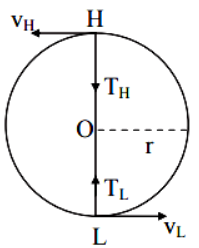
i. Suppose a body of mass 'm' performs V.C.M on a circle of radius $r$ as shown in the figure.
Image
ii. Let,
$T _{ L }=$ tension at the lowest point
$T _{ H }=$ tension at the highest point
$V_L=$ velocity at the lowest point
$v_H=$ velocity at the highest point
iii. At lowest point $L$,
$T _{ L }=\frac{ mv _{ L }^2}{ r }+ mg$
At highest point $H _{\text {, }}$
$T _{ H }=\frac{ mv _{ H }^2}{ r }- mg$
iv. Subtracting (1) by (2),
$ T _{ L }- T _{ H }=\frac{ mv _{ L }^2}{ r }+ mg -\left(\frac{ mv _{ H }^2}{ r }- mg \right)$
$=\frac{ m }{ r }\left( v _{ L }^2- v _{ H }^2\right)+2 mg$
$\therefore T _{ L }- T _{ H }=\frac{ m }{ r }\left( v _{ L }^2- v _{ H }^2\right)+2 mg \ldots \ldots \ldots . .(3) $
$v$. By law of conservation of energy,
$ ( P . E + K . E ) \text { at } L =( P . E + K . E ) \text { at } H$
$\therefore 0+\frac{1}{2} mv _{ L }^2= mg \cdot 2 r +\frac{1}{2} mv _{ H }^2$
$\therefore \frac{1}{2} m \left( v _{ L }^2- v _{ H }^2\right)= mg \cdot 2 r$
$\therefore v _{ L }^2- v _{ H }^2=4 gr \ldots \ldots . .(4) $
vi. From equation (3) and (4),
$ T _{ L }- T _H=\frac{ m }{ r }(4 gr )+2 mg =4 mg +2 mg$
$\therefore T _{ L }- T _{ H }=6 mg $

Need a full question paper?

Generate a complete, print-ready paper with questions like this in minutes — across 16+ boards, with answer keys.

Start Generating Free

Similar questions

When two kilocalories of heat are supplied to a system, the internal energy of the system increases by $5030 \mathrm{~J}$ and the work done by the gas against the external pressure is $3350 \mathrm{~J}$. Calculate J, the mechanical equivalent of heat.
The diameters of two pistons in a hydraulic press are $5 \mathrm{~cm}$ and $25 \mathrm{~cm}$ respectively. A force of $20 \mathrm{~N}$ is applied to the smaller piston. Find the force exerted on the larger piston.
Calculate the force required to move a flat glass plate of area of $10 \mathrm{~cm}^2$ with a uniform velocity of $1 \mathrm{~cm} / \mathrm{s}$ over the surface of a liquid $2 \mathrm{~mm}$ thick, if the coefficient of viscosity of the liquid is 2 Pa.s.
What should be the tension applied to a wire of length $1 m$ and mass $10 grams$, if it has to vibrate with the fundamental frequency of $50 Hz$ ?
What is a thermodynamic process ? Explain.
What are the steps through which a refrigerant goes in one complete cycle of refrigeration?
In Young's double$-$slit experiment, the ratio of the intensities of the maxima and minima in an interference pattern is $36: 9$. What is the ratio of the intensities of the two interfering waves?
Show that for radioactive decay $N ( t )= N _{ O } e ^{-\lambda t }$, where symbols have their usual meaning.
Find the dimensions of the coefficient of viscosity. State its SI and CGS units.
Draw a well labelled diagram of photoelectric cell. Explain the observations made by Hertz and Lenard about the phenomenon of photoelectric emission.