Maharashtra BoardEnglish MediumSTD 12 SciencePhysicsQuestion Bank [ 2022 ]4 Marks
Question
Derive an expression for the electric potential due to an electric dipole.
✓
Answer
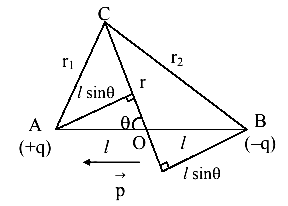
i. Consider an electric dipole. Let origin be at the centre of the dipole as shown in the figure below.
Electric potential due to an electric Dipole
ii. Let $C$ be any point near the electric dipole at a distance $r$ from the centre $O$ inclined at an angle $\theta$ with the axis of the dipole.
Let $r_1$ and $r_2$ be the distances of point $C$ from charges $+q$ and $-q$, respectively.
iii. Potential at $C$ due to charge $+q$ at $A$ is,
$V _1=\frac{+ q }{4 \pi \varepsilon_0 r _1}$
Potential at $C$ due to charge $-q$ at $B$ is,
$V _2=\frac{- q }{4 \pi \varepsilon_0 r _2}$
iv. The potential at $C$ due to the dipole is,
$V _{ C }= V _1+ V _2=\frac{ q }{4 \pi \varepsilon_0}\left[\frac{1}{ r _1}-\frac{1}{ r _2}\right]$
v. By geometry,
$ r_1^2=r^2+l^2-2 r l \cos \theta$
$r_2^2=r^2+l^2+2 r l \cos \theta$
$r_1^2=r^2\left(1+\frac{l^2}{r^2}-2 \frac{1}{r} \cos \theta\right)$
$r_2^2=r^2\left(1+\frac{l^2}{r^2}+2 \frac{1}{r} \cos \theta\right) $
For a short dipole, $2 I \ll r$ and
If $r>>$; $\frac{1}{r}$ is small
$\therefore \frac{ l ^2}{ r ^2}$ can be neglected
$\therefore r _1^2= r ^2\left(1-2 \frac{ l }{ r } \cos \theta\right)$
$r _2^2= r ^2\left(1+\frac{2 l }{ r } \cos \theta\right)$
$\therefore r _1= r \left(1-\frac{2 l}{ r } \cos \theta\right)^{\frac{1}{2}}$
$\therefore r _2= r \left(1+\frac{2 l}{ r } \cos \theta\right)^{\frac{1}{2}}$
$\therefore \frac{1}{ r _1}=\frac{1}{ r }\left(1-\frac{2 l}{ r } \cos \theta\right)^{\frac{-1}{2}}$ and
$\frac{1}{ r _2}=\frac{1}{ r }\left(1+\frac{2 l}{ r } \cos \theta\right)^{\frac{-1}{2}}$
vi. Using equations (1) and (2),
$ V _{ C }= V _1+ V _2$
$=\frac{ q }{4 \pi \varepsilon_0}\left[\frac{1}{ r }\left(1-\frac{2 l \cos \theta}{ r }\right)^{\frac{-1}{2}}-\frac{1}{ r }\left(1+\frac{2 l \cos \theta}{ r }\right)^{\frac{-1}{2}}\right] $
iii. Using binomial expansion, $(1+ x )^{ n }=1+ nx , x <<$ I and retaining terms up to the first order of $\frac{l}{r}$ only, we get
$ V _{ C }=\frac{ q }{4 \pi \varepsilon_0} \frac{1}{ r }\left[\left(1+\frac{l}{ r } \cos \theta\right)-\left(1-\frac{l}{ r } \cos \theta\right)\right]$
$=\frac{ q }{4 \pi \varepsilon_0 r }\left[1+\frac{l}{ r } \cos \theta-1+\frac{l}{ r } \cos \theta\right]$
$=\frac{ q }{4 \pi \varepsilon_0 r }\left[\frac{2 l }{ r } \cos \theta\right]$
$\therefore V _{ C }=\frac{1}{4 \pi \varepsilon_0} \frac{ p \cos \theta}{ r ^2} \ldots \ldots .(\because p = q \times 2 l ) $
viii. Electric potential at $C$, can also be expressed as,
$ V _{ C }=\frac{1}{4 \pi \varepsilon_0} \frac{\overrightarrow{ p } \cdot \overrightarrow{ r }}{ r ^3}$
$V _{ C }=\frac{1}{4 \pi \varepsilon_0} \frac{\overrightarrow{ p } \cdot \hat{ r }}{ r ^2},\left(\hat{ r }=\frac{\overrightarrow{ r }}{ r }\right) \ldots \ldots \ldots\left(\hat{ r }=\frac{\overrightarrow{ r }}{ r }\right) $
where $\hat{ r }$ is a unit vector along the position vector $\overrightarrow{ OC }=\hat{ r }$
Need a full question paper?
Generate a complete, print-ready paper with questions like this in minutes — across 16+ boards, with answer keys.