Question
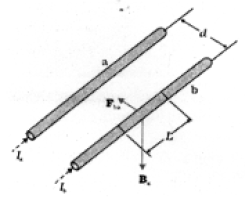
  1. Derive an expression for the force between two long parallel current carrying conductors.
  2. Use this expression to define $S.I.$ unit of current.
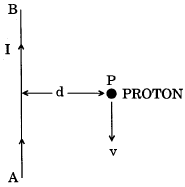
  3. $A$ long straight wire $AB$ carries a current $I. A$ proton $P$ travels with a speed $v,$ parallel to the wire, at a distance $d$ from it in a direction opposite to the current as shown in the figure. What is the force experienced by the proton and what is its direction?
Answer

  1.  

Two long parallel conductors $'a\ '$ and $'b\ '$ are separated by $a$ distance $d$ and carry $($parallel$)$ currents $I_a$ and $I_b,$ respectively.
The conductor $'a\ '$ produces, the same magnetic field $B_a$ at all points along the conductor $'b\ ' .$
$\text{B}_{a} = \frac{\mu_{0}\text{I}_{a}}{2\pi\text{d}}$
$F_{ba},$ is the force on a segment $L$ of $'b\ '$ due to $'a\ '.$
The magnitude of this force is given by
$F_{ba}= I_b LB_a$
$=\frac{\mu_{0}\text{I}_{a}\text{I}_{b}}{2\pi\text{d}}\text{L}$
  1. The ampere is the value of that steady current which, when maintained in each of the two very long, straight, parallel conductors of negligible cross $-$ section, and placed one metre apart in vacuum, would produce on each of these conductors a force equal to $2 \times 10^{–7}$ newton per metre of length.
  2. Magnetic field due to the straight wire $AB$ at a perpendicular distance $d$ from it.
$\text{B} = \frac{\mu_{0}\text{I}}{2\pi\text{d}}$
Therefore, force on proton moving with velocity $'v\ '$ perpendicular to $B,$  is
$\text{f} = \text{qvB} = \frac{\mu_{0}\text{Iqv}}{2\pi\text{d}}$
Direction: Towards right.

Need a full question paper?

Generate a complete, print-ready paper with questions like this in minutes — across 16+ boards, with answer keys.

Start Generating Free

Similar questions

Doubly$-$ionised helium ions are projected with a speed of $10\ km/s^{-1}$ in a direction perpendicular to a uniform magnetic field of magnitude $1.0T.$ Find
  1. The force acting on an ion.
  2. The radius of the circle in which it circulates.
  3. The time taken by an ion to complete the circle.
Consider the situation shown in figure $(17-E6)$. The two slits $S_1$ and $S_2\ p$ laced symmetrically around the central line are illuminated by a monochromatic light of wavelength $\lambda.$ The separation between the slits is $d$. The light transmitted by the slits falls on a screen $E_1$ placed at a distance $D$ from the slits. The slit $S_3$ is at the central line and the slit $S_4$ is at a distance $z$ from $S_3$. Another
screen $\sum_2$ is placed a further distance $D$ away from $\sum_1$. Find the ratio of the maximum to minimum intensity observed on $\sum_2$, if z is equal to,
  1. $\text{z}=\frac{\lambda\text{D}}{2\text{d}}$
  2. $\frac{\lambda\text{D}}{\text{d}}$
  3. $\frac{\lambda\text{D}}{4\text{d}}$
The angle between the resultant contact force and the normal force exerted by a body on the other is called the angle of friction. Show that, if $\lambda$ be the angle of friction and la the coefficient of static friction, $\lambda\leq\tan^{-1}\mu.$
Find the charge required to flow through an electrolyte to liberate one atom of.
  1. A monovalent material.
  2. A divalent material.
Monochromatic light of wavelength $632.8 \ nm$ is produced by a helium $-$ neon laser. The power emitted is $9.42 mW$.
  1. Find the energy and momentum of each photon in the light beam,
  2. How many photons per second, on the average, arrive at a target irradiated by this beam? $($Assume the beam to have uniform cross $-$ section which is less than the target area$),$ and
  3. How fast does a hydrogen atom have to travel in order to have the same momentum as that of the photon?
Figure shows a small body of mass m placed over a larger mass $M$ whose surface is horizontal near the smaller mass and gradually curves to become vertical. The smaller mass is pushed on the longer one at a speed $v$ and the system is left to itself. Assume that all the surfaces are frictionless.
  1. Find the speed of the larger block when the smaller block is sliding on the vertical part.
  2. Find the speed of the smaller mass when it breaks off the larger mass at height h.
  3. Find the maximum height $($from the ground$)$ that the smaller mass ascends.
  4. Show that the smaller mass will again land on the bigger one. Find the distance traversed by the bigger block during the time when the smaller block was in its flight under gravity.
In Young’s double $-$ slit experiment using monochromatic light of wavelength $\lambda ,$ the intensity of light at a point on the screen where path difference is $\lambda ,$ is $K$ units. What is the intensity of light at a point where path difference is $\lambda /3$?
A ball is kept at a height h above the surface of a heavy transparent sphere made of a material of refractive index $\mu.$ The radius of the sphere is R. At t = 0, the ball is dropped to fall normally on the sphere. Find the speed of the image formed as a function of time for $\text{t}<\sqrt{\frac{2\text{h}}{\text{g}}}.$ Consider only the image by a single refraction.
A box weighing 2000N is to be slowly slid through 20m on a straight track having friction coefficient 0.2 with the box.
  1. Find the work done by the person pulling the box with a chain at an angle $\theta $ with the horizontal.
  2. Find the work when the person has chosen a value of $\theta $ which ensures him the minimum magnitude of the force.
A short object of length $L$ is placed along the principal axis of a concave mirror away from focus. The object distance is u. If the mirror has a focal length $f,$ what will be the length of the image? You may take $L < < |v - f|.$