-
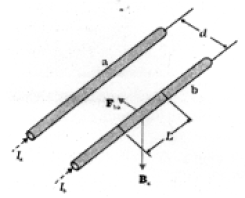
Two long parallel conductors ‘a’ and ‘b’ are separated by a distance d and carry (parallel) currents Ia and Ib, respectively. The conductor ‘a’ produces, the same magnetic field Ba at all points along the conductor ‘b’.
$\text{B}_{a} = \frac{\mu_{0}\text{I}_{a}}{2\pi\text{d}}$
Fba, is the force on a segment L of ‘b’ due to ‘a’. The magnitude of this force is given by
Fba = Ib LBa
$=\frac{\mu_{0}\text{I}_{a}\text{I}_{b}}{2\pi\text{d}}\text{L}$
- The ampere is the value of that steady current which, when maintained in each of the two very long, straight, parallel conductors of negligible cross-section, and placed one metre apart in vacuum, would produce on each of these conductors a force equal to 2 × 10⁻⁷ newton per metre of length.
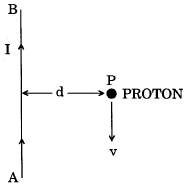
- Magnetic field due to the straight wire AB at a perpendicular distance d from it.
$\text{B} = \frac{\mu_{0}\text{I}}{2\pi\text{d}}$
Therefore, force on proton moving with velocity ‘v’ perpendicular to B, is
$\text{f} = \text{qvB} = \frac{\mu_{0}\text{Iqv}}{2\pi\text{d}}$
Direction: Towards right.