Question
Derive an expression for the force experienced by a current carrying straight conductor placed in a magnetic field. Under what condition is this force maximum?
Answer

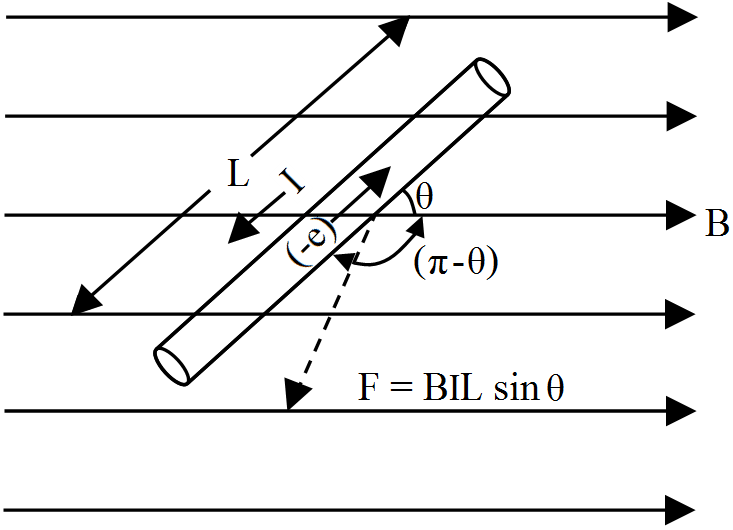
Force on a current carrying conductor on the basis of force on a moving charge: Consider a metallic conductor of length L, cross-sectional area A placed in a uniform magnetic field B and its length makes an angle $\theta$ with the direction of magnetic field B. The current in the conductor is I.

According to free electron model of metals, the current in a metal is due to the motion of free electrons. When a conductor is placed in a magnetic field, the magnetic field exerts a force on every free-electron. The sum of forces acting on all electrons is the net force acting on the conductor. If vd is the drift velocity of free electrons, then

Current $\text{I}=\text{neAv}_\text{d}\ \ .....(\text{i})$

Where n is number of free electrons per unit volume.

Magnetic force on each electron $=\text{ev}_\text{d}\text{B}\sin\theta\ \ .....(\text{ii}) $

Its direction is perpendicular to both $\overrightarrow{\text{vd}}$ and $\vec{\text{B}}$

Volume of conductor V = AL

Therefore, the total number of free electrons in the conductor = nAL

Net magnetic force on each conductor

F = (force on one electron) × (number of electrons)

$=\text{ev}_\text{d}\text{B}\sin\theta.(\text{nAL})=(\text{neAv}_\text{d}).\text{BL}\sin\theta$  $$

Using equation (i) $\text{F}=\text{IBL}\sin\theta$$$ ...(iii)

$\therefore\text{F}=\text{IBL}\sin\theta$

This is the general formula for the force acting on a current carrying conductor.

In vector form $\vec{\text{F}}=\text{I}\vec{L}\times\vec{\text{B}}$

Force will be maximum when $\sin\theta=1$ or $\theta=90^\circ$. That is when length of conductor is perpendicular to magnetic field.

Need a full question paper?

Generate a complete, print-ready paper with questions like this in minutes — across 16+ boards, with answer keys.

Start Generating Free

Similar questions

In a Young's double slit experiment using monochromatic light, the fringe pattern shifts by a certain distance on the screen when a mica sheet of refractive index 1.6 and thickness 1.964 micron (1 micron = 10-6m) is introduced in the path of one of the interfering waves. The mica sheet is then removed and the distance between the screen and the slits is doubled. It is found that the distance between the successive maxima now is the same as the observed fringe-shift upon the introduction of the mica sheet. Calculate the wavelength of the monochromatic light used in the experiment.
The equation of a wave travelling on a string stretched along the X-axis is given by-

$\text{y}=\text{A}\text{e}^{-\Big(\frac{\text{x}}{\text{a}}+\frac{\text{t}}{\text{T}}\Big)^2}.$
  1. Write the dimensions of A, a and T.
  2. Find the wave speed.
  3. In which direction is the wave. travelling?
  4. Where is the maximum of the pulse located at t = T? at t = 2T?
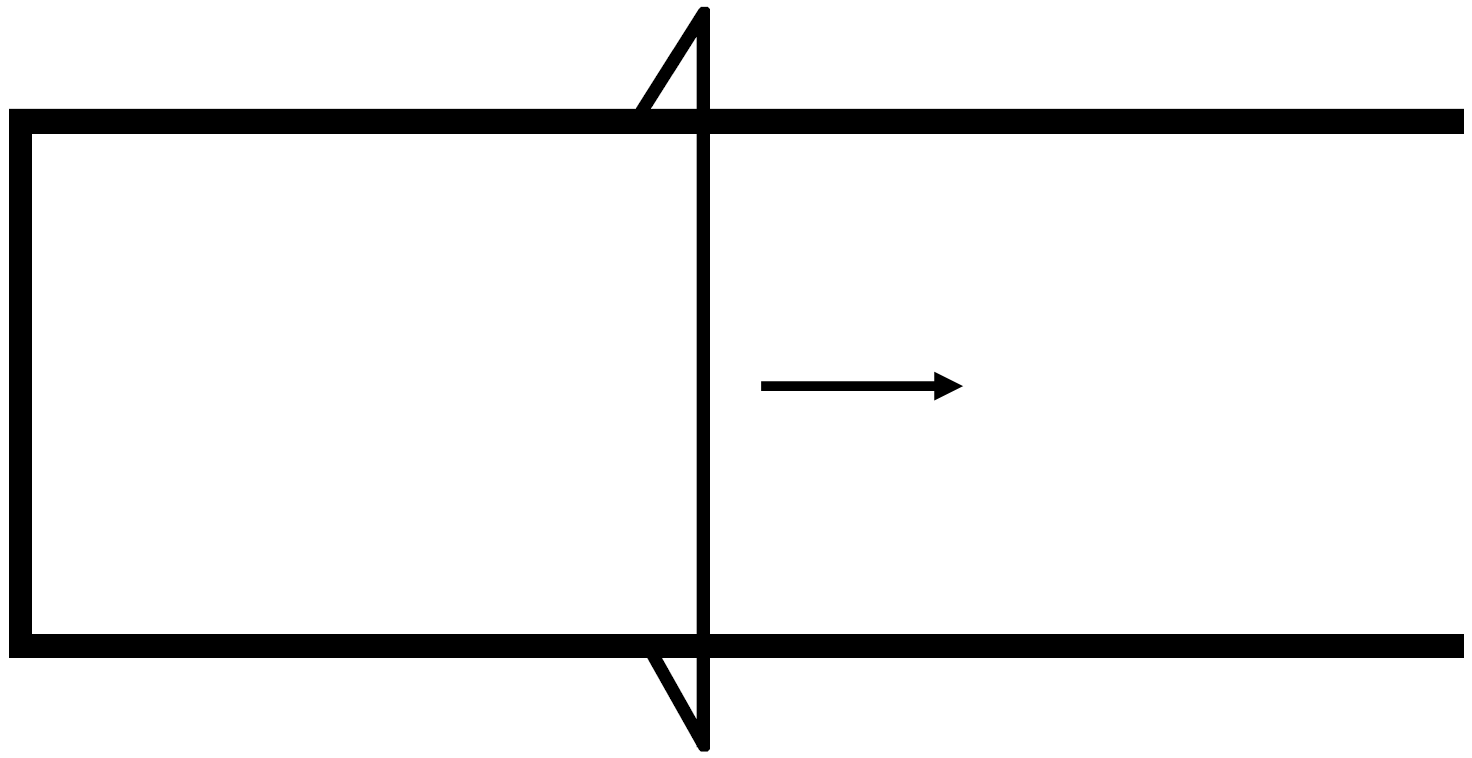
Figure shows a metallic wire of resistance $0.20\Omega$ sliding on a horizontal, U-shaped metallic rail. The separation between the parallel arms is 20cm. An electric current of $2.0\mu\text{A}$ passes through the wire when it is slid at a rate of 20cms-1. If the horizontal component of the earth's magnetic field is 3.0 × 10⁻⁵ T, calculate the dip at the place.

If the radius of the earth decreases by 1% without changing its mass, will the acceleration due to gravity at the surface of the earth increase or decrease? If so, by what per cent?
Prove that the value of energy stored in a capacitor is $\frac{1 Q^2}{2 C}$ and the energy density of the electric field is $u=\frac{1}{2} \in_0 E ^2$.
A person with a normal near point (25 cm) using a compound microscope with objective of focal length 8.0 mm and an eyepiece of focal length 2.5 cm can bring an object placed at 9.0 mm from the objective in sharp focus. What is the separation between the two lenses? Calculate the magnifying power of the microscope.
 An electric kettle used to prepare tea, takes 2 minutes to boil 4 cups of water (1 cup contains 200cc of water) if the room temperature is 25C.
  1. If the cost of power consumption is Rs. 1.00 per unit (1 unit - 1000 watt-hour), calculate the cost of boiling 4 cups of water.
  2. What will be the corresponding cost if the room temperature drops to 5°C?
A particle is found to be at rest when seen from a frame S1 and moving with constant velocity when seen from another frame S2. Mark out the possible options:
  1. Both the frames are inertial.
  2. Both the frames are non-inertial.
  3. S1 is inertial and S2 is non-inertial.
  4. S1 is non-inertial and S2 is inertial.
The amount of charge that passes in time t through a cross-section of a wire is,
Q(t) = At2 + Bt + C.
  1. Write the dimensional formulae for A, B and C.
  2. If the numerical values of A, B and C are 5, 3 and 1, respectively, in S.I units, find the value of the current at t = 5s.
(a) Obtain an expression for current flowing through an ideal inductor joined with an ac source of voltage $v=v_0 \sin \omega t$ by using phasor diagram. Draw a graph between (i) voltage applied and (ii) current as a function of (wt.).
(b) Obtain an expression for average power dissipation in any series LCR circuit.