Question
Derive an expression for the force experienced by a current carrying straight conductor placed in a magnetic field. Under what condition is this force maximum?
Answer

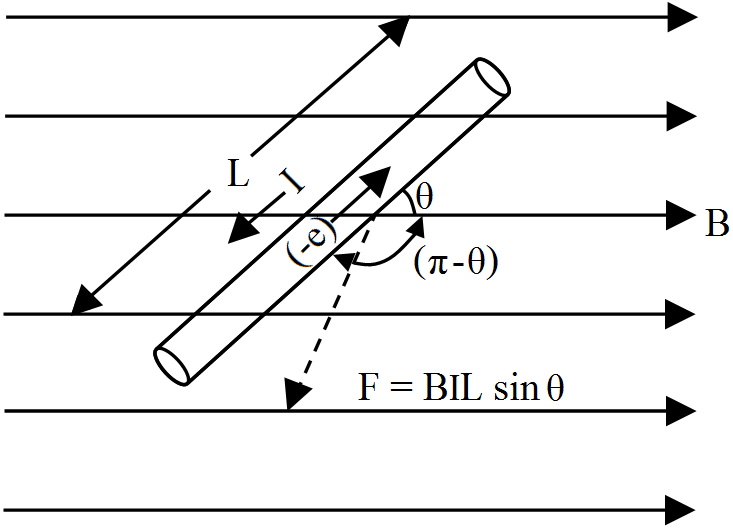
Force on a current carrying conductor on the basis of force on a moving charge: Consider a metallic conductor of length L, cross-sectional area A placed in a uniform magnetic field B and its length makes an angle $\theta$ with the direction of magnetic field B. The current in the conductor is I.

According to free electron model of metals, the current in a metal is due to the motion of free electrons. When a conductor is placed in a magnetic field, the magnetic field exerts a force on every free-electron. The sum of forces acting on all electrons is the net force acting on the conductor. If vd is the drift velocity of free electrons, then

Current $\text{I}=\text{neAv}_\text{d}\ \ .....(\text{i})$

Where n is number of free electrons per unit volume.

Magnetic force on each electron $=\text{ev}_\text{d}\text{B}\sin\theta\ \ .....(\text{ii}) $

Its direction is perpendicular to both $\overrightarrow{\text{vd}}$ and $\vec{\text{B}}$

Volume of conductor V = AL

Therefore, the total number of free electrons in the conductor = nAL

Net magnetic force on each conductor

F = (force on one electron) × (number of electrons)

$=\text{ev}_\text{d}\text{B}\sin\theta.(\text{nAL})=(\text{neAv}_\text{d}).\text{BL}\sin\theta$  $$

Using equation (i) $\text{F}=\text{IBL}\sin\theta$$$ ...(iii)

$\therefore\text{F}=\text{IBL}\sin\theta$

This is the general formula for the force acting on a current carrying conductor.

In vector form $\vec{\text{F}}=\text{I}\vec{L}\times\vec{\text{B}}$

Force will be maximum when $\sin\theta=1$ or $\theta=90^\circ$. That is when length of conductor is perpendicular to magnetic field.

Need a full question paper?

Generate a complete, print-ready paper with questions like this in minutes — across 16+ boards, with answer keys.

Start Generating Free

Similar questions

The terminology of different parts of the electromagnetic spectrum is given in the text. Use the formula E = hν (for energy of a quantum of radiation: photon) and obtain the photon energy in units of eV for different parts of the electromagnetic spectrum. In what way are the different scales of photon energies that you obtain related to the sources of electromagnetic radiation?
What is Gauss theorem? With its help, obtain an expression for the electric field intensity at any point near a uniformly charged linear conductor of infinite length.###Make the necessary diagram and with the help of Gauss law, calculate the electric field intensity at any point due to a charged wire of infinite length. Plot the change in intensity with distance.###Define Gauss' law. With its help, find the value of electric field intensity at a distance from a uniformly charged linear conductor of infinite extension. Make the necessary diagram and also make a graph of the change of electric field with distance.
Explain the principle of superposition in terms of position vectors of charges.
An electron makes 3 × 10⁵ revolutions per second in a circle of radius 0.5 angstrom. Find the magnetic field B at the centre of the circle.
The conduction band of a solid is partially filled at 0K. Will it be a conductor, a semiconductor or an insulator?
  1. Using the Bohr’s model calculate the speed of the electron in a hydrogen atom in the n = 1, 2, and 3 levels.
  2. Calculate the orbital period in each of these levels.
A 4µF capacitor is charged by a 200V supply. It is then disconnected from the supply, and is connected to another uncharged 2µF capacitor. How much electrostatic energy of the first capacitor is lost in the form of heat and electromagnetic radiation?
Let $\text{X}=\overline{\text{ABC}}+\overline{\text{BCA}}+\overline{\text{CAB}}.$ Evaluate X for:
  1. $\text{A}=1,\text{B}=0,\text{C}=1$
  2. $\text{A}=\text{B}=\text{C}=1$
  3. $\text{A}=\text{B}=\text{C}=0$
An object is placed infront of a concave mirror of radius of curvature 15 cm at a distance of (i) 10 cm and (ii) 5 cm from the mirror. Calculate the position, nature and magnification of the image in each case.
A block of mass 2.0kg kept at rest on an inclined plane of inclination 37° is pulled up the plane by applying a constant force of 20N parallel to the incline. The force acts for one second.
  1. Show that the work done by the applied force does not exceed 40J.
  2. Find the work done by the force of gravity in that one second if the work done by the applied force is 40J.
  3. Find the kinetic energy of the block at the instant the force ceases to act. Take g = 10m/s2.