Question
Derive an expression for the magnetic field due to a bar magnet at an arbitrary point.

Answer

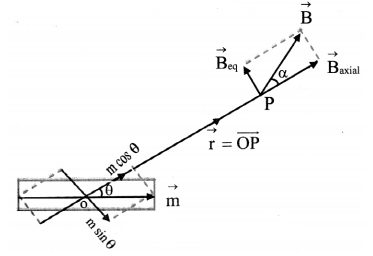
i. Consider a bar magnet of magnetic moment $\vec{m}$ with centre at $O$ as shown in figure and let $P$ be any point in its magnetic field.

Image

ii. Magnetic moment $\vec{m}$ is resolved into components along $\vec{r}$ and perpendicular to $\vec{r}$.
iii. For the component $m \cos \theta$ along $\vec{r}$, the point P is an axial point.
iv. For the component $m \sin \theta$ perpendicular to $\vec{r}$, the point P is an equatorial point at the same distance $\vec{r}$.
v. For a point on the axis, $B _{ a }=\frac{\mu_0}{4 \pi} \frac{2 m}{ r ^3}$
Here
$B _{ a }=\frac{\mu_0}{4 \pi} \frac{2 m \cos \theta}{r^3}$
directed along $m \cos \theta$.
vi. For point on equator,
$B _{ a }=\frac{\mu_o}{4 \pi} \frac{m \sin \theta}{r^3}$
directed opposite to $m \sin \theta$
vii. Thus, the magnitude of the resultant magnetic field $B$, at point $P$ is given by
$\begin{aligned}
& B & =\sqrt{B_a^2+B_{e q}^2} \\
\therefore & B & =\sqrt{\left(\frac{\mu_0}{4 \pi} \frac{2 m \cos \theta}{r^3}\right)^2+\left(\frac{\mu_0}{4 \pi} \frac{ m \sin \theta}{r^3}\right)^2} \\
\therefore & B & =\frac{\mu_o}{4 \pi} \frac{ m }{ r ^3} \sqrt{(2 \cos \theta)^2+(\sin \theta)^2} \\
\therefore & B & =\frac{\mu_o}{4 \pi} \frac{ m }{ r ^3} \sqrt{3 \cos ^2 \theta+1}
\end{aligned}$
viii. Let a be the angle made by the direction of $\vec{B}$ with $\vec{r}$. Then, by using equation (1) and equation (2),
$\tan \alpha=\frac{B_{\text {eq }}}{B_a}=\frac{1}{2}(\tan \theta)$
The angle between directions of $\vec{B}$ and $\vec{m}$ is then $(\theta+ a )$.

Need a full question paper?

Generate a complete, print-ready paper with questions like this in minutes — across 16+ boards, with answer keys.

Start Generating Free

Similar questions

A liquid drop of $1.00 g$ falls from height of cliff $1.00 \ km.$ It hits the ground with a speed of $50 \ m s^{-1}.$ What is the work done by the unknown force? $($Take $g = 9.8 \ m/s^2)$
Explain concept of charging by induction.
Activity to understand the dependence of boiling point on pressure:
Take a round bottom flask, more than half filled with water. Keep it over a burner and fix a thermometer and steam outlet through the cork of the flask as shown in figure. As water in the flask gets heated, note that first the air, which was dissolved in the water comes out as small bubbles. Later bubbles of steam form at the bottom but as they rise to the cooler water near the top, they condense and disappear. Finally, as the temperature of the entire mass of the water reaches 100 oc, bubbles of steam reach the surface and boiling is said to occur. The steam in the flask may not be visible hut as it comes out of the flask, It condenses as tiny droplets of water giving a foggy appearance.
Image
If now the steam outlet is closed for a few seconds to increase the pressure in the flask, you will notice that boiling stops. More heat would be required to raise the temperature (depending on the increase in pressure) before boiling starts again. Thus, boiling point increases with increase in pressure. Let us now remove the burner. Allow water to cool to about 80°C. Remove the thermometers and steam outlet. Close the flask with a air tight cork. Keep the flask turned upside down on a stand. Pour icecold water on the flask. Water vapours in the flask condense reducing the pressure on the water surface inside the flask. Water begins to boil again, now at a lower temperature. Thus boiling point decreases with decrease in pressure and increases with increase in pressure.
Distinguish between ohmic and non ohmic substances; explain with the help of example.
Describe the construction of Cavendish balance with the help of neat labelled diagram.
Discuss the following as special cases of elastic collisions and obtain their exact or approximate final velocities in terms
of their initial velocities.
(i) Colliding bodies are identical.
(ii) A very heavy object collides on a lighter object, initially at rest.
(iii) A very light object collides on a comparatively much massive object, initially at rest.
What is a geographic meridian? How does the declination vary with latitude? Where is it minimum?
Explain the process of diffusion in p-n junction.
Define escape speed. Derive an expression for the escape speed of an object from the surface of the earth.
What are some features of $p-$type semiconductors?